Content debt in VET isn't a maintenance chore any more; it's a design problem. Training packages, the 2025 Standards for RTOs and the AI conversation are all moving at once, so material built unit-by-unit and hard-wired to today's tools will age badly. Instructional design for RTOs now means separating what changes from what endures.
Why this lands on your desk
When a unit of competency changes, you own the rework. You're also the person asked whether the materials are still mapped and current. That was always true. What's new is the number of directions the pressure comes from.
The 2025 Standards for RTOs took effect on 1 July 2025. ASQA says they focus on the quality of outcomes for students and employers, with more flexibility and room for innovation in delivery. Flexibility cuts both ways: you get more freedom, and you're expected to explain your choices.
That explanation increasingly runs through the learning design itself. Not just the paperwork around it.
Four ways your content goes stale at once
- Training package reform. The Department of Employment and Workplace Relations (DEWR) is moving to a qualification-first approach built on a coherent body of knowledge and skills, rather than a long list of units covering every function and task.
- Jobs and Skills Council (JSC) updates. From July 2025 the revised Training Package Organising Framework and templates became available to JSCs, which will gradually review, update and develop products.
- Legislation and technology. Live JSC projects include new AI units in the ICT Training Package, new digital capability units in the BSB package (including generalist gen AI and cyber security), and a TLI update reflecting the updated Heavy Vehicle National Law.
- Regulatory expectations. Standard 1.1 asks you to show training is structured and paced with enough time for instruction, practice, feedback and assessment.
Content tied to specific legislation and specific technology is the most exposed. That's where your debt compounds fastest.
Separate what changes from what endures
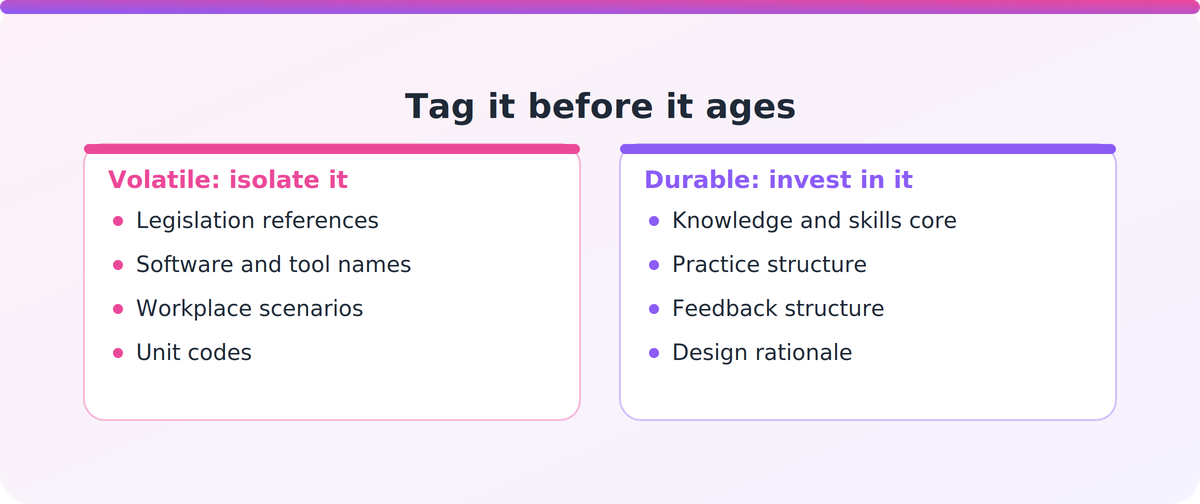
The most useful habit you can build this quarter is tagging. Every element of a learning resource is either volatile or durable. Most content debt comes from never deciding which.
The volatile layer
Legislation references, software screens and tool names, workplace scenarios, forms and codes, and anything that quotes a unit code. These should live where one person can change them in one place. If a Heavy Vehicle National Law reference is baked into a slide, a video voiceover and an assessment prompt, you've built three jobs where one would do.
The durable layer
The coherent body of knowledge and skills the qualification actually develops, plus the practice-and-feedback structure around it. DEWR's new templates let developers describe either job functions and tasks or knowledge and skills outcomes. Designing for the coherent whole, not unit-by-unit fragments, should reduce churn when packages are reshaped.
A sequence of explanation, rehearsal, feedback and reflection survives a change of tools. A module named after last year's unit code doesn't.
Design for the regulator's tests, not a one-off audit
ASQA has said it won't provide a training and assessment strategy template. Providers decide how to compile and present their strategies. That makes your design rationale the evidence: why this sequence, why this pacing, why this amount of training.
The AQF Volume of Learning requirements still apply, according to ASQA's 2025 Standards FAQs (v3.0). The old Amount of Training concept no longer features, but you still have to justify the amount you choose.
Two habits make that defensible:
- Write the rationale as you design. One short note per course or cluster: who the cohort is, what the learning environment looks like, and why the time allocated is enough for practice and feedback, not just content.
- Put independent review inside the cycle. ASQA's FAQs say validation outcomes must not be determined solely by someone who designed or delivered the training and assessment. If you're the designer, you can't be the only reviewer. Schedule it from the start, not when an audit looms.
Contextualisation matters here too. Secondary sources report that ASQA names purchased tools not contextualised to the cohort, environment or product as a known risk. Generic content, bought or generated, is exposed for the same reason.
A note on AI
Several consultancies report that ASQA's 2026 sector workshops will examine AI use against the 2025 Standards, and that AI cannot make assessment decisions. These are secondary sources, so check asqa.gov.au before you cite anything. The sensible reading holds either way: anything AI helps you produce still needs to be valid, contextualised, mapped, pitched to the cohort and able to generate sufficient evidence. Speed doesn't replace those tests.
Build for the people who will maintain it
You probably won't be the last person to touch your content. Jobs and Skills Australia's October 2024 VET workforce study found a workforce that is older and highly casualised, with almost half over 50. The VET Workforce Project reports that digital transformation is increasing the time and cost of maintaining vocational currency.
Practically, that means casual trainers with little paid time to patch resources. Materials that need heavy rework to stay usable will quietly drift out of date in the classroom, whatever the master copy says.
The same data shows First Nations people and people who speak a language other than English at home are under-represented, especially in Teach, Train and Assess roles. That's a prompt to ask who is shaping your scenarios and who is reviewing them. Cultural competency built into the durable layer, through case material and feedback structures, ages far better than a bolted-on module.
One caution before you rebuild everything. The TAE and FSK training packages are under temporary DEWR oversight, and the reference group is not seeking their redevelopment. If you work in those areas, expect relative stability, but confirm the current status before you plan.
Key takeaways
- Content goes stale from several directions at once: package reform, JSC updates, legislation and technology changes, and Standard 1.1 expectations.
- Tag every element as volatile (legislation, tools, scenarios, unit codes) or durable (the knowledge and skills core, plus practice and feedback structure), and keep volatile elements in one editable place.
- Design for the coherent qualification, not unit-by-unit fragments.
- Under the 2025 Standards, your design rationale is the evidence, so write it as you build.
- Validation can't rest solely with the designer or deliverer; schedule independent review into the cycle.
Our take
Most content debt isn't a speed problem. It's a structure problem. We keep trying to update faster when we should be building so that less needs updating.
The tempting response to reform and AI is to produce more, sooner. We'd argue the better bet is fewer, sturdier decisions: a stable learning core, clearly isolated volatile parts, and a written reason for each design choice. That's also what the 2025 Standards seem to be asking for.
Speed still matters, and tools that shorten production will help. But a fast build with no rationale and no independent review is just quicker debt.
FAQ
What does content debt mean for instructional design in RTOs?
It's the accumulated cost of learning resources that no longer match current units of competency, legislation, tools or scenarios. Debt builds fastest where content is tied to specific legislation and technology, and where one change must be repeated in many places.
Do the 2025 Standards for RTOs still require a set amount of training?
ASQA's FAQs (v3.0) say the AQF Volume of Learning requirements still apply. Amount of Training is no longer featured, but providers must show training is structured and paced with enough time for instruction, practice, feedback and assessment (Standard 1.1), and must justify the amount they choose.
Can I validate my own materials?
Not on your own. ASQA's FAQs say validation outcomes must not be determined solely by someone who designed or delivered the training and assessment. Build independent review points into your design cycle.
Can I use AI to build learning content?
Secondary sources report that ASQA's position is that AI cannot make assessment decisions, and that AI-generated tools must still be valid, contextualised, mapped and pitched to the cohort. Confirm the current position at asqa.gov.au before you rely on it.
Where should I start this quarter?
Pick one high-enrolment unit. List every legislation reference, tool name and scenario in its resources, then count the places each appears. That count shows your debt, and the places to fix first.