Simulated Work Environment for RTOs: The Fidelity Test
A simulated work environment can cut the capital cost of practical training for an RTO, but it doesn't cut the standard. Under Outcome Standard 1.8 of the Standards for RTOs 2025, the simulation must replicate contemporary industry equipment, resources and conditions. You need recorded industry engagement to prove it, and you must stay within the training package.
What does ASQA expect from a simulated workplace?
ASQA's practical training and assessment guidance is direct. When practical skills are taught in a simulated environment, the provider must give learners access to all the facilities, resources and equipment found in a contemporary workplace.
Notice what that sentence doesn't say. It doesn't say the simulation must be cheap, or expensive, or physical, or digital. The test is fidelity. Cost is your problem, not the regulator's.
The Standards for RTOs 2025 took effect on 1 July 2025. We found no recent ASQA or DEWR publication aimed specifically at simulation, so most of the current commentary comes from consultancies and vendors. Check any claim you read, including ours, against ASQA's guides and the assessment conditions on training.gov.au.
Where does Outcome Standard 1.8 bite?
Outcome Standard 1.8 requires equipment to be contemporary and relevant to current industry practice, including emerging technologies. ASQA's Facilities, Resources & Equipment Practice Guide says RTOs must be able to show how a simulated environment reflects current industry settings.
CAQA frames this as an audit-risk test rather than a description exercise. In practice, an auditor will want to see:
- What the training package requires. The assessment conditions for each unit of competency set the facilities and equipment you have to replicate.
- What industry actually uses today. A simulation modelled on kit that was standard five years ago is a weak position.
- How you know the two match. "We built it to look realistic" isn't evidence.
How do you make a simulation defensible?
Industry engagement is what turns a simulated environment from an assertion into a position you can defend. ASQA guidance says providers should engage with industry and keep records of that engagement.
Commentary on the 2025 Standards from Knowledge Foundry and VET Resources goes further. It says engagement should be genuine and ongoing, should inform training and assessment, and that training products need validating at least every five years. That is secondary commentary, so confirm the wording against ASQA's own materials.
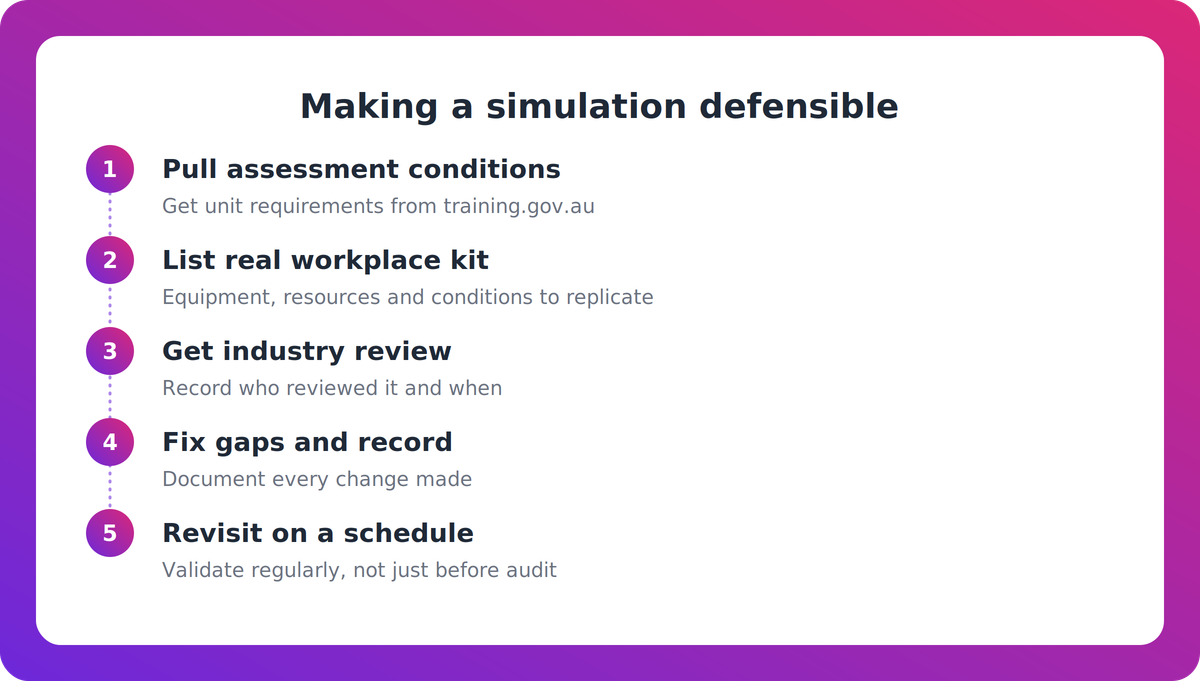
A workable sequence:
- Pull the assessment conditions for each unit from training.gov.au.
- List the equipment, resources and conditions a real workplace would have.
- Ask industry contacts to review your simulation against that list, and record who said what, and when.
- Fix the gaps they find, and record the fix.
- Revisit the whole thing on a schedule, not only before an audit.
The records matter as much as the simulation. Supahuman's own piece on industry consultation argues that auditors now look for current, context-specific evidence rather than policy documents. It's vendor commentary, but it matches the direction of ASQA's guidance.
Where can't simulation replace the real thing?
This is the limit on any "no capital spend" argument. On 23 March 2026, ASQA said it is seeking to better understand the quality of workplace assessment in high-risk industries: Individual Support, Carpentry and Early Childhood Education.
CAQA warns that assessing entirely through simulation where the training package mandates workplace assessment is a compliance gap. That isn't a grey area. If the package says workplace, a simulation can't stand in for it.
For accredited courses, ASQA's Users' Guide to the Standards for VET Accredited Courses (uploaded February 2026) allows simulation where workplace assessment isn't possible for safety reasons or because of access to equipment and resources. Even then, the simulated environment must include the relevant equipment and resources of the real working environment.
So the order of questions matters:
- Does the training package require workplace assessment? If yes, simulate only where it expressly allows.
- If simulation is permitted, can you replicate the real conditions?
- Can you prove it with industry records?
So where does the saving actually come from?
Not from lowering the bar. The saving comes from choosing where fidelity is cheap to achieve.
Physical, equipment-heavy skills are expensive to replicate, and software doesn't change that. But much of what employers want is behavioural: handling a distressed client, running a difficult conversation, escalating a concern, following a procedure under pressure. Those conditions are about people and judgement, so they can be recreated without a purpose-built facility.
One Supahuman guide says real-time video role-play is an accepted method for assessing remote cohorts. That's vendor commentary, and we couldn't verify it against a primary ASQA source, so confirm it for your units before you rely on it. The same commentary notes the 2025 Standards set no lower compliance bar for technology-based delivery, which is consistent with everything above.
The practical upshot: spend your capital where the training package demands real kit, and use simulation to widen practice time where it's permitted and credible. Don't use it to dodge a requirement.
What's still uncertain?
Two things. First, we found no ASQA or DEWR publication in the last 90 days that deals only with simulation, so you're reading across general guidance. Second, we couldn't verify claims about Jobs and Skills Council pilots or a $500,000-per-doctor placement cost against primary sources, so we've left them out.
If you're unsure whether a unit allows simulation, the answer is in its assessment conditions, not in a blog post.
Key takeaways
- The compliance test for a simulated work environment is fidelity, not cost. Simulation can lower delivery cost but not the standard of what's replicated.
- Outcome Standard 1.8 expects contemporary equipment and resources, and ASQA expects you to show how a simulation reflects current industry settings.
- Recorded, ongoing industry engagement is what makes a simulation defensible at audit.
- Simulation can't replace workplace assessment where the training package requires it. ASQA's March 2026 focus on Individual Support, Carpentry and Early Childhood Education shows where that risk sits.
- Always check the assessment conditions on training.gov.au and ASQA's practice guides before relying on any vendor or consultancy commentary.
Our take
The "simulation saves capital" pitch is true only for the skills where fidelity is cheap, and the sector oversells it. We think the smart move is to be strict about the line: real kit and real workplaces where the package demands them, and simulation for the behavioural practice that learners rarely get enough of. Providers who keep industry records as carefully as they build the scenarios will be the ones who can use simulation with confidence, rather than hoping an auditor doesn't ask.
FAQ
Can an RTO assess entirely in a simulated work environment?
Only where the training package assessment conditions allow it. CAQA warns that assessing entirely through simulation where the package mandates workplace assessment is a compliance gap. Check each unit of competency on training.gov.au first.
What does Outcome Standard 1.8 require of simulated environments?
Equipment must be contemporary and relevant to current industry practice, including emerging technologies. ASQA's Facilities, Resources & Equipment Practice Guide says RTOs must be able to show how a simulated environment reflects current industry settings.
What evidence shows a simulation meets industry standards?
Recorded industry engagement is central. ASQA guidance says providers should engage with industry and keep records. Commentary on the 2025 Standards says engagement should be genuine and ongoing, and that training products should be validated at least every five years.
Why is ASQA looking at workplace assessment in 2026?
On 23 March 2026, ASQA said it is seeking to better understand the quality of workplace assessment in high-risk industries: Individual Support, Carpentry and Early Childhood Education. RTOs in those areas should expect close attention to any reliance on simulation.
Does simulation lower the compliance bar for technology-based delivery?
No. Vendor commentary on the 2025 Standards makes the same point: they give clearer scope to justify simulated environments but set no lower bar. The fidelity requirement is unchanged.