Unit of Competency Coverage Mapping Audit: Find Gaps First
An evidence-mapping gap is rarely a documentation failure. It is a visibility failure. The mapping exists and someone signed it off, but nobody tested it until an auditor put the assessment tool next to the unit of competency. Under the Standards for RTOs 2025, the fix is an internal coverage test with named owners, run before anyone external looks.
Why this lands on your desk
You own audit-readiness. Yet mapping quality is usually tested only when an assessor, a validator or the regulator lays the tool beside the unit. By then you have already signed off.
The Standards for RTOs 2025 replaced the 2015 Standards for ASQA-regulated RTOs from 1 July 2025. You are the person translating that into current policies, training and assessment strategies (TAS) and evidence, and answering for whether it all still lines up.
Then there is the practical mess. When evidence sits across drives, inboxes and spreadsheets, it is hard to say who last checked a mapping, or against which version of the unit. That makes you the bottleneck for every document review. It also leaves you with no early warning.
What the 2025 Standards change about evidence
The 2025 Standards comprise Outcome Standards, Compliance Standards (including the Fit and Proper Person Requirements) and the Credential Policy. DEWR says compliance and administrative requirements were deliberately moved out of the Outcome Standards and into the Compliance Standards and Credential Policy.
The practical implication is that evidence should show outcomes are being achieved, not only that paperwork exists. A tidy mapping matrix proves you ticked boxes. It does not prove the assessment tool collects evidence of what the unit actually requires.
One housekeeping point: ASQA is the National VET Regulator, but Victoria's VRQA and Western Australia's Training Accreditation Council regulate RTOs in their own jurisdictions. Confirm which regulator applies to your registration before you interpret any of this.
What is actually being found, and what isn't
Sector commentary repeatedly names superficial mapping as a recurring audit finding. Nearly all of it comes from vendors and consultancies, not from ASQA. We could not find ASQA's own published mapping figures, so treat it as a commonly reported risk, not a verified statistic.
Be wary of the numbers in circulation, too. One vendor blog reports 89 performance reviews between July 2025 and January 2026 with a 62% compliance rate. It also cites ASQA as saying 76% of assessments reviewed were poor quality. Don't repeat those to your board without checking them against ASQA.
What ASQA's own research does say is useful. Some RTOs run high-volume, low-quality assessment models and issue qualifications through RPL without adequately verifying competency. ASQA's 2025-26 risk priorities (now archived) led with non-genuine providers and bad-faith operators. If you are a genuine RTO, you are still assessed in a climate where weak assessment evidence draws attention.
Training packages keep moving the target
A mapping that was sound last year can quietly drift. The updated Training Package Organising Framework took effect on 1 July 2025. Queensland's DTET expects reformed qualifications to be available for delivery from 2026.
JSC projects add more movement. One example is the update to the TLI Transport and Logistics Training Package for Heavy Vehicle National Law fatigue requirements, expected between February and June 2026. Check training.gov.au and your JSC for the packages you deliver.
The question for you is not "was this mapped correctly?" It is "was this mapped correctly against the version of the unit we are delivering today?" Without version traceability, you can't answer that.
Running a unit of competency coverage mapping audit yourself
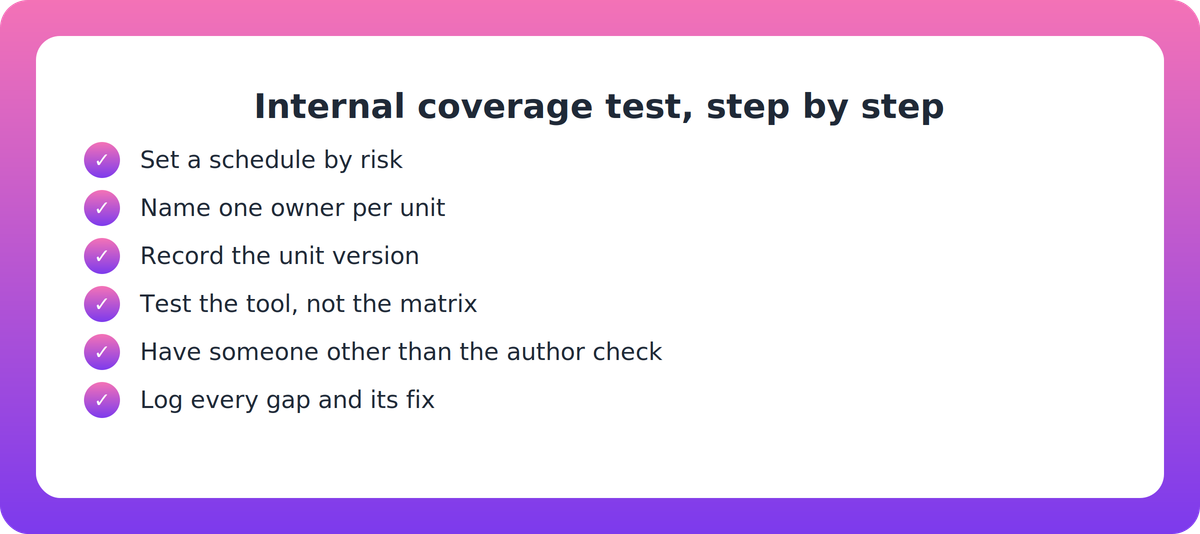
The goal is simple: the first reviewer to find a gap is you. A workable internal cycle looks like this.
- Set a schedule by risk. Test high-enrolment, high-risk and recently changed units more often than stable ones.
- Name an owner per unit. One person answers for the mapping, not a team or a shared folder.
- Record the unit version. Every mapping should state which release of the unit it was checked against, and when.
- Test the tool, not the matrix. Take each performance criterion, knowledge evidence and performance evidence requirement, and find the actual question or task that collects it.
- Have someone other than the author check it. A fresh pair of eyes finds the gaps the writer reads straight past.
- Log the gap and the fix. A dated record of finding and rectifying a gap is evidence of a working system.
Step 6 matters more than it looks. Consultancy sources report a 3–31 March 2026 Annual Declaration on Compliance window. One says the 2026 declaration allows RTOs to disclose non-compliance alongside rectification steps. Both are unconfirmed, so verify them on asqa.gov.au. If accurate, they reward exactly this habit of finding and documenting gaps internally first.
Key takeaways
- Mapping gaps are usually found late because mapping is only tested when an external reviewer arrives.
- The Standards for RTOs 2025 (from 1 July 2025) put outcomes at the centre, so evidence must show what learners can do, not just that documents exist.
- "Superficial mapping" as a common finding is a vendor claim. ASQA's own figures weren't found, so don't quote circulating statistics unchecked.
- Training package changes under the Training Package Organising Framework and JSC projects mean mappings expire. Record the unit version on every one.
- Test coverage on an internal schedule, with a named owner per unit and a logged fix for every gap.
Our take
Most compliance managers are asked to be the last line of defence. That is the wrong job description for mapping. You can't personally re-read every tool against every unit, and a sign-off at the end of development only tells you someone believed the mapping was right.
Our view is that coverage should be treated like any other control: tested on a schedule, owned by a named person, traceable to a version, and independent of whoever wrote it. That moves you from bottleneck to system owner. It also changes the audit conversation. "We found this ourselves in March and fixed it" is a far stronger position than "we'll look into that."
The honest caveat is that this takes time you may not have. Start small and risk-based rather than trying to re-test the whole portfolio at once.
FAQ
What is a unit of competency coverage mapping audit?
It is an internal check that every requirement in a unit of competency (performance criteria, knowledge evidence and performance evidence) is genuinely collected by a specific question or task in your assessment tool. It tests the tool itself, not only the mapping document.
Does ASQA publish how often mapping gaps are found?
We could not find ASQA-published figures on mapping gaps. Claims that superficial mapping is a recurring finding come from vendor and consultancy sources, so treat them as a reported risk and verify before citing.
How often should we re-test mapping?
On a schedule based on risk. Test high-volume units and any unit whose training package has been revised more often. Re-test whenever the unit version you deliver changes, and check training.gov.au and your JSC for updates.
Which regulator's expectations apply to us?
ASQA regulates RTOs under the National VET Regulator, and ASQA-regulated RTOs must meet the 2025 Standards. Victoria's VRQA and Western Australia's Training Accreditation Council regulate RTOs in their own jurisdictions, so confirm which applies to your registration.
Pick one unit this week and pull its mapping. Can you say who last checked it, and against which version of the unit? If you can't answer in a minute, you have found your first gap before anyone else did.