Role play training in New Zealand works best when learners can rehearse real conversations with a skilled partner. Outside Auckland, Wellington and Christchurch, flying in facilitators or actors rarely stacks up financially, so regional learners often get less practice. It's a delivery-cost problem, and providers now have new ways to solve it.
Why does role play training cost more outside the main centres?
Because the expensive parts of role play don't shrink with the cohort. A skilled facilitator, a trained actor or an experienced assessor costs roughly the same to engage whether they face 30 learners or six. Add the logistics of getting them there, and small regional groups carry the highest cost per learner.
The usual pressure points are structural:
- Travel and accommodation for people who live in the main centres.
- Small, scattered cohorts that make a dedicated session hard to justify.
- Scheduling around shift work, seasonal peaks and long drives for learners.
- A thin local pool of people who can run a credible simulation.
We haven't seen published New Zealand data that puts a dollar figure on this gap. That's part of the point. It sits in provider budgets and quiet trade-offs, not in any report, which is why it's easy to overlook.
Which learners and sectors feel it most?
The sectors with the sharpest skills shortages in 2025 are largely the ones where practice matters most: regional healthcare, hospitality, trades and service roles. These are jobs where you handle people, pressure and safety in real time.
Illustrative examples of what learners need to rehearse:
- Telling a worried family member something difficult.
- De-escalating an upset customer at the counter.
- Running a site safety conversation with a reluctant colleague.
- Giving a first-time team leader's feedback without damaging the relationship.
Reading about these doesn't build the skill. Doing them, with feedback, does. When a regional cohort gets a slide deck and a metro cohort gets a live simulation, that's a two-tier system, even if nobody designed it that way.
Why should TEC and Workforce Development Councils care?
Because equity of outcomes across regions is becoming a workforce policy question, not just a provider budget line. Workforce Development Councils are under pressure to show that training serves industries and learners everywhere, and TEC's workforce goals depend on regional capability actually growing.
If the most realistic form of practice is only affordable in the big three centres, regional completion may look fine on paper while real-world readiness lags. Qualifications on the NZQF can be identical on both sides of that line. The practice behind them may not be.
We'd be cautious about claiming how large the effect is. The direction is clear; the measurement isn't there yet.
What are the realistic options for providers?
Providers and corporate L&D teams have four main routes. None is perfect.
- Fly-in blocks. Concentrate role play into fewer, longer visits. It cuts travel, but it also cuts the repetition that makes skills stick.
- Develop local facilitators. Train experienced regional staff to run simulations. It builds community capability, but it takes time and depends on a few individuals.
- Peer role play. Cheap and flexible, though quality varies and learners often don't know what good looks like.
- AI-coached practice. Learners rehearse scenarios by voice, video or guided interaction, with feedback, at any hour and in any location. The quality depends entirely on how well the scenarios are designed.
The fourth option is the one that has changed most recently. It's the problem we built Nova for at Supahuman: custom role plays and coached practice generated in minutes rather than weeks, so a learner in Whanganui or Whakatāne practises the same scenario quality as one in Ponsonby.
What should good AI-coached practice look like?
AI doesn't earn a place just by being available. For a New Zealand PTE, polytechnic or wānanga, or a corporate L&D team, it should clear a short bar.
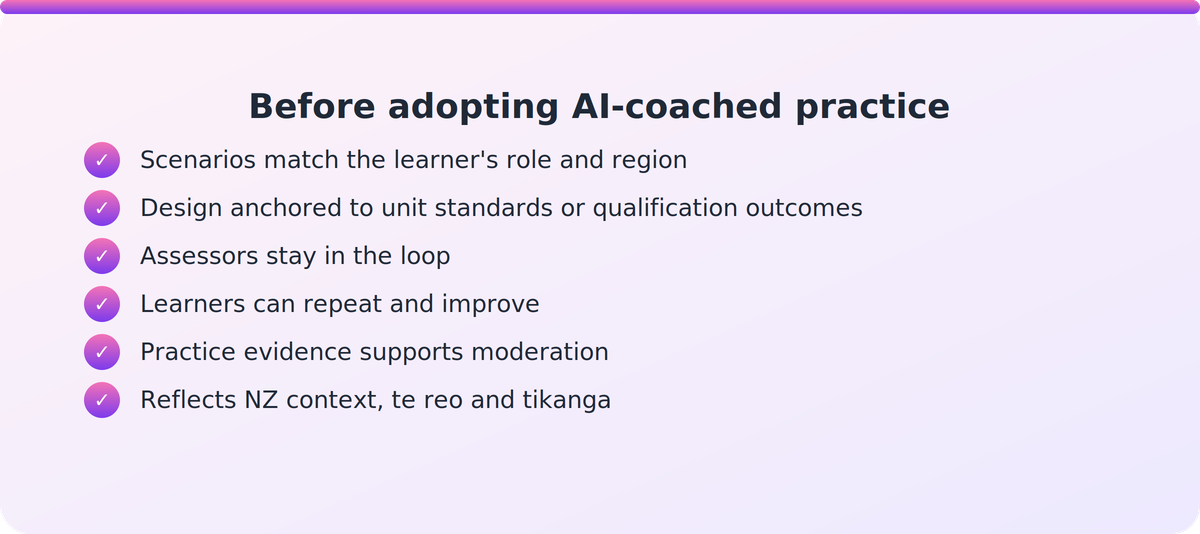
A checklist before you adopt it
- Scenarios reflect the learner's actual role, workplace and region, not generic examples.
- Design is anchored to the unit standards or qualification outcomes being assessed.
- Assessors and facilitators stay in the loop and decide what counts as competent.
- Learners can repeat a scenario and see feedback that changes their next attempt.
- Practice evidence is captured in a form that supports moderation and NZQA expectations.
- Content respects New Zealand context, including te reo Māori and tikanga where they apply.
The last point matters more than it looks. A simulation built around an overseas workplace teaches learners the wrong cues.
Can AI replace the facilitator?
No, and it shouldn't try. A good facilitator reads the room, notices what a learner avoids and adjusts. What AI can do is take over the repetitive rehearsal that currently never happens because nobody can afford it. That frees scarce human time for debriefs, judgement and assessment.
The sensible model is practice at volume by AI, with human expertise reserved for the moments that need it.
Key takeaways
- Role play costs don't scale down with cohort size, so regional learners carry the highest cost per head.
- The sectors most affected by 2025 skills shortages are the ones that depend most on practised interpersonal skills.
- Unequal access to realistic practice is turning into a regional equity issue that TEC and Workforce Development Councils will need to address.
- No published NZ data yet quantifies the gap, so providers should measure their own.
- AI-coached practice can close much of the access gap if it's contextual, tied to NZQF outcomes and overseen by human assessors.
Our take
The uncomfortable part is that nobody chose this. It emerged from budgets that made sense one cohort at a time. We think providers should start by costing it honestly: how many practice hours does a regional learner get compared with a metro one? Once that number is on the table, the case for rethinking delivery tends to make itself.
FAQ
What is role play training in a New Zealand vocational context?
It's structured practice where learners act out realistic workplace scenarios, such as a difficult customer, patient or team conversation, and receive feedback. In New Zealand it's used across PTEs, polytechnics, wānanga and workplace training to build skills that assessments on the NZQF rely on.
Why is role play harder to deliver in regional New Zealand?
Facilitators, actors and assessors are concentrated in the main centres, and getting them to smaller towns adds travel and accommodation costs. Smaller cohorts spread those costs over fewer learners, so each learner's share is higher.
Does uneven access to practice affect workforce goals?
Potentially, yes. TEC's workforce goals and the equity expectations on Workforce Development Councils both depend on training that works for every region. We haven't found published figures quantifying the gap, so the size of the effect is still uncertain.
Can AI-coached practice meet NZQA expectations?
It can support them when scenarios are designed around the relevant unit standards or qualification outcomes, and when qualified assessors still make the competency judgements. AI provides the practice and the evidence trail; people retain the decision.
Where should a provider start?
Start by measuring how many hours of realistic practice regional learners get compared with metro learners. Then pilot one high-stakes scenario, such as a patient conversation or a customer complaint, and compare confidence and assessment results.