Every learning design has a half-life, and in New Zealand vocational education the clock is running faster than most designers budgeted for. The bodies that own standards, programmes and delivery have all changed within about a year. Build a course as a fixed artefact and you are accruing design debt from the day it ships.
Why this lands on your desk
You are the person whose documents quietly go out of date. Standard-setting now sits with Industry Skills Boards (ISBs), which the TEC says were established formally from 1 January 2026. Any course document that names a Workforce Development Council, assumes an old sign-off path or cites an owner who no longer exists needs re-checking.
You also answer for grounding in regulation. NZQA's 2026 rules, effective 19 January 2026, keep the requirement under Programme Approval Criterion 7 for adequate and effective processes for ongoing review of a programme and updating it accordingly. "We'll review it later" is not a process.
Then there is money. The TEC's 2026 funding-rate document shows a 2% VET increase for targeted areas and a 10% decrease for all work-based delivery, with a worked-example net decrease of 7%. Rates are to be finalised after consultation, so check final figures before you quote them. The direction is still clear: rebuild-from-scratch cycles are harder to justify.
The structures around your design are moving
Te Pūkenga is being wound up. The Ministry of Education describes Te Pūkenga, renamed NZIST, as a transitional entity supporting programme handover and continuity until it is disestablished on or before 31 March 2027. The Government's October 2025 release says the amendment bill enables re-establishing, initially, ten regionally governed polytechnics.
Work-based learning is mid-move as well. The TEC says the transition runs across 2026 and 2027. Work-based learning divisions moved from NZIST to an ISB in January 2026, and then move on to polytechnics, wānanga or PTEs. A course you design today may change hands before its first full review cycle.
The final ISB count was not confirmed in the sources I used, so check the TEC site before you name boards in a design document.
Separate what changes from what endures
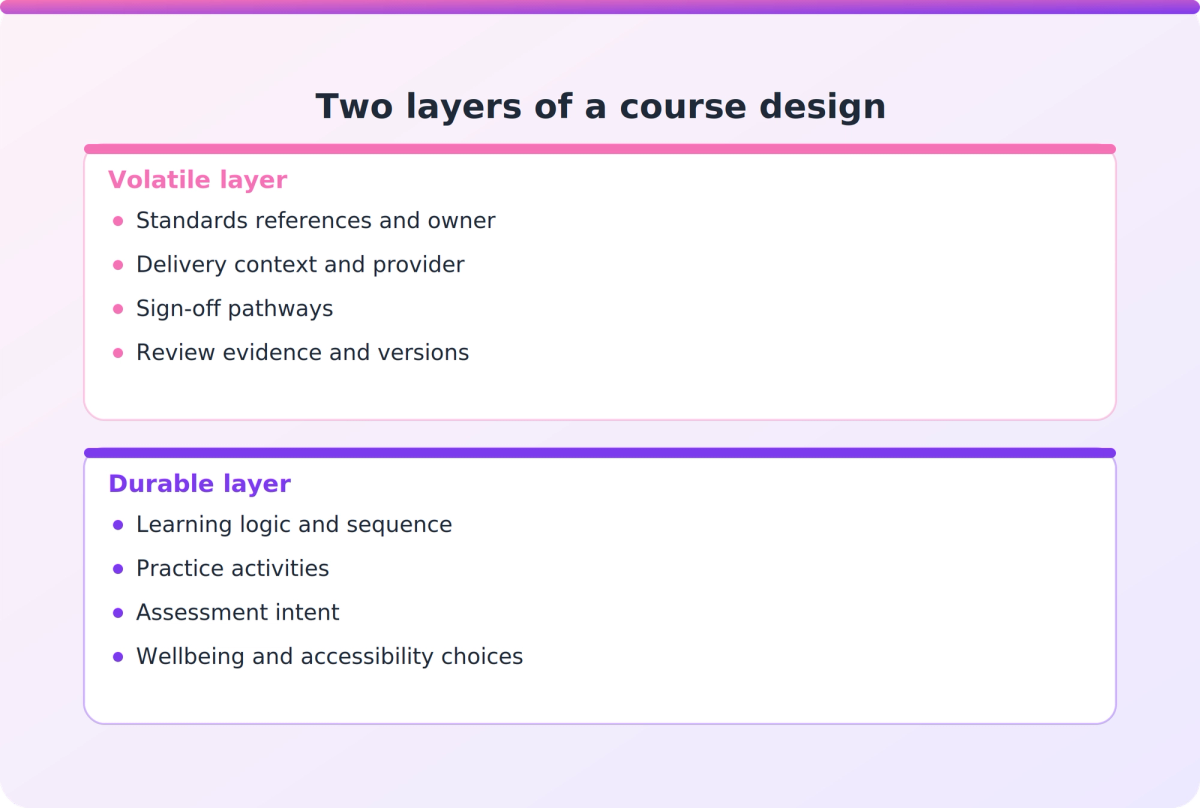
The most useful design habit this year is a clean split between volatile and stable material. Most courses blend the two, which is why a single rule change can force a rewrite.
What belongs in the volatile layer
- Standards references and the body that owns them
- Delivery context: which provider, which mode, which workplace
- Sign-off and endorsement pathways
- Review evidence and version records
What belongs in the durable layer
- The learning logic: what the learner must be able to do, and why the sequence works
- The practice activities that build that capability
- The assessment intent: what a competent performance looks like
If your standards references are scattered through slide footers, facilitator notes and LMS descriptions, you have no volatile layer. You have a find-and-replace problem waiting for a deadline.
Keep a traceable line back to the current rules
A simple traceability table does most of the work. Each learning outcome maps to a standard or qualification reference, the assessment task that evidences it, and the date and basis on which you last checked it.
This matters more now. NZQA's 2026 rules remove references to external evaluation and review, following its replacement with self-review and monitoring. That puts more weight on a provider's own evidence of review. Version histories, design rationales and traceability are material you can produce as a normal by-product of designing, rather than assembling it before an audit.
Two more rule changes are worth reading against your own programmes:
- Lighter updates. NZQA's Programme Approval rules reduce requirements where a qualification is made up entirely of skill standards. The Manufacturing and Engineering ISB confirms that Type 2 programme changes now go directly to NZQA, while ISBs continue to endorse new programmes. Routine updates may be lighter to process. Confirm how that applies to yours.
- Currency is explicit. The Qualification and Micro-credential Listing rules remove maximum review periods. They add a process for assigning "expiring" status to qualifications and micro-credentials that go unawarded or unreviewed for a specified period. The ongoing-review requirement stays. My reading is that review discipline now matters more than review deadlines. That is an interpretation of the NZQA text, not an NZQA statement.
Design wellbeing in, not on
The Education (Pastoral Care of Tertiary and International Learners) Code of Practice 2021 applies to tertiary providers and covers all tertiary learners, including offshore and work-based learners. NZQA guidance lists Outcome 3 as safe, inclusive, supportive and accessible physical and digital learning environments.
That lands on LMS and online course design. Accessible formats, clear pathways to support, and culturally aware examples are design decisions, not a compliance appendix. If they are built into the durable layer, they survive every handover.
Our take
The sector is treating 2026 as a disruption to ride out. We think it is a design brief. The rules have shifted weight from external review towards a provider's own evidence, and funding pressure means fewer chances to start again. Courses that can absorb change will outlast courses that were merely well made.
That means fewer polished artefacts and more maintainable systems. It also means being honest with stakeholders: a design is never finished, only current as of a date you can prove. We would rather see a modest course with a clean revision trail than a beautiful one nobody dares touch.
A first step for this week: pick one live course and highlight every reference to a standard, owner or delivery body. Count them, then ask whether you could update all of them in an afternoon. If not, that is your design debt, and you can start paying it down now.
Key takeaways
- Design for revision from day one. Standards, owners and delivery contexts are all changing across 2026 and 2027.
- Keep standards references, delivery context and review evidence in a separate layer from the learning logic, practice and assessment intent.
- NZQA's 2026 rules keep ongoing programme review (Criterion 7), remove maximum review periods and add "expiring" status for unreviewed or unawarded qualifications and micro-credentials.
- With external evaluation and review references removed, your own version histories and traceability carry more weight.
- Treat Outcome 3 of the Pastoral Care Code as a design input for every online and work-based course.
FAQ
Who sets standards for NZ vocational education now?
The TEC says Industry Skills Boards, established formally from 1 January 2026, have a core role of standard setting for vocational education across their sectors. NZQA's ISB rules require arrangements for developing, setting and maintaining skills standards and capstone assessments, and for maintaining unit standards. Check the TEC site for the confirmed list of boards.
Do NZQA's 2026 rules still require programme review?
Yes. The ongoing-review requirement remains under Programme Approval Criterion 7, which expects adequate and effective processes for reviewing and updating a programme. The Qualification and Micro-credential Listing rules remove maximum review periods but add an "expiring" status for items not awarded or reviewed for a specified period.
How do I make a course easier to update?
Separate volatile content (standards references, owning body, delivery context, review records) from durable content (learning logic, practice, assessment intent). Add a traceability table linking outcomes to standards and assessments, with a last-checked date. Updates then touch one layer instead of the whole course.
Does the pastoral care code affect online course design?
Yes. The Code applies to all tertiary learners, including offshore and work-based learners. NZQA guidance lists Outcome 3 as safe, inclusive, supportive and accessible physical and digital learning environments, which applies directly to how LMS-based courses are structured and presented.