Your RTO almost certainly knows what each enrolment earns. It probably doesn't know what each unit of competency costs to build, deliver, validate and keep audit-ready. No national benchmark exists for that figure, so the only version that counts is the one you construct from your own data.
Why this lands on your desk
You own the P&L. You also can't look up how your RTO cost per student compares with the sector's. In the material we reviewed, neither NCVER nor ASQA appears to publish a benchmark for cost per unit, cost per student or margin. That's a gap, and we're not going to paper over it with an invented figure.
That makes this an internal number that only you can demand. Your compliance manager sees audit risk. Your head of training sees delivery load. Your finance lead sees salaries and platform fees. Nobody sees the cost of a single unit end to end unless you ask for it.
The mix of your business is also moving. NCVER reports more than 5.1 million students in nationally recognised VET in 2025, with qualification enrolments down more than 5% across all jurisdictions and provider types. Short courses and stand-alone subjects increased. More of your revenue is being earned at unit level, so unit-level economics decide more of your margin.
Why cost per student hides the leak
Cost per student is a fine headline metric. It's also an average, and averages hide the units that quietly lose money.
Two units in the same qualification can have very different cost profiles. One might be a stable unit with a validated tool that hasn't needed touching in two years. The other might be rebuilt every time the training package changes, re-validated after a finding, and supported by an assessor who rewrites half the tool on the fly. Both show up as one line in the per-student figure.
When funded volumes soften, this matters more. One commentator's analysis of NCVER data reports a 6.6% fall in government-funded students for January to September 2025. That's a secondary source, but the direction is the point. Fewer funded students means each unit in your portfolio has to carry its own weight.
Where unit-level cost and audit risk collide
The Standards for RTOs 2025 replaced the 2015 Standards from 1 July 2025. ASQA-regulated RTOs are now assessed against the Outcome Standards Instrument 2025 and the Compliance Standards (including Fit and Proper Person Requirements) Instrument 2025. The Credential Policy sets the credentials needed to deliver, assess and validate.
Notes from ASQA's March 2026 Brisbane workshop, a secondary source, record 89 performance reviews from July 2025 to 30 January 2026 with a 62% compliance rate. Two common findings stand out for a CEO:
- Assessment tools that did not match the required knowledge and skills.
- A lack of evidence of active continuous improvement.
Both are unit-level problems. Each one costs money whichever way it lands: rework on the tool, re-validation, assessor time spent patching gaps, or remediation after a poor audit outcome. If you don't track those costs by unit, they get absorbed into overhead and you never see the pattern.
The downside isn't only rework. A CAQA summary of ASQA's 2025–26 Annual Report (worth checking against the report itself) cites 110 decisions to cancel registration or reject renewal, involving 60 providers. Getting units wrong is a regulatory risk that sits on your board's desk.
Building your own cost-per-unit view
You don't need a perfect model. You need a consistent one you can compare year on year and unit to unit. Start with your five or ten highest-revenue units and cost them across the whole life of the unit, not just delivery.
A first-pass method
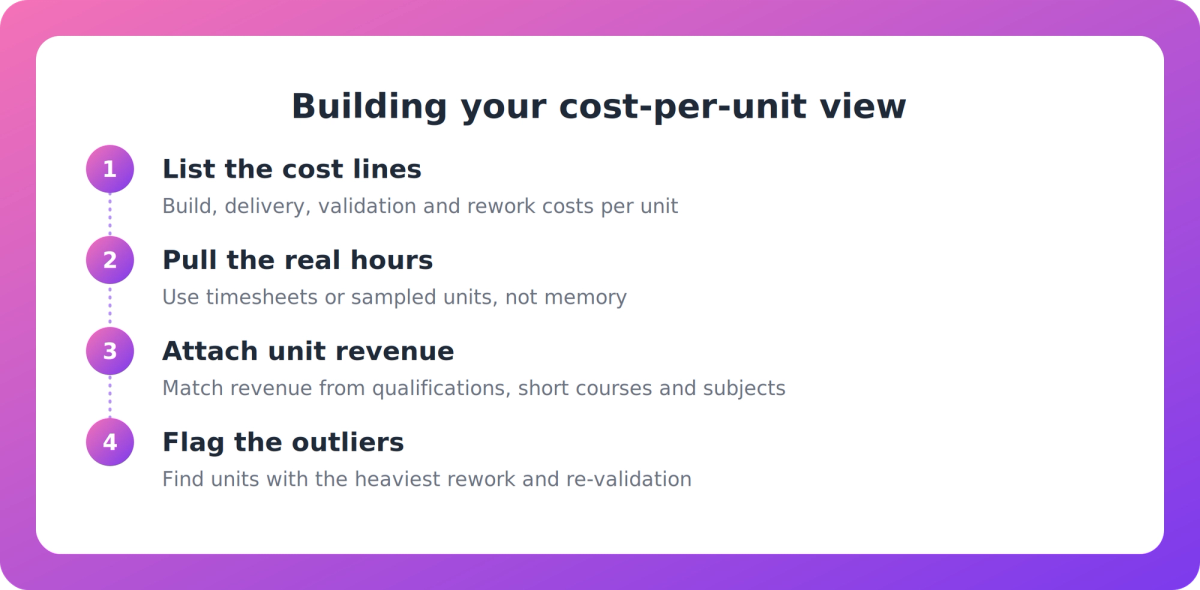
- List the cost lines. Tool development and mapping, learning material production, delivery and assessing, validation, and rework after findings or feedback.
- Pull the hours. Ask your team for real time, not estimates from memory. Where there are no timesheets, sample a few units and extrapolate.
- Attach revenue. Match the revenue each unit earns, whether through a full qualification, a short course or a stand-alone enrolment.
- Flag the outliers. The units with the highest rework or re-validation hours are where margin leaks. They're also where audit risk concentrates.
Expect the first version to be rough. That's fine. A rough number you own beats a polished one you can't get.
Where AI fits, and where it doesn't
It's tempting to treat AI as the lever on unit cost. Be careful with that story. We found no authoritative data on AI savings in RTO back offices, so any figure you hear is a vendor claim until you've tested it in your own operation.
ASQA's Assessment Practice Guide says RTOs should confirm that AI used in assessments matches workplace expectations and doesn't compromise skill demonstration. Commentary on ASQA's position says AI cannot make assessment decisions or complete validation where qualified people are required, and that ASQA's AI principles introduce no new regulatory requirements. Treat that as a secondary reading and check ASQA's own material.
The practical rule is that any efficiency case must keep qualified human judgement in the loop. If a proposed saving depends on removing that, it isn't a saving. It's a finding waiting to happen.
Key takeaways
- No national benchmark exists for RTO cost per unit of competency or cost per student, so you have to build your own baseline.
- With qualification enrolments down more than 5% and short courses and stand-alone subjects growing (NCVER, 2025), more of your margin is decided at unit level.
- ASQA's commonly cited weaknesses, tools that don't match required knowledge and skills and thin continuous improvement evidence, are unit-level costs.
- Start with your top five to ten units and cost them across build, delivery, validation and rework.
- Test any AI efficiency claim against your own data, and keep qualified human assessment decisions intact.
Our take
Most CEOs we'd expect to read this already track compliance spend as a line item. That's the wrong unit of analysis. Compliance isn't a separate cost sitting beside delivery. It's embedded in every unit, and it's cheapest when the unit is right the first time.
We think the CEOs who'll hold margin through this period are the ones who stop asking "what does compliance cost us?" and start asking "which units cost us the most to keep right, and why?" That question has an answer in your own data. It also shapes pricing, scope and portfolio decisions in a way a sector benchmark never could, even if one existed.
ASQA says it monitors financial viability in some cases, such as an RTO cutting its scope by 95% (secondary source; we didn't retrieve ASQA's formal viability requirements). Whatever the formal test, being able to explain your unit-level economics is a stronger position than being unable to.
FAQ
Is there a published benchmark for RTO cost per student or cost per unit?
Not that we found. NCVER and ASQA do not appear to publish a national benchmark for cost per unit of competency, cost per student or margin. You need to build the figure from your own financial and time data.
Why measure cost per unit of competency rather than cost per student?
Cost per student averages out differences between units. A unit that needs frequent rebuilds or re-validation can lose margin while the per-student figure looks healthy. With short courses and stand-alone subjects growing, unit-level revenue and cost are increasingly what you earn and spend.
How do ASQA's audit findings connect to unit economics?
Commonly reported findings include assessment tools that don't match the required knowledge and skills, and a lack of evidence of continuous improvement. Fixing them means rework, re-validation or remediation, all of which are costs you can attribute to specific units.
Can AI reduce the cost of producing and validating units?
Possibly, but we found no authoritative data on savings in RTO back offices. ASQA's guidance keeps qualified human judgement central to assessment decisions and validation. Test any claim against your own baseline and keep human accountability in place.
Here's a first step for this week. Ask your team for the real hours behind one high-revenue unit, from build through to the last time it was reworked. If nobody can answer, you've learned something already.