NZQA no longer sends an external reviewer to test whether your quality system works. Under the PTE Rules 2026, your own self-review and your own records carry that load. If they live in your quality lead's head, a resignation is a continuity risk for your NZQA standing, even though no NZQA statement says what happens next.
Why this lands on your desk
You own regulatory standing, and the way it gets tested has moved inside your building. NZQA's PTE Rules 2026, re-issued on 19 January 2026, reflect the removal of External Evaluation and Review (EER) and its replacement with self-review and monitoring. Nobody external now judges whether you are audit-ready. You do, using what your people can produce.
That makes this a board question as much as a compliance one. A quality management system, an annual self-review, reporting on it to NZQA and discussing the improvement plan are ongoing obligations, according to a consultancy summary of the rules. Ongoing obligations depend on named people and retrievable records. Check the exact wording against the rules text before you quote it to your board.
There is a growth angle too. TEC's 2026 Plan Guidance says appetite for risk is lower and that providers with strong delivery records are best placed. Work-based learning moving to providers during 2026 and 2027 is an opening. A compliance wobble is a poor time to find out your system is one person deep.
What we know, and what nobody has said
Here is the honest limit. The research behind this piece found no NZQA statement on what happens to a PTE's standing when its quality lead leaves. There is no rule and no stated penalty. Don't let anyone, including us, tell you otherwise.
The risk is practical. The quality management system and the self-review rest on your own people and your own records. If the person who knows where the evidence is, why decisions were made and what the improvement plan really says walks out, you are left to reconstruct it under pressure.
Some details are reported only by secondary sources and should be verified with NZQA:
- iQAF went live in January 2026, and NZQA stopped starting new EER processes from 1 January 2026.
- Providers without a compliant quality management system reportedly have until 1 January 2027 to build one.
- One source gives July 2026 as the start of the annual self-review for non-university providers. The research flagged that exact date as unconfirmed, so treat it as a question for NZQA, not a fact.
- NZQA is reported to have consulted on overall quality descriptors (Highly effective, Effective, Not effective), which it expects to use from July 2027.
It seems likely the self-review evidence you build now will feed those later judgements. That is our inference, not a sourced claim.
The Friday test: what you should be able to produce
Picture your quality lead resigning on Friday. On Monday, could you show NZQA, TEC and your partners that the system runs without them? Work through these with whoever runs your quality function, and watch for answers that begin with a person's name instead of a document or a role.
- Where is the current quality management system, and who besides your quality lead can open and explain it?
- Where is the latest annual self-review, and what did you say you would improve?
- Can a second person locate the evidence behind any single claim in it without asking the author?
- Who holds delegated authority for quality assurance approvals, and is that written down?
- Which tasks happen only because one person remembers to do them?
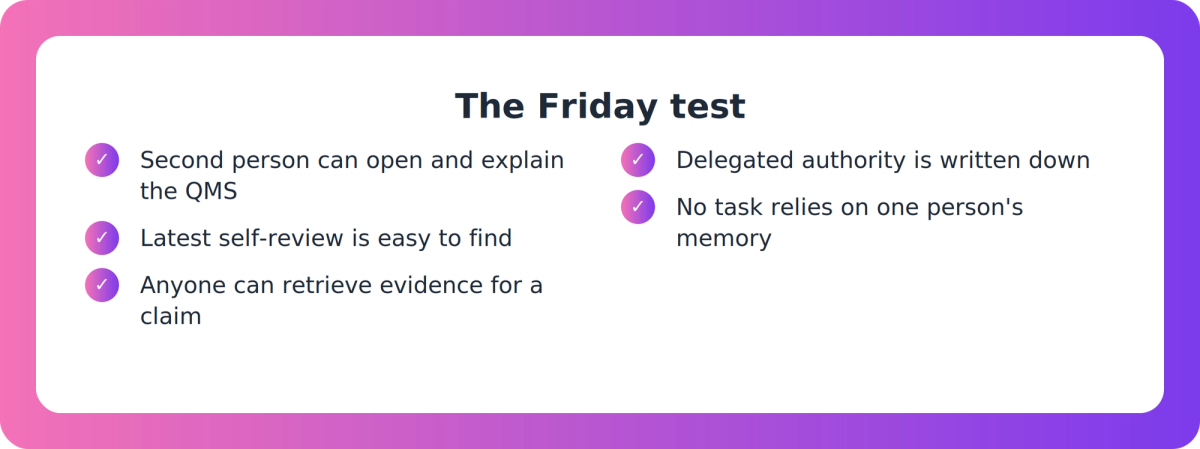
If three or more answers are "only them", you have found the exposure before anyone else did.
Where the exposure shows up
Delegated authority is partly yours
A secondary source says sub-contracting arrangements need evidence of internal quality assurance approval by the Chief Executive or a senior manager with delegated authority. If your quality lead has been signing off in practice while the paperwork says otherwise, the gap is yours personally. Fix the delegation record before you need it.
Partners and legacy ratings
Partners will ask how you assure quality, and "ask Sam" is a poor answer. One secondary source also reports that Immigration NZ will keep using existing EER ratings for 12 months from early 2026, with no successor arrangement found. The primary notice (11 December 2025) wasn't retrieved, so confirm it directly. If true, your old rating is a depreciating asset, and your self-review evidence is what replaces it.
Funding and viability
TEC's 2026 Plan Guidance expects funding demand to exceed what is available. The 2026 Funding Conditions Catalogue requires PTEs to take part in a financial viability assessment when asked. A provider that can show a documented, shared quality system tells a steadier story than one that depends on a single expert.
What to do this quarter
You don't need a restructure. You need three moves.
- Run the Friday test with your quality lead's help, and frame it as protecting them from being the single point of failure, not as a performance review.
- Name a deputy for each core quality task: self-review, moderation oversight, evidence retrieval and partner assurance. Record the delegation in writing.
- Rehearse the handover. Have the deputy produce the self-review evidence for one claim, unaided, while the lead watches. Fix whatever breaks.
Then ask NZQA directly the questions this research couldn't answer, including the self-review timing and how it will treat a change of key personnel. Write down the reply.
Key takeaways
- With EER replaced by self-review and monitoring under the PTE Rules 2026, your own records and people carry the proof of quality.
- No NZQA statement was found on what happens to your standing if your quality lead leaves. The exposure is practical, not a codified penalty.
- The Friday test shows quickly whether your quality system is shared or personal.
- Delegated authority for quality assurance approvals, especially for sub-contracting, is partly your own accountability.
- Verify the secondary-source details (iQAF dates, the 1 January 2027 deadline, self-review timing, Immigration NZ's treatment of EER ratings) with NZQA before relying on them.
Our take
Most PTEs treat the quality lead as an asset. Under self-review, that is also a concentration risk. The better your quality person, the more likely your system has quietly become them.
The fix isn't distrust. It is making the system boring: documented, delegated and rehearsed. Owners and CEOs who do that early get two benefits. They survive a resignation, and they walk into any conversation with NZQA, TEC or a partner holding evidence instead of reassurance.
FAQ
Does NZQA say what happens if our quality lead leaves?
The research found no NZQA statement on this. No rule or penalty was identified. The exposure is practical: your quality management system, annual self-review and records depend on people, so losing the one who holds them makes it harder to demonstrate your system works.
What replaced EER for NZ PTEs?
The PTE Rules 2026, re-issued 19 January 2026, reflect the removal of EER as a quality assurance mechanism and its replacement with self-review and monitoring. A consultancy summary adds obligations for a current quality management system, an annual self-review, reporting to NZQA and discussing the improvement plan. Verify against the rules text.
Who can approve quality assurance for sub-contracting?
A secondary source says sub-contracting arrangements need evidence of internal quality assurance approval by the Chief Executive or a senior manager with delegated authority. Confirm the current requirement with NZQA, and make sure any delegation is recorded in writing.
Do old EER ratings still count?
For now, in some settings. A secondary source reports Immigration NZ will keep using existing EER ratings for 12 months from early 2026, with no successor arrangement found. The primary notice wasn't retrieved, so check it directly before relying on it.
So the question to sit with is simple. If your quality lead resigned on Friday, whose name would you give NZQA on Monday?