Audit readiness is no longer something you build in the weeks before an NZQA visit. With External Evaluation and Review (EER) removed and self-review and monitoring in its place, the real risk isn't a missing policy. It's evidence nobody can locate, attribute or date. If it sits across drives and inboxes, your early-warning system is whoever remembers where it went.
Key takeaways
- The test is simple: on any given day, can you show where each piece of evidence lives, who owns it and which version of the rules it answers to?
- Unowned evidence is a bigger risk than missing evidence, because it goes stale without anyone noticing.
- The Private Training Establishment Rules 2026 replace two older instruments, so every document citing the old ones needs checking.
- Several dates in circulation (iQAF go-live, QMS deadline, annual declaration timing) are unverified. Confirm them on NZQA's own pages before you build a process around them.
Why this lands on your desk
You own registration maintenance. Once registered, a PTE must comply with the rules made under section 452 of the Education and Training Act 2020, as NZQA's registration maintenance page sets out. The Private Training Establishment Rules 2026 replace the PTE Registration Rules 2025 and the PTE Enrolment and Academic Records Rules 2022.
NZQA says the rules were re-issued to adjust terminology for the removal of EER and its replacement with self-review and monitoring. That puts you in charge of a current quality management system and an evidence-based self-review. A self-review is only as reliable as your last manual search.
Then there's the single-reviewer problem. The annual declaration, the Pastoral Care Code and any student fee protection audit each carry their own evidence trail and clock. Often you're the one person standing between your team and a gap.
What the 2026 rules settled, and what they didn't
Some things are clear. The 2026 rules remove the annual fee, and non-funded PTEs now provide annual financial returns biennially unless NZQA notifies otherwise (NZQA, PTE Rules 2026). Any internal document that still uses EER language, or assumes the old financial return pattern, needs updating.
Other things are not. Secondary commentary from Technical Institute describes the new expectations as a current QMS, an annual evidence-based self-review with a short summary on an NZQA template, and an annual conversation with NZQA. Useful, but secondary. Read the rules text before you build on it.
Dates are murkier still. Secondary sources give three different iQAF go-live dates (1, 15 or 19 January 2026). NZQA's ISB rules PDF shows 19 January 2026 for the ISB rules specifically. One vendor blog cites a QMS deadline and a July 2026 self-review start. We couldn't verify either, so treat them as questions for NZQA, not facts for your board paper.
Unowned evidence is the real risk
Standard-setting is moving too. TEC says Industry Skills Boards (ISBs) were formally established from 1 January 2026, with a core role of setting vocational education standards. NZQA says ISBs, NZQA and the Ministry of Education set criteria for consent to assess, and ISBs handle national external moderation of industry standards.
So a document can be perfectly filed and still wrong. A programme file that cites Workforce Development Councils or EER categories may sit in the right folder with the right name. Nobody has asked whether it still matches the rules.
That's the gap scattered drives hide. The evidence exists, but nothing tells you it has aged.
Build an evidence register before you build anything else
You don't need a new system to start. You need one page that answers five questions for each evidence item. The example below is illustrative, not a prescribed NZQA format.
- What is it? A named item, such as the current self-review summary or the Pastoral Care Code signatory record.
- Where does the master copy live? One location. Everything else is a link, not a copy.
- Who owns it? A named person who updates it, not the reviewer who checks it.
- Which rule does it answer to? The specific instrument and version, for example the PTE Rules 2026, not "NZQA requirements".
- When was it last checked against that rule? Plus a date for the next check.
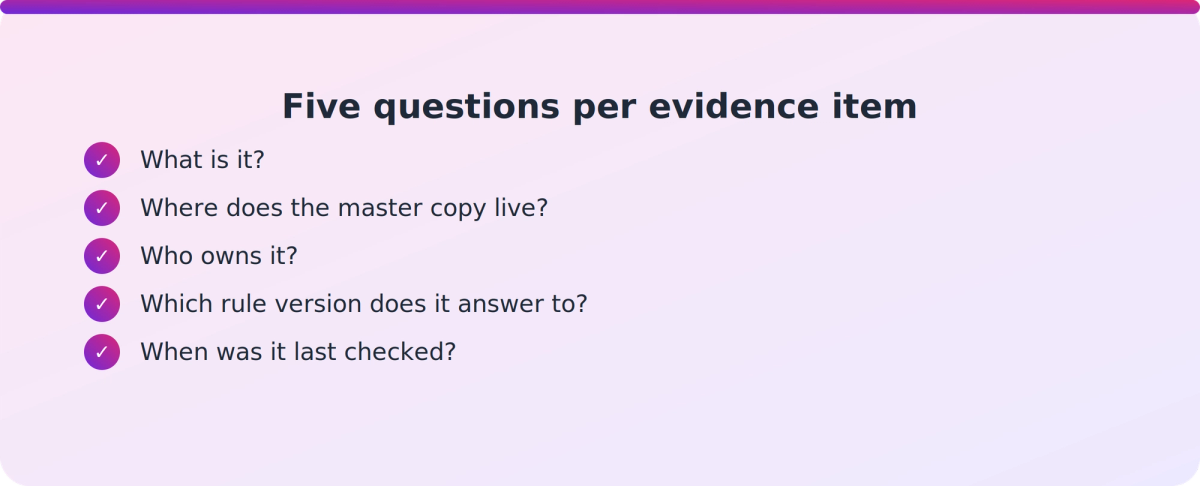
The fifth column is the early-warning signal. When an ISB, NZQA or TEC publishes a change, you filter by the rule it touches and see what's affected in minutes, not days. It also moves you out of the bottleneck seat. Owners keep their evidence current, and you review exceptions instead of everything.
Four evidence streams, four different clocks
Treat these separately in your register. Each has its own owner and calendar.
- Self-review and QMS. Confirm the current requirements and any template on NZQA's pages before you fix your cycle.
- Annual declaration. NZQA's annual declarations page describes attesting compliance with the Act and NZQA rules within five months of financial year-end. We couldn't confirm whether the 2026 rules changed this, so check the page for currency.
- Student fee protection audit. NZQA's audit requirements page also cites five months from year-end. That page is old, so verify it against current rules.
- Pastoral Care Code. In force since 1 January 2022, administered and monitored by NZQA, with approved signatory status required before enrolling international students (NZQA, the Code). It needs its own traceable ownership, separate from your self-review evidence.
Our take
Most PTEs treat audit readiness as a storage problem and respond with a tidier folder structure. That fixes findability and nothing else. The harder problem is currency: knowing that a document, and the rule it cites, still match.
With EER gone, no external visit will point out that a procedure cites a superseded instrument. You'll find it yourself, or a learner complaint, a declaration or a monitoring conversation will. We think the Compliance Manager's job is shifting from collecting evidence to certifying that it's current, and that only works if ownership is spread across the people who actually produce the evidence.
FAQ
What does NZQA audit evidence management mean for a PTE now that EER has gone?
It means keeping evidence continuously, not assembling it for a visit. NZQA says EER has been replaced by self-review and monitoring, so you need to show where evidence is, who owns it and which rules it answers to year-round.
Which rules should our policies cite?
The Private Training Establishment Rules 2026, which replace the PTE Registration Rules 2025 and the PTE Enrolment and Academic Records Rules 2022. Check any document citing the older instruments or using EER terminology.
Can I rely on published dates for iQAF and QMS deadlines?
Not without checking. Secondary sources disagree on the iQAF go-live date, and one QMS deadline claim is unverified. Confirm every date against NZQA's rules text and pages.
Do the annual declaration and fee protection audit timings still apply?
NZQA pages describe both as due within five months of financial year-end, but those pages may reflect older rules. We couldn't confirm whether the 2026 rules changed the timing, so verify with NZQA before you set your calendar.
Your next step
Pick one evidence stream this week, such as your Pastoral Care Code records, and answer the five register questions for each item. Note every row where you can't name the owner or the rule version. Those gaps are where your next audit scramble would start.