The idea of preparing "between EERs" has expired. NZQA stopped beginning new External Evaluation and Review processes on 1 January 2026, so there is no review date left to peak for. Under the integrated Quality Assurance Framework (iQAF), your evidence is tested continuously: annual self-review, risk-informed quality assurance, and a yearly conversation about your improvement plan.
Why this lands on your desk
You own the annual self-review summary and the follow-up discussion with NZQA about the improvement plan. That is a standing yearly deliverable. Evidence scattered across drives, inboxes and spreadsheets used to cost you one bad month before a review. Now it costs you every year.
NZQA's design paper says quality assurance activities will be informed by risk assessments. So NZQA may form a view about your organisation before you have. You are the person who needs early warning, ideally before anyone outside the building does.
And the ground keeps moving. The Private Training Establishment Rules 2026 were re-issued on 19 January 2026. Eight Industry Skills Boards became operational on 1 January 2026, and about 1,200 skill standards have been developed that will increasingly replace many unit standards. The compliance picture changes during the year, not just at review time.
What actually changed
NZQA announced that iQAF went live in January 2026. Providers already in an EER or consistency review will see it completed, but nothing new starts. In its place:
- An annual self-review summary report to NZQA.
- A meeting with NZQA to discuss the improvement plan.
- Quality assurance activity informed by risk assessments, with safety and wellbeing monitoring integrated into it.
The PTE Rules 2026 reflect this. The annual financial return becomes biennial unless NZQA notifies a PTE otherwise. The enrolment and academic records rules were folded in, and the Annual Fee Rules 2022 are revoked.
Some operational detail comes from secondary sources. Technical Institute reports that the summary is completed online in MyNZQA and that the July 2026 to July 2027 thematic question is generative AI in delivery and assessment. Verify both on NZQA's site before you build a plan around them.
Why a pre-review sprint no longer works
A sprint assumes a known deadline and a known audience. Neither exists any more. The deadline is annual, and the audience includes a risk process you don't control.
NZQA's proposed quality descriptors point the same way. They have four weighted criteria: programme and micro-credential design, delivery, assessment practice, and quality management system implementation. Scores would draw on evidence NZQA already holds and the provider knows about. Providers would be described as Highly effective, Effective or Not effective.
This is a proposal only. Consultation opened on 10 August 2026 and, per NZQA's consultations page, closed on 7 September 2026. One secondary source says use from July 2027, which is unconfirmed. But the direction is clear. If it lands, your standing evidence will matter more than how any single review week went.
Build ownership and traceability into ordinary work
The fix is not a better binder. It is making evidence a by-product of operations rather than a project.
Give every piece of evidence an owner and a date
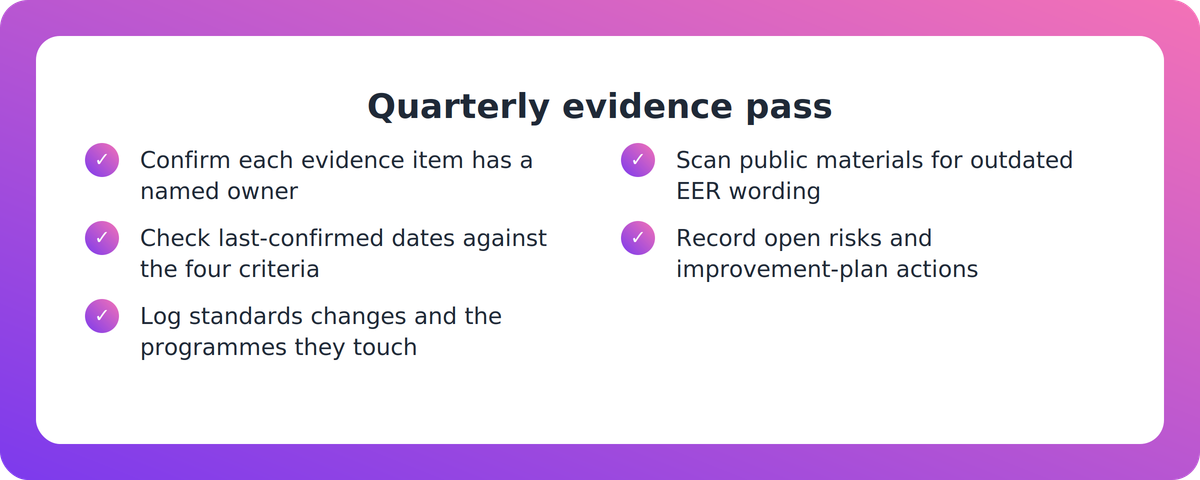
For each of the four proposed criteria, ask three things. Who owns the evidence? Where does it live? When was it last confirmed current? If the answer to any is "it depends who you ask", that is a gap NZQA could find before you do.
The point is also to stop being the bottleneck. When programme leaders own their evidence and you own the standard it is held to, you review exceptions instead of every document.
A quarterly evidence rhythm
Annual self-review works best when it is the sum of four small check-ins, not one large write-up. Each quarter, run a short, fixed pass.
Build a change radar, not a change panic
Standards changes now arrive from several places. Change reports and interim rulings are published per Industry Skills Board. Examples include the Transport ISB, and the Manufacturing and Engineering ISB's food-related review of 47 unit standards. NZQA Rules also require suitable skill standards in qualification and micro-credential listings.
Name one person per ISB or sector you deliver in to watch for changes. Log each change against the programmes it touches, with a decision and a date. Then the question "are we aligned?" has an answer you can show.
Mind the legacy language
Old habits carry risk. Providers that keep referring to their EER category must include an accompanying statement under Rule 10 of the Quality Assurance of Tertiary Education Providers Rules 2026. Audit your website, brochures and agent materials for outdated claims.
Immigration NZ has confirmed it will keep using current EER ratings when setting visa conditions in 2026. I could not find its 2027 position, so treat that as an open question and ask.
Pastoral care stays in play
NZQA administers the Code of Practice and monitors and supports signatories. International students cannot study at an institution that is not a signatory (Immigration NZ).
Technical Institute reports, and it is not NZQA, that Code self-review is now reported within the annual self-review submission. A secondary summary adds that NZQA's updated guidance expects the report to be readily available to learners, staff and the public. Check both against NZQA directly. If either is right, pastoral care evidence belongs in the same year-round trail.
Key takeaways
- NZQA stopped starting new EER processes on 1 January 2026. Reviews already under way will be completed.
- The new rhythm is an annual self-review summary, a discussion with NZQA about the improvement plan, and risk-informed quality assurance.
- The PTE Rules 2026 and the move to skill standards mean your compliance position can shift mid-year.
- NZQA's proposed quality descriptors are only a proposal, but they point to standing evidence that is owned, traceable and current.
- Check legacy EER wording under Rule 10, and verify secondary-source details with NZQA before relying on them.
Our take
The most useful thing about EER going away is that it removes the excuse. For years, a review date made it rational to let evidence drift and then fix it in a rush. That was a poor system, but it had a schedule.
Without the review date, the only thing that separates a calm compliance function from a frantic one is ordinary discipline. Every item has an owner, a location and a last-confirmed date. Standards changes get logged when they happen.
We think the compliance managers who do well will be the ones who spend less time writing about quality and more time making it easy to see. If your evidence can only be assembled by you, over a weekend, you are the risk.
FAQ
Has NZQA really ended EER?
For non-university providers, yes, for new reviews. NZQA announced that from 1 January 2026 it stopped beginning new EER processes or assuring consistency reviews. Those already under way will be completed.
What replaces EER for a PTE?
An annual provider self-review summary report to NZQA, a meeting with NZQA to discuss the improvement plan, and quality assurance activities informed by risk assessments. Safety and wellbeing monitoring is integrated with these activities.
Are the proposed quality descriptors in force?
No. They are a proposal. NZQA's consultation opened on 10 August 2026 and, per its consultations page, closed on 7 September 2026. They would score programme and micro-credential design, delivery, assessment practice, and quality management system implementation, using evidence NZQA already holds and the provider knows about.
Can I still refer to our EER category?
Yes, but you must include an accompanying statement under Rule 10 of the Quality Assurance of Tertiary Education Providers Rules 2026. Immigration NZ has said it will keep using current EER ratings for visa conditions in 2026. Confirm its 2027 position directly.
Where to start
Pick one of the four proposed criteria, say assessment practice. Then spend thirty minutes trying to trace one claim in your last self-review back to its source, owner and date. How long did it take, and who did you have to ask?