NZQA External Moderation Unit Standards: Keep the Evidence
Pre-assessment moderation is the only moderation step that happens before a learner is assessed, so its paper trail is your best proof of assessment quality. Rules differ by Consent and Moderation Requirements (CMR) document, and moderation now sits with Industry Skills Boards (ISBs). Providers need a record of what was checked, when, and against which standard.
Key takeaways
- Moderation is a registration condition. The Private Training Establishment Rules 2026 require a PTE to operate a coherent system to ensure assessment and moderation.
- Pre-moderation rules vary by standard, from mandatory for new or modified material to requested only when issues arise. Read the CMR for every standard you deliver.
- Editing moderated material can undo its approval. Version control and a change record are part of your quality evidence.
- Weak evidence costs money and risk: extra moderation is charged at $240 per hour excluding GST, and consent to assess can be conditioned or withdrawn.
- We found no pre-moderation rule changes in the past 90 days. This is about getting the settled baseline right.
Why does pre-moderation evidence matter more in 2026?
Because the rules are now explicit and the other external checkpoints are thinning out. NZQA updated a series of Rules to align with the new integrated Quality Assurance Framework, and they came into force on 19 January 2026.
One independent summary, from Technical Institute, says NZQA stopped starting new external evaluation and review processes on 1 January 2026. That is a provider's summary rather than a regulator source, so confirm it with NZQA. If it holds, national external moderation becomes one of the few remaining outside looks at your assessment.
That is our reading, not something the sources say outright. It is a reasonable one. When fewer people check your work, the record you can produce on request matters more.
Do all unit standards require pre-moderation?
No, and that is the trap. Each CMR sets its own rules. NZQA publishes them as separate documents; the Horticulture (version 6) and First Aid (version 5) CMRs are two examples. Across the CMRs we reviewed, requirements ranged from mandatory to risk-triggered:
- Services CMR: self-developed assessment materials must be submitted for moderation and approval before use.
- Competenz CMR: pre-assessment moderation happens under your own internal moderation system before materials go to Competenz.
- An NZQA-managed CMR: pre-assessment moderation by NZQA is not usually required, but may be requested where issues have been identified around capability to develop valid assessment material.
A provider delivering across several industries can face all three models in one year. One house rule for "how we pre-moderate" will not cover that.
What are the ISBs asking for?
Moderation responsibility has moved to the ISBs, and their expectations are concrete:
- Manufacturing and Engineering ISB: all new or modified material goes for pre-assessment moderation, with a report aimed for within 20 working days.
- Services ISB: material can be submitted for pre-moderation at any time, per its 2026–27 Operational Plan. Organisations assessing across many industries may be called for post-assessment moderation more than once a year.
- Education, Health and Community ISB: materials pre-moderated by a TITO and left unchanged are recognised as meeting CMR requirements. If you alter them, they go back for pre-assessment moderation.
That last rule is the quiet one. A local tweak to a moderated assessment can switch off the approval you were relying on.
What happens when the evidence is weak?
The CMR text says the QAB may ultimately withdraw consent to assess or impose a condition on it. That is the outer limit.
The nearer cost is money. NZQA's fees table lists additional moderation resulting from non-compliance at $240 per hour excluding GST. As an illustration only, ten hours of extra moderation would be $2,400 plus GST, before counting the staff time spent reworking materials.
What should a pre-moderation evidence log hold?
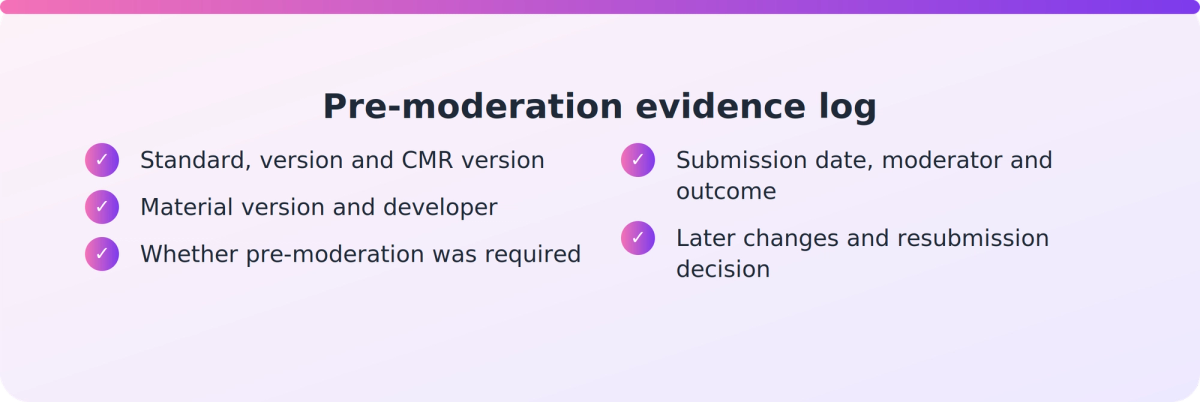
Enough that someone outside your organisation can see what happened without asking you. For each standard, record:
- The standard, its version, and the CMR version you applied.
- The assessment material version, and who developed it.
- Whether pre-moderation was required, requested or optional, and why.
- The submission date, the moderator or body, and the outcome.
- Every later change, with a decision on whether it triggers resubmission.
A short, illustrative example: a PTE adapts a case study in a TITO-moderated assessment to suit a local workplace. If the log records the edit and shows the material went back for pre-assessment moderation before use, the story is clean. If the edit is invisible, the earlier approval may not cover what learners actually sat.
How do you build this into normal delivery?
Treat it as a routine, not a project:
- List every standard you deliver and find its CMR.
- Mark each as mandatory, risk-triggered or on-request for pre-moderation.
- Put a gate on edits: no change to moderated material goes live without a resubmission decision.
- Keep the mapping from each assessment back to its standard alongside the moderation record, so coverage is shown rather than asserted. Tools that hold version history and mapping together make the log a by-product. Supahuman is one way to do it.
- Review the list when ISB rules change. NZIST (formerly Te Pūkenga) is due to be disestablished on or before 31 March 2027, so responsibilities may keep shifting.
One caution. You may see claims that external moderation now requires a set number of learner samples per round. We couldn't corroborate that against an NZQA or ISB source. Check the relevant CMR before you plan around it.
Our take
Pre-moderation evidence is the real currency of assessment quality because it's the only proof made before a learner is assessed. The sources don't put it that way; that's our argument. With the CMRs varying by standard, a log that records what was checked, when, and what changed afterwards is the most reliable defence a provider has. Providers that treat it as admin will keep getting surprised by ISBs.
FAQ
Is pre-assessment moderation compulsory for NZ unit standards?
It depends on the CMR. The Services CMR requires self-developed materials to be moderated and approved before use, while an NZQA-managed CMR says pre-assessment moderation by NZQA is not usually required but may be requested. Check the CMR for each standard.
Who runs national external moderation now?
Moderation responsibility has moved to the Industry Skills Boards. Each publishes its own expectations, such as the Manufacturing and Engineering ISB's aim of returning pre-assessment moderation reports within 20 working days.
Do I need to resubmit assessment materials if I change them?
Often, yes. The Education, Health and Community ISB recognises TITO-moderated materials only if they are unchanged. If you alter them, they must go back for pre-assessment moderation.
What are the consequences of poor moderation evidence?
The CMR text says the QAB may withdraw consent to assess or impose a condition on it. NZQA also lists additional moderation resulting from non-compliance at $240 per hour excluding GST.
Next step
Pick one standard you deliver this week. Read its CMR, then check whether your records show what was pre-moderated, when, and whether anything changed since.