Practical assessment looks cheap on a programme budget and expensive in everything else: assessor diaries, role-player bookings, evidence chasing and moderation rework. No public figure tells you what it costs a PTE, so you have to measure it yourself. In 2026, with self-review replacing external evaluation, that measurement matters more.
Key takeaways
- The cost of practical assessment is mostly operational attention (coordination, evidence handling, rework), and it rarely shows up as a budget line.
- No authoritative public benchmark exists for PTE role-play logistics. Anyone quoting one is guessing, so measure assessor hours, role-player hours, rescheduling and evidence rework yourself.
- Any step that needs a person physically present for every learner will grow in line with enrolments. Find those steps first.
- Process knowledge held in one coordinator's head is a risk under the PTE Rules 2026 and a quality management system requirement. Document it before it walks out the door.
- Verify secondary-source claims about the new rules against NZQA's own text before you change how you run assessment.
Why this lands on your desk
Role-play assessment is where scheduling, assessor capacity, evidence capture and record-keeping all meet. You own every one of those systems. When it goes well nobody notices. When it goes badly you spend a week firefighting a double-booked assessor and a missing recording.
The context has also shifted. NZQA says the Private Training Establishment Rules 2026 replace the PTE Registration Rules 2025 and the PTE Enrolment and Academic Records Rules 2022, and reflect the removal of External Evaluation and Review in favour of self-review and monitoring. The rules also require a copy of your quality management system.
Our inference, not an NZQA statement: that puts more weight on processes that are documented, repeatable and evidenced. That is the COO's territory.
What else has moved around assessment
Standard-setting and moderation now involve more than NZQA. TEC says eight Industry Skills Boards began operating on 1 January 2026. They set standards (including capstone assessments), endorse programmes and moderate assessments.
Meanwhile TEC's Single Data Return cycle carries on. Submission runs through the Data Exchange Platform, and TEC offers an API portal for integration. Assessment outcomes captured at the point of practice only help if they flow cleanly into that reporting.
The practical move is to read the 2026–27 operational plan for the ISB covering your programmes, such as the Services ISB plan or the ETITC ISB plan. Look for what moderation will expect of practical assessment.
Map one role-play assessment end to end
Pick one programme and walk a single role-play assessment from request to reported result. Write down every step, who does it, and how long it really takes. A typical map looks like this:
- Assessment is scheduled against a cohort list.
- Assessor, role-player and room or equipment are booked.
- Learners are briefed and, where needed, given practice time.
- The assessment runs and the evidence is captured (observation notes, recording, checklist).
- The result is recorded, and evidence is filed and retained.
- Moderation checks the decision, and the outcome feeds reporting.
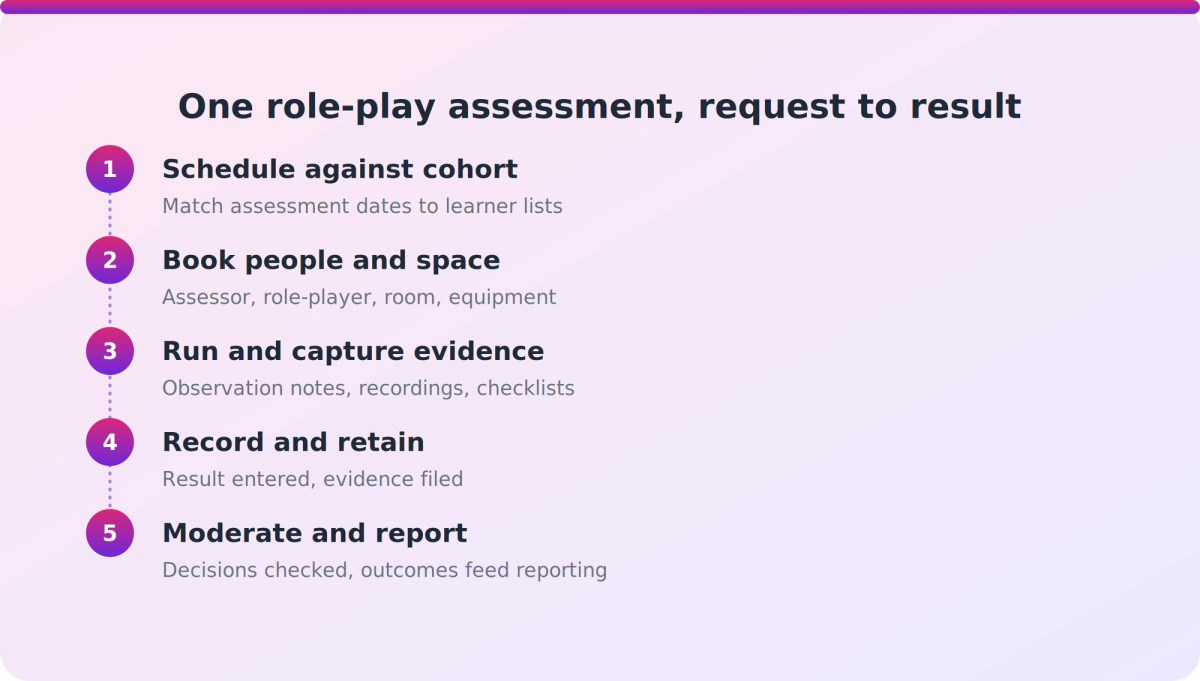
Most COOs find the formal assessment is the shortest step. The time sits in steps 2, 3 and 5: chasing availability, arranging practice, and tidying evidence after the fact.
Three tests for finding the hidden cost
Where does the knowledge live?
For each step, ask what happens if the person who normally does it is away for two weeks. If the answer is "it stalls", the process lives in someone's head. Write it down now, because a quality management system is only as good as the processes it describes.
What scales with enrolments?
Mark every step that needs a person present for each learner or attempt. Live role-players and one-to-one assessor observation are the usual culprits. Double your enrolments on paper and see which steps double with them. Public sources do not quantify this, so treat it as a question to test, not a conclusion.
Where does rework appear?
Count rescheduled sessions, evidence that was incomplete or unusable, and results queried at moderation. Rework is the clearest signal of a process being firefought rather than designed. Even a rough tally over one term tells you more than any benchmark.
An illustrative example, not a real case: if one coordinator spends several hours each week re-confirming role-player availability, that effort never appears in a programme budget. It appears as a bottleneck the week that coordinator is sick.
What to treat with caution
Some advice circulating about the 2026 rules comes from secondary sources. Technical Institute reports that non-university providers now complete an annual self-review and discuss it with NZQA. It also reports that NZQA consulted on proposed quality descriptors with assessment practice among the criteria, and that generative AI in delivery and assessment is a thematic question for July 2026 to July 2027.
We have not confirmed those points on NZQA's own site. A vendor blog also claims specific retention periods for assessment materials, including sub-contractor evidence. Check anything like that against the PTE Rules 2026 text before it shapes your retention policy.
Role-play is also a learner experience
The Pastoral Care Code of Practice applies to all providers enrolling tertiary learners. The brief does not say it addresses role-play, and we are not claiming it does. But a role-play is a high-stakes moment for a learner, and operations designs it, whether through room choice, notice given or the chance to practise first. A badly run session is a retention risk as well as a logistics failure.
Our take
The usual instinct is to treat assessment logistics as a scheduling problem and buy a better calendar. We think that misreads it. The cost sits in rehearsal, rework and undocumented knowledge, not in the assessment itself.
So separate practice from assessment in your process map. Formal, evidenced assessment may well need a person in the room. Rehearsal often does not, and that is where a linear-with-enrolments cost is hardest to justify. Providers are looking at simulated practice, and NZQA's reported interest in generative AI makes it a question worth having a view on. Decide on the evidence from your own map, not on anyone's promises.
FAQ
How much does practical assessment cost a PTE?
No authoritative public figure exists for PTE staffing, utilisation or role-play logistics. Measure assessor and role-player hours, rescheduling, evidence rework and moderation findings in your own operation rather than relying on a benchmark.
Why does this matter more in 2026?
NZQA's PTE Rules 2026 replace External Evaluation and Review with self-review and monitoring and require a quality management system. Industry Skills Boards, operating since 1 January 2026, now set standards and moderate assessments, so evidence has to stand up to more scrutiny.
Which steps are most likely to scale linearly with enrolments?
Any step needing a person physically present for each learner or attempt, typically live role-players and one-to-one observation. Publicly available sources do not quantify this, so test it by modelling a doubling of enrolments on your own process map.
Can I rely on blog summaries of the new rules?
Treat them as pointers, not authority. Claims about retention periods, sub-contractor responsibility or quality management system deadlines should be checked against NZQA's rules text and TEC's pages before you act.
One step to take this week
Choose one programme with a role-play assessment and map it end to end, as above. Next to each step, write who does it, how long it takes and what would happen if they were away. Bring that single page to your next operations meeting.