Role Play Training NZ: Why Graduates Freeze at Interview
New Zealand graduates who freeze in interviews are more likely short of rehearsal than talent. Graduate roles are about 2% of Seek ads, so every interview is rare and costly to waste. Most tertiary support offers frameworks and recorded practice, not repeated, coached role play. That link is our inference, not a measured finding.
Key takeaways
- Scarcity changes the stakes. Graduate roles were just over 2% of Seek ads, so each interview carries more weight than it used to.
- No NZ study we found measures interview "freezing". Treat the practice-gap explanation as a reasoned inference.
- Typical provision (recorded mock interviews, the STAR method, booklets) is useful scaffolding. It isn't adaptive, coached rehearsal.
- Employers say communication and interpersonal skills count for more as AI reshapes hiring.
- Role play only builds skill when it is repeated, specific to the learner's field and followed by feedback. Judge any tool, AI or human, on those three things.
Why does every interview now carry so much weight?
Because there are far fewer of them. B2B News NZ reports that graduate roles made up just over 2% of jobs advertised on Seek, and graduates compete with each other and with people who already have work experience. Check Seek's own NZ Employment Report before quoting that figure directly.
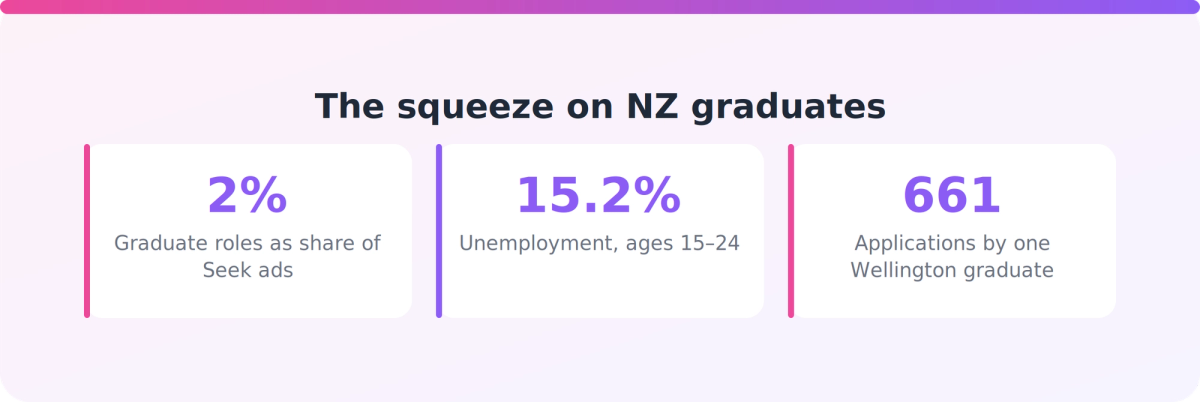
The youth picture is similar. B2B News NZ puts 15–24 unemployment at 15.2%, with 25.2% for teenagers and 11.3% for 20–24-year-olds. Rolebird, an analytical site rather than an official source, estimates 12.0% for 20–24-year-olds against 6.5% for 25–29s. Verify both against Stats NZ tables before citing them.
The practical effect: a graduate may get only a handful of interviews in a whole job search. Fewer attempts means less room to learn on the job.
Is the 'freeze' a talent problem or a practice-access problem?
The evidence points toward access, though it can't prove it. We found no NZ study that measures graduates freezing in interviews. What we have are signals.
- Interviews aren't converting. An RNZ Morning Report story describes a Wellington graduate who sent 661 applications between July 2025 and July 2026, landed 53 interviews and received two offers. That's one anecdote. It does suggest that interview performance, not only access, can be a bottleneck.
- Employers want communication. In RNZ's reporting on international graduates, Robert Walters Auckland senior director David Lacire says soft skills matter more as AI changes how employers assess candidates, with more weight on communication and interpersonal skills alongside technical expertise.
- Graduates are filling the gap themselves. The same piece reports two international graduates who launched a programme to build confidence connecting with employers. It also notes that many arrived believing strong grades and technical skills would be enough.
Put together: capable people, high stakes, little rehearsal. That's a pattern, not proof.
What do tertiary institutions typically offer?
Mostly knowledge and recorded practice. The University of Auckland Business School's interviews page points students to recorded Interview Stream practice via MyCDES and the STAR method. The University of Otago's Career Development Centre publishes an interview skills booklet.
These are good resources. STAR gives a graduate a structure, and recording yourself builds self-awareness. But neither one pushes back, changes the question mid-answer, or tells you what you just did to lose the room. And these two pages are examples of current provision, not a sector-wide audit. PTEs, polytechnics and wānanga may do more than we can see from public pages.
What does effective rehearsal actually need?
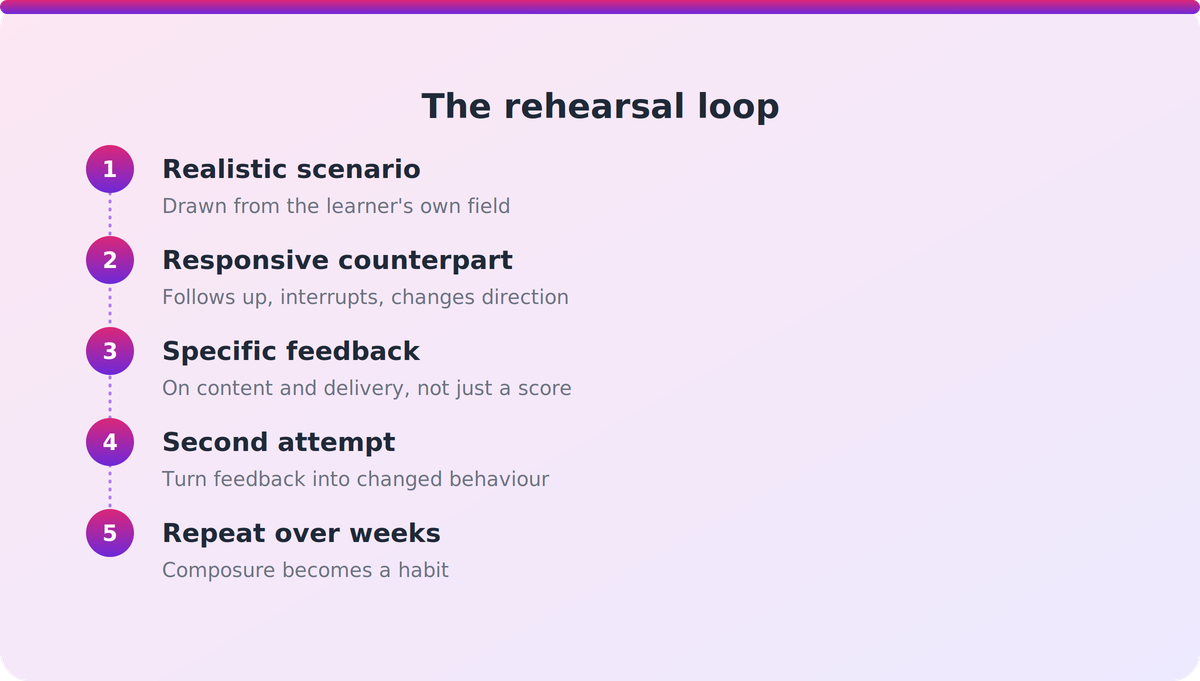
Think of it like any performance skill. Reading about a handshake doesn't make it firm. A workable rehearsal loop has five parts:
- A realistic scenario drawn from the learner's field, not a generic "tell me about yourself".
- A responsive counterpart that follows up, interrupts and changes direction.
- Specific feedback on what was said and how, not just a score.
- A second attempt straight afterwards, so the feedback turns into behaviour.
- Repetition over weeks, so composure under pressure becomes a habit.
The usual barrier is cost. Human role-play partners, actors and facilitators don't scale across a whole cohort, so most learners get one mock interview, if any.
An illustrative example
This is a hypothetical, not a case study. Picture a PTE running a business administration programme with 60 learners in a cohort. The careers adviser can run perhaps one live mock interview per learner a year. Each learner also records a few answers on video and gets a checklist.
Now imagine each learner could run a dozen varied, role-specific rehearsals before their first real interview, each with immediate feedback. The same adviser could then spend their time on the hardest cases instead of on logistics. The graduate's first live interview would feel like their thirteenth.
Where do AI role-play tools fit, and what should you ask of them?
A category is forming, and it deserves cautious curiosity. Bodyswaps, in a vendor blog (so treat it as biased), says purpose-built AI tools for practising high-stakes conversations have appeared in the last two years. FindMeAJob NZ offers a free AI interview simulator that scores spoken answers out of 100.
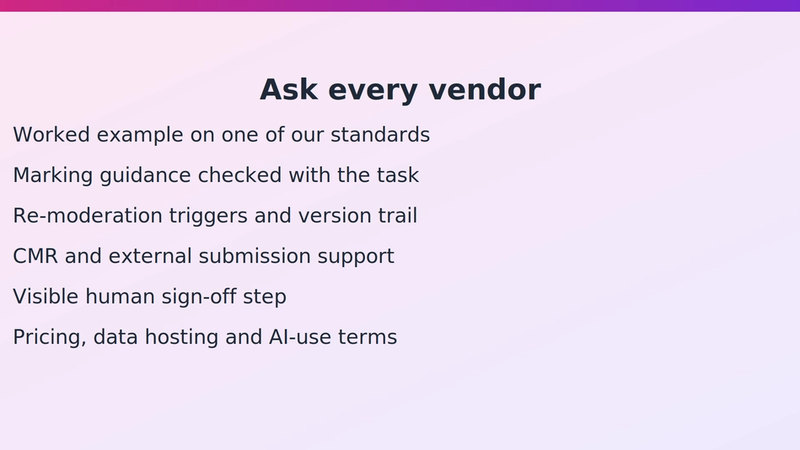
Both show demand. Neither is independent evidence that practice with such tools improves interview outcomes. Before adopting anything, ask:
- Does it adapt to the learner's field and the actual job description?
- Does it feed back on delivery and content, or only hand out a number?
- Can learners repeat scenarios and see progress over time?
- Does it support your outcomes, such as NZQF qualification and unit standard requirements for communication, rather than sit beside them?
- Can you see how learners are using it, so staff can follow up?
Our take
We think the sector has been treating interview readiness as information to deliver, when it's a skill to rehearse. The freeze is an understandable human response to a high-stakes event with few second chances. If graduate interviews stay scarce, institutions that make repeated, coached practice routine will give their learners an edge that a framework handout can't. We hold that view with open eyes: it rests on inference, and someone should measure it.
FAQ
Why do NZ graduates struggle in interviews?
No NZ study we found measures this directly. The evidence points to a tight market (graduate roles at roughly 2% of Seek ads), employers placing more weight on communication skills, and limited chances to rehearse. Our reading is that practice access matters as much as ability, but that's an inference.
Is role play training effective for interview preparation?
Rehearsal with feedback is how most performance skills are built, so it's a reasonable bet. We haven't found independent NZ evidence of outcomes from AI role-play tools, so pilot, measure and compare before scaling.
What do NZ universities currently offer for interview practice?
The University of Auckland Business School points students to recorded Interview Stream practice and the STAR method. Otago's Career Development Centre publishes an interview skills booklet. These are examples of current provision, not an audit of the whole sector.
Can AI replace human coaches for interview practice?
Not entirely. AI can provide repeated, available practice at scale. Human advisers are better placed to read context, handle sensitive cases and build confidence. The strongest approach likely combines both.
Your next step
Ask five recent graduates from your programme how many times they rehearsed out loud, with live feedback, before their first interview. Their answers will tell you whether your gap is information or practice.