Moderation becomes a bottleneck when it is treated as a checkpoint at the end of the cycle rather than a step in the delivery plan. The fix is a pre-moderation process: quality checks designed in before assessments reach the formal queue, with evidence produced as a by-product. For a PTE COO, that is capacity you can't buy with headcount.
Key takeaways
- NZQA's 2026 rules expect a coherent assessment and moderation system, at programme approval and in ongoing operation. Moderation is an operational design question, not only a compliance one.
- TEC tells providers not to assume funding will be maintained or increased, and rate rises are modest. Absorbing moderation workload with more staff is a weak answer.
- Pull quality checks forward so that the formal moderation queue receives work that is already mapped, complete and consistent.
- Evidence should fall out of the process. Retention and retrieval need to be designed in before NZQA asks.
- If the process lives in two or three people's heads, it will not survive the VET restructure or a volume increase.
Why this lands on your desk
You own the path from unit design to delivery. When moderation is a late queue, start dates slip, assessor time gets tied up in rework, and your team fights fires it could have prevented.
The rules have also moved. NZQA reissued the Private Training Establishment Rules 2026 on 19 January 2026. 'Assessment and moderation' is among the listed requirements, including operating a coherent system for both.
The Programme Approval, Recognition, and Accreditation Rules 2026 require assessment methodology that is fair, valid, consistent and appropriate. They also require an effective system for moderating assessment materials and decisions. The Quality Assurance rules expect an up-to-date quality management system that covers it too.
None of this says where in the cycle you check quality. That choice is yours, and it is an operations decision.
Why more headcount is the wrong answer
TEC's 2026 Plan Guidance says not to assume funding will be increased or maintained in 2026, and that low-performing provision may be reduced or disinvested. Budget 2025 lifted targeted subsidies by 3% from 1 January 2026, and by a further 1.75% at Levels 7–10.
That is not enough to hire your way through a moderation backlog. If capacity gains are coming, they have to come from the process.
There is a second pressure. Eight Industry Skills Boards and ten regional polytechnics became operational on 1 January 2026. The Programme Approval Rules tie 'consent and moderation requirements' to the standard-setting body requirements. TEC says work-based learning is moving to PTEs, and the Boards cease managing training on 31 December 2027. I could not find an official figure for how many learners PTEs will absorb, so plan for a range, not a number.
What a pre-moderation process looks like in practice
The idea is simple. Move the questions moderators would ask to the point where they are cheapest to answer, which is before the material leaves the person who built it. The steps below are my suggested design, not an NZQA requirement.
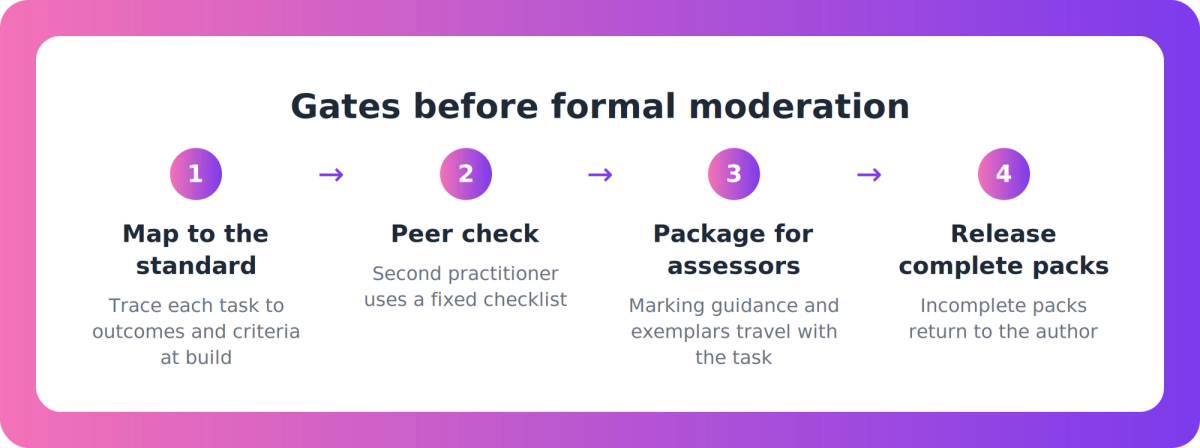
Design the gates before the queue
- Map to the standard at build. Every assessment task is traced to the unit standard's outcomes and performance criteria when it is written, not reconstructed afterwards.
- Peer check against a fixed checklist. A second practitioner confirms the task is fair, valid, consistent and appropriate, the language the approval rules use.
- Package for the assessor. Marking guidance and exemplars travel with the task, so decisions stay consistent across assessors and sites.
- Release to formal moderation only when the pack is complete. Incomplete packs go back to the author, not into the queue.
Make evidence a by-product
PTEs must keep all student assessment materials, or full copies, for at least 12 months from completion, including sub-contractors' materials, per NZQA's PTE Rules page. NZQA may also notify a provider to engage in monitoring of particular programmes or qualifications, which may include site visits.
If retrieving moderation records means emailing three people, you are one request away from a scramble. Decide where records live, who owns them and how fast you can produce them.
An illustrative example
Imagine a PTE with a 14-day average wait between assessment completion and moderation sign-off (hypothetical figures). Half of those days are spent on rework: missing mapping, unclear marking guidance, inconsistent formats. Gates one to four attack that half. The queue shortens because less rework enters it. No extra moderator is needed.
Where this touches reporting
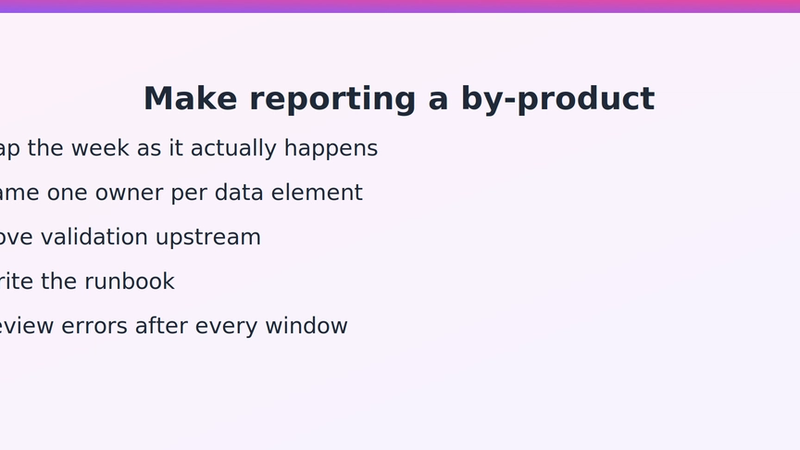
Fixed reporting windows leave little slack. The August 2026 Single Data Return round ran from 8 to 21 August 2026.
My inference, not a stated TEC finding, is that a delay in assessment approval that holds up enrolments or results can flow straight into those windows. Late quality checks are therefore a reporting risk as well as a delivery one. For related reading on operational cadence, see this COO's playbook on the NZQA unit standard review process.
Our take
Most PTEs treat moderation as a compliance obligation to be survived. The better frame is that it's a production process with a quality gate, and like any production process it is cheapest to fix upstream.
A caution: the iQAF consultation design describes an annual conversation with NZQA informed by risk assessments, but that document is a consultation draft, not final policy. NZQA says it is not conducting new EERs from 1 January 2026. Don't read the end of EERs as lighter scrutiny. The rules still expect a coherent, documented system, and a documented process is the easiest thing to show.
FAQ
What is a pre-moderation process for an NZ PTE?
It is a set of internal quality checks run before assessments reach formal moderation. Typical checks cover mapping to the standard, peer review and assessor guidance. It is an operational practice, not a named NZQA requirement. NZQA's rules require a coherent assessment and moderation system.
Does NZQA require moderation at programme approval?
Yes. The Programme Approval, Recognition, and Accreditation Rules 2026 require an effective system for moderation of assessment materials and decisions. They also require assessment methodology that is fair, valid, consistent and appropriate.
How long must we keep assessment materials?
The PTE Rules require all student assessment materials, or full copies, to be kept for at least 12 months from completion. This includes materials from sub-contractors.
How will the Industry Skills Boards affect our moderation process?
The Boards are standards-setting bodies only, and the Programme Approval Rules link consent and moderation requirements to standard-setting body requirements. Document your process so it can adapt as those requirements settle.
Next step
Take the last three units that went through formal moderation and trace each one from assessment draft to sign-off, noting every handoff and every day of waiting. Mark where the delay came from rework. That map is your pre-moderation design brief.