No New Zealand source has measured what format fragmentation costs PTEs, so the "quiet drain" is an inference, not a statistic. It's a reasonable inference, though. With NZQA moving to provider self-review in 2026, keeping print and LMS versions of the same content consistent is now your own quality-assurance problem.
Is format fragmentation really draining PTE budgets?
We can't prove it, and we won't pretend to. Neither NZQA, TEC nor any independent study we found quantifies the cost of maintaining the same assessment and training material across print and LMS in a New Zealand PTE.
What we do have is regulatory change, practitioner commentary and vendor material. That's enough to build an argument. It isn't enough to put a dollar figure on it.
So treat the rest of this post as reasoning to test against your own numbers, not a finding to quote.
What changed in NZQA's rules in 2026?
Two things matter for training material development in NZ.
- EER is winding down. Per Technical Institute's explainer, from 1 January 2026 NZQA stopped starting new external evaluation and review (EER) processes and consistency reviews. Providers now send NZQA a yearly self-review summary report under the iQAF approach, and meet NZQA to discuss their improvement plan.
- New PTE Rules. The NZQA Private Training Establishment Rules 2026 came into force on 19 January 2026. They replace the 2025 registration rules and the 2022 PTE Enrolment and Academic Records Rules, and remove the annual fee. Non-funded PTEs now provide financial returns biennially unless NZQA says otherwise.
SAARA also notes that sub-contracting provisions left the Programme Rules on 19 January 2026 and now sit in the Quality Assurance of Tertiary Education Providers Rules 2026.
Why does self-review make print and LMS drift riskier?
This is the analytical leap, and it's ours. Self-review puts more weight on your own systems and document control. An external panel no longer arrives every few years to catch inconsistencies for you.
Now picture a unit standard assessment that exists as a printed workbook, a Moodle or other LMS page, and a copy a sub-contractor edited last term. If a standard changes and only two of three get updated, that's not a formatting nuisance. It's a gap in your self-review evidence.
The sub-contracting point sharpens this. Content shared with delivery partners in several formats raises the stakes on knowing which version is current.
None of this is a documented NZQA finding. It's what the new settings imply for anyone running more than one format.
Where does the rework actually come from?
Three sources show up in the practitioner and vendor evidence.
Standards churn
SupaHuman's own piece on LMS integration (vendor-authored, so read it as a view, not proof) argues that every LMS learning outcome should trace to a live standard entry owned by the relevant Industry Skills Board. Hard-coding course structure against standards that are still being finalised, it says, builds debt into the LMS from day one. Whatever the LMS holds, the print copy needs the same fix.
LMS technical differences
Coursebox, in an overseas vendor comparison that isn't NZ-specific, says Moodle core lacks native SCORM 2004 sequencing. SCORM 2004 or cmi5 content therefore needs the paid Rustici SCORM Cloud plugin, with the organisation owning hosting, upgrades and support. That's a concrete example of content built once, then reworked for the platform.
We've deliberately left out the generic overseas SCORM build costs floating around online. They aren't NZ PTE numbers.
Parallel editing
This one is inference again. When a Word file, a print layout and an LMS page are edited by hand in separate places, every correction gets made two or three times. Every extra manual copy is also another chance for versions to diverge.
How can a PTE test the drain with its own data?
You don't need a study. A one-term audit will tell you whether this is a real cost for you.
- List every assessment and learning resource that exists in more than one format.
- Record who edits each format and where the "master" lives.
- Count the last three standard or content changes and how many places each one had to be made.
- Log the hours spent on re-formatting, re-uploading or reconciling versions.
- Check whether your self-review evidence can show which version learners received, and when.
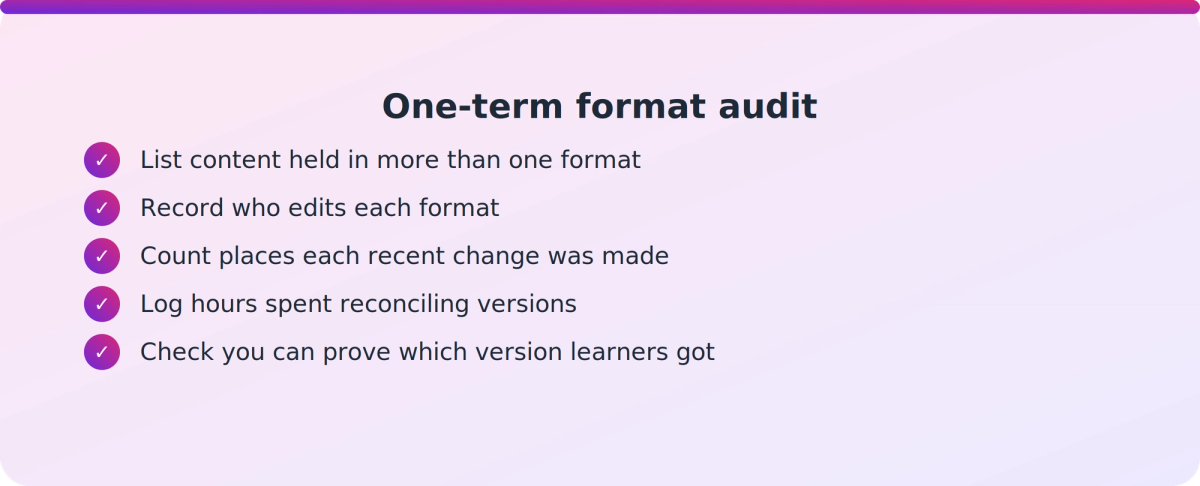
If the hours are small and the version trail is clean, good. You can ignore this post. If not, you've got your own number, which beats any we could quote.
What about single-source, multi-output approaches?
The obvious response is to author once and export many times. That's the model behind VETos, which we build at SupaHuman. It exports to Word (.docx) and Adobe InDesign (.idml) for print-ready materials, and offers SCORM and LTI 1.3 for LMS use.
Treat that as positioning, not independent validation. BusinessDesk reported SupaHuman's $2.6m Series A and said Connexis, Competenz, ServiceIQ and Mast Academy helped shape the products. That tells you who was in the room. It doesn't tell you what the approach saves a PTE.
The principle holds regardless of tooling. One authoritative source, traceable to the standard, with formats generated from it rather than hand-copied. How you get there is a separate question. Worth asking your team which copy is the real one today.
Key takeaways
- No NZ source (NZQA, TEC or independent research) quantifies format fragmentation as a PTE cost. The "drain" is an inference.
- Since 1 January 2026, NZQA has stopped starting new EER processes. PTEs now submit a yearly iQAF self-review summary report.
- The PTE Rules 2026 (in force 19 January 2026) and the new sub-contracting arrangements put more weight on your own document control.
- Divergent print and LMS versions of the same content are a plausible self-review risk. That link is analytical, not documented.
- A one-term audit of your own formats, edits and version trail is the fastest way to test the claim.
Our take
Most PTEs we'd expect to feel this won't call it a format problem. It will show up as "the workbook and the LMS don't match" at the worst moment, like a self-review conversation or a moderation query. We think the sensible move is to stop treating print and LMS as separate projects and start treating content as one governed asset with several outputs. We'd also like to see PTEs, or TEC, publish real numbers. Until then, anyone claiming a precise saving, including us, is guessing.
FAQ
Has NZQA or TEC measured the cost of format fragmentation for PTEs?
Not that we found. No NZQA, TEC or independent source quantifies it. The argument that it drains budgets is a reasoned inference from the 2026 regulatory change and practitioner evidence, and PTEs should test it against their own data.
What changed for PTEs under NZQA's 2026 approach?
According to Technical Institute, from 1 January 2026 NZQA stopped starting new EER processes and consistency reviews. Providers now send a yearly self-review summary report and meet NZQA to discuss their improvement plan. The NZQA Private Training Establishment Rules 2026 also took effect on 19 January 2026.
Why does version control matter more under self-review?
Self-review puts more weight on your own document control. If print and LMS versions of the same assessment diverge, you carry the risk of showing which version is current. This link is our analysis, not an NZQA statement.
Do LMS platforms handle SCORM differently?
Yes. Coursebox, a vendor comparison not specific to NZ, says Moodle core lacks native SCORM 2004 sequencing. SCORM 2004 or cmi5 content needs the paid Rustici SCORM Cloud plugin, with the organisation responsible for hosting, upgrades and support.
Does a single-source, multi-output tool solve the problem?
It may reduce duplicate editing, but that's a product claim, not independent proof. Test any tool, including VETos, against your own audit of formats, hours and version trails.