Cost per learner is the easiest number in a PTE to calculate and the easiest to steer wrongly. It is a lagging figure that rewards cutting whatever is most visible. In 2026, NZQA, TEC and the market reward what is harder to see: learner outcomes, a defensible evidence trail, and a business that doesn't hang on two people.
Key takeaways
- Treat cost per learner as one input. Read it beside what each learner receives, how well that can be evidenced, and how much key-person dependency it hides.
- Margin pressure looks structural, not cyclical. TEC's 2026 guidance tells providers not to assume funding will be maintained.
- Cuts to assessment practice, documentation or learner support now carry more regulatory risk, because the evidence trail is continuous rather than periodic.
- No authoritative sector benchmark for PTE cost per learner was found. Define the metric inside your own business and test it there.
- Ask which kinds of delivery work best, then work out how to make them affordable. That is a better question than "how do we make delivery cheaper?"
Why this lands on your desk
You own the P&L and answer to the board for margin. TEC's 2026 Plan Guidance says funding will be limited and focused on economic priorities, and that providers should not assume it will be increased or maintained. The 2026 Funding Conditions Catalogue for PTEs includes a financial viability action plan. Margin is a board concern and a regulatory-adjacent one.
With no new money coming, the pull is towards the cost line you can see. Trainer hours, assessment time, student support and small cohorts all look like savings on a spreadsheet. The trouble is that none of them shows up on the spreadsheet as the thing it protects.
What cost per learner can't see
The evidence trail
The Private Training Establishment Rules 2026 commenced on 19 January 2026. They require PTEs to keep student assessment materials, including those from sub-contractors, for at least 12 months after training is completed. The cost of evidence is part of the model, not an overhead you can wish away.
NZQA also said it updated its Rules to align with the integrated Quality Assurance Framework. The PTE annual financial return becomes biennial unless NZQA notifies a PTE that it must file annually. That is a modest relief in reporting load. It is not a reduction in accountability.
One secondary source, a PTE rather than the regulator, reports that NZQA stopped starting new EER processes from 1 January 2026. Providers instead send a yearly self-review summary and meet NZQA to discuss their improvement plan. Verify that against NZQA directly. If it holds, standing depends on a trail you build all year. Thinning out documentation or practice-based assessment to protect margin is then a bigger bet than it would have been under a periodic review.
Learner support
Tertiary providers must follow the Education (Pastoral Care of Tertiary and International Learners) Code of Practice 2021, and signatory status is required to enrol international learners, per the Ministry of Education. Learner support is a cost line you can't trim without regulatory consequence, and it is also a retention line. Your cost-per-learner figure will treat it as pure cost.
Key-person dependency
A low cost per learner can come from one compliance lead who holds the whole evidence trail in their head, or one senior trainer who carries the hard cohorts. The number looks great until that person leaves. Nothing in the metric prices that risk, so you have to ask about it separately.
The field is shifting under you
TEC says ten independent regional polytechnics became stand-alone institutions on 1 January 2026, and work-based learning divisions are moving to new or existing PTEs, polytechnics and wānanga. The new PTEs include BCITO Limited, MITO Limited, HITO, NZMA and Skills Group.
Competing on price alone against entrants of that scale is a weak position. Your durable edge is more likely to be what your learners achieve and how convincingly you can show it.
A test to run this quarter
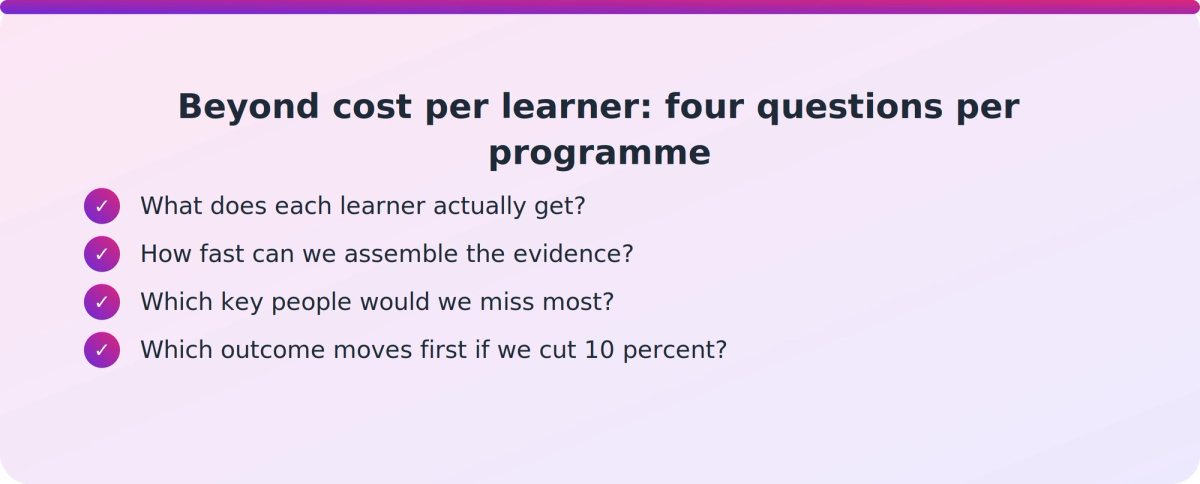
There's no sector benchmark to borrow, so build your own view. Take your two or three largest programmes and ask the following for each.
- What does a learner actually get? Count practice, feedback and support, not just contact hours.
- If NZQA asked tomorrow, how long would it take to assemble the evidence, and who would assemble it?
- Which two or three people would hurt us most if they left in the next month?
- If we cut this cost line by 10 percent, which outcome measure would move first, and would we see it in time?
An illustrative case: two programmes carry the same cost per learner. One gets there through structured, evidenced practice and shared systems. The other gets there because one person absorbs the load informally. The metric calls them equal. Your risk position says otherwise.
Where AI fits the question
NZQA's tertiary guidance recommends policies on appropriate use of generative AI, a range of assessment methods, and clear communication of academic-integrity responsibilities to learners. I found no NZQA or TEC statement on AI in PTE delivery or back-office work, so you are deciding without explicit sector guidance.
That argues for caution about AI as a pure cost cutter. It is better judged by the same test: does it make the most effective kinds of learning, such as realistic practice with feedback, affordable enough to deliver to everyone? Does it leave your evidence trail stronger or weaker? Run it through the same four questions before you count the savings.
Our take
Margin matters, and I'm not arguing for spending more. I'm arguing against a single metric doing the steering. Cost per learner tells you what delivery cost you last year. It doesn't tell you what you are protecting or what you are exposing.
The better discipline is to name the delivery that works best for learners and regulators, then find ways to afford it at scale. Cutting from the bottom of the cost line is easier, but it tends to cut the things that hold your standing.
FAQ
Is there a benchmark for PTE cost per student in New Zealand?
No authoritative sector benchmark was found for PTE cost per learner, margins or compliance cost trends. Define the metric inside your own business, apply it consistently, and compare programmes against each other rather than against an outside figure.
Why is cutting delivery cost riskier in 2026?
The evidence trail is now continuous. A secondary source reports that NZQA moved from EER to yearly self-review summaries and improvement-plan conversations, so thinner documentation or assessment practice shows up all year, not just at a review. Verify the detail with NZQA.
Will TEC funding rise to ease margin pressure?
TEC's 2026 Plan Guidance says funding will be limited, that providers should not assume increases or maintenance of funding, and that additional funding in 2026 is unlikely. Plan for margin pressure as a structural condition.
Can we safely trim learner support to protect margin?
Be careful. Providers must follow the Pastoral Care Code of Practice 2021, and signatory status is required to enrol international learners. NZQA can take action against signatories in breach, so support is a cost you can't trim without consequence.
A first step: put your three largest programmes through the four questions above at your next leadership meeting, and see which answers nobody can give quickly.