PTE Staff Compliance Training NZ: Prove Understanding
A signed-off policy proves it was issued, not that anyone understood it. Under NZQA's iQAF, where self-review replaces external evaluation and review, the stronger evidence is that staff can explain and apply what the policy says. No NZQA rule says training records must be kept as proof. Sound practice points that way anyway.
Key takeaways
- "Issued and signed off" is the weakest level of evidence. "Staff can apply it" is the strongest.
- No NZQA source we reviewed requires staff training records as evidence. Treat them as good self-review practice that your QMS and Code obligations imply.
- With no new EERs from 1 January 2026, you explain in your own words how you know practice works.
- The Pastoral Care Code is where staff understanding is most visible, so test it there first.
- Check the exact QMS wording and dates in the Rules themselves, not in commentary.
Why this lands on your desk
You own the quality management system and the evidence behind it. The Quality Assurance of Tertiary Education Providers Rules 2026 replace the 2022 Quality Assurance (including EER) Rules and include having an up-to-date quality management system. A policy that has been distributed but never revisited is your exposure.
NZQA's iQAF design paper says no new EERs will be conducted from 1 January 2026. Every tertiary education organisation submits a self-review summary report and takes part in an annual conversation with NZQA. Someone has to answer "how do you know your people do this?" in that conversation. That someone is usually you.
What NZQA says, and what it doesn't
Precision matters here, because you'll be asked to defend your position.
What the sources support:
- The iQAF applies across PTEs, wānanga, polytechnics, industry skills boards and government training establishments, per the NZQA quality assurance hub.
- The 2026 Rules include an up-to-date quality management system.
- Providers must follow the Pastoral Care Code, and NZQA, as Code administrator, monitors and supports signatories (see the Ministry of Education guidance).
What we couldn't find: any NZQA statement that staff training records are required evidence. We also found no published NZQA risk-scoring method for PTEs. So this is an argument from implication, not a mandate. If a consultant tells you it's compulsory, ask for the clause.
One more caution. Some commentary cites specific deadlines for the QMS rule that we couldn't confirm in NZQA's text. Read the Rules themselves and check the dates yourself.
Why understanding is now your best evidence
Commentary on the iQAF notes that NZQA's self-review summaries aren't published. That's a secondary source, but the logic holds. There's no external rating to lean on, and enforcement tools such as compliance notices and conditions on registration remain available. Your internal evidence carries more weight.
A self-review that says "policies reviewed, staff informed" is thin. One that says "we checked whether staff could apply the policy, found a gap, and fixed it" shows a provider that knows itself. That is the story an annual conversation rewards.
The evidence ladder
Think of five rungs. Most PTEs stop at the second.
- Issued. The policy exists and is in the QMS.
- Acknowledged. Staff signed or clicked to say they've read it.
- Understood. Staff can explain it in their own words or answer scenario questions.
- Applied. Practice, such as case notes, file reviews or observed interactions, matches the policy.
- Refreshed. When the policy or the regulatory language changes, staff are told what changed and re-checked.
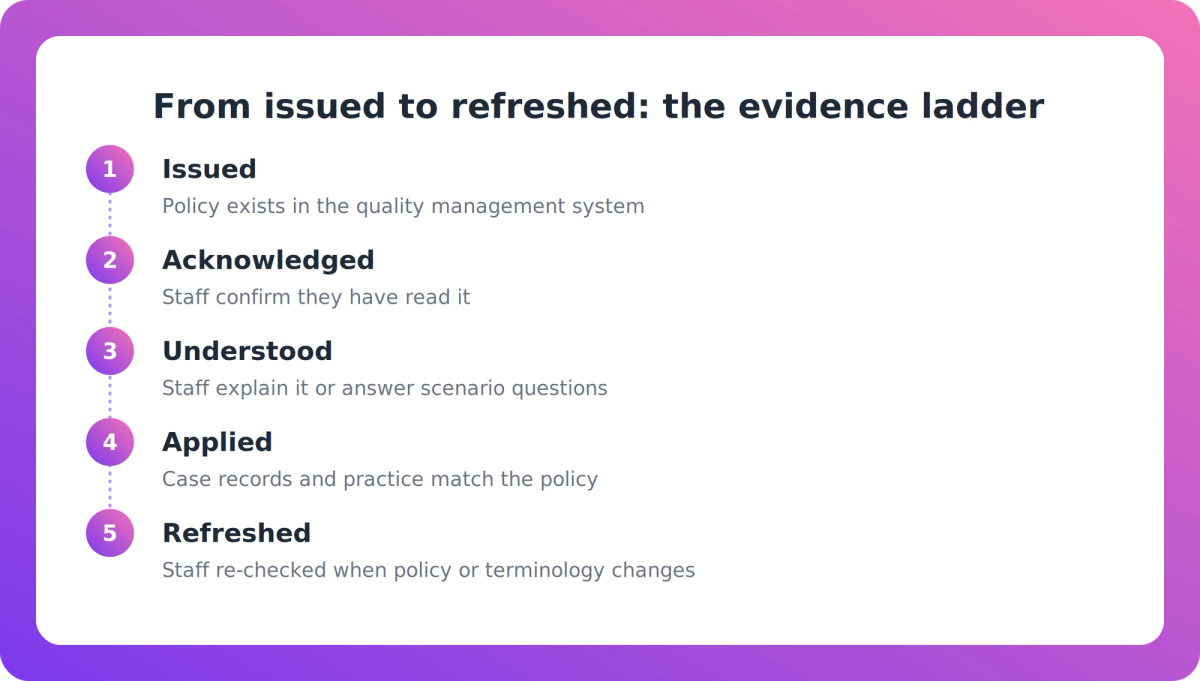
Rungs 3 to 5 are where the gap between "documented" and "effective" lives. They also give your self-review something real to say.
Test the Pastoral Care Code first
If you can only strengthen evidence in one area, choose the Pastoral Care Code. It governs front-line moments: a learner in distress, a complaint, a safety concern. Those are exactly where a gap between policy and practice shows.
Here's an illustrative example, not a real case. A learner tells a tutor they're struggling to cope. The policy says the tutor should refer the learner to a named support person. A signed acknowledgement says the tutor read the policy. It says nothing about whether this tutor, on this day, knew who that person was.
A ten-minute scenario check run with tutors would show you. So would a quick review of a sample of referral records. Either gives you something the signature can't.
Re-communicate when the language changes
The 2026 Rules change terminology to reflect the vocational education reforms, including references to Workforce Development Councils and industry skills boards. NZQA doesn't say your documents need rewriting. It's a reasonable inference that policies and teaching and assessment materials naming outdated bodies deserve a check. Staff also need to know what changed and why.
That can make you the bottleneck. Don't run it as a document-by-document review that only you can clear.
- List which policies touch the changed terminology.
- Give each policy an owner outside compliance, accountable for the update and the staff briefing.
- Ask owners to record the briefing and one check of understanding, however small.
- Keep your role to sampling and sign-off. Our piece on compliance evidence ownership covers how to spread that load.
Our take
The compliance profession has spent years proving distribution: policy issued, signature collected, box ticked. That was always a proxy, and iQAF removes the external reviewer who used to accept it. The better question for a Compliance Manager is whether you'd be comfortable if NZQA asked a front-line staff member to explain the policy.
We'd rather see a small, honest sample of staff understanding, with the gaps shown, than a perfect acknowledgement register. Evidence of a gap you found and closed is not a weakness. It is the clearest sign your quality management system works. Just don't present it as an NZQA requirement, because it isn't.
FAQ
Does NZQA require PTEs to keep staff training records as compliance evidence?
No NZQA source we reviewed says so. The 2026 Rules require an up-to-date quality management system, and the Pastoral Care Code expects practice to follow it. Training and understanding records are therefore sound self-review evidence, not a stated mandate. Check the Rules for the exact wording.
What replaces EER under the iQAF?
NZQA says no new EERs will be conducted from 1 January 2026. Tertiary education organisations submit a self-review summary report and take part in an annual conversation with NZQA.
What's the difference between acknowledgement and evidence of understanding?
Acknowledgement shows a staff member received a policy. Evidence of understanding shows they can explain or apply it, for example through scenario questions or a sample review of their case records.
Where should we start if our evidence is thin?
Start with Pastoral Care Code practice. Pick two or three high-risk scenarios, test a sample of staff and record the results. Then move to policies affected by the 2026 terminology changes.
A first step for this month
Choose one policy that front-line staff apply daily. Ask three staff members to explain it, or walk through a realistic scenario with them. Write down what you find, then ask whether your current evidence would have predicted it.