Training Package Currency RTO: There's No Reset Clock
A Jobs and Skills Council (JSC) update doesn't start a fixed countdown under the Standards for RTOs 2025. It triggers a transition obligation: move or finish learners in a "timely manner", product by product. The risk for an RTO is applying a blanket 12-month rule without checking the release, the mapping and any extension.
Key takeaways
- No single timeframe applies. Treat each superseded product as its own transition, not as one shared clock.
- ASQA updates scope automatically for equivalent products, so an update doesn't need a scope application.
- Many provider policies still cite a 12-month enrol-by rule. ASQA's 2025 Standards FAQs and the WA Government fact sheet describe a "timely manner" test instead.
- Transition extensions are product-specific. Check ASQA's extension list before you set any timeline.
- Keep a dated transition record per product. It's your best evidence of a considered decision.
Does a JSC update really "reset the clock"?
No. "Reset" is a useful warning, but it's the wrong mental model. ASQA's When training products change page says RTOs can only deliver products on their scope of registration. When products are updated, RTOs must move to the newest version and manage enrolments so the Standards are still met.
That's an obligation, not a stopwatch. ASQA's Training packages page adds that it automatically updates an RTO's scope when equivalent products are released. The relevant JSC also publishes a Companion Volume Implementation Guide with each revision, which is where you'll find what actually changed.
Is the 12-month enrol-by rule still in force?
The sources disagree, and that's the point. Plenty of provider documents still say you must stop enrolling in a superseded product 12 months after its replacement is released. A February 2026 RTO transition policy is one example. ASQA's legacy how to transition page also still shows a 12-month example.
The more current material points elsewhere:
- ASQA's 2025 Standards FAQs (version 3) describe transferring or completing students in a "timely manner".
- The WA Government fact sheet says superseded products are no longer automatically removed from scope. It says completion is allowed in a timely manner but not indefinitely, and that no single timeframe applies.
The exact mechanics sit in Compliance Requirement 14 of the 2025 instrument. Read it directly rather than relying on anyone's summary, including ours.
Why are extensions the other half of the picture?
Because a standard timeline can be wrong for your product. ASQA's FAQs say it will keep approving transition extension requests. Its October 2026 news notes an extended transition period for a group of AHC training products.
Before you apply any default, check ASQA's training products with current transition extensions list. An extension can lengthen your runway. Missing one can mean you teach out earlier than you needed to.
What's changing upstream?
The way products reach you is shifting. The Training Package Organising Framework (TPOF) took effect on 1 July 2025. Under Training Package Assurance, an Assurance Body assesses products against the TPOF and recommends to Skills Ministers whether to endorse them.
Endorsed products are published on the National Register of VET, and Skills Ministers may endorse them for a limited period. DEWR's Training Package Assurance Project Outcomes page lists JSC submissions by status. That's a useful early signal of what's coming for your scope.
How should you run a transition?
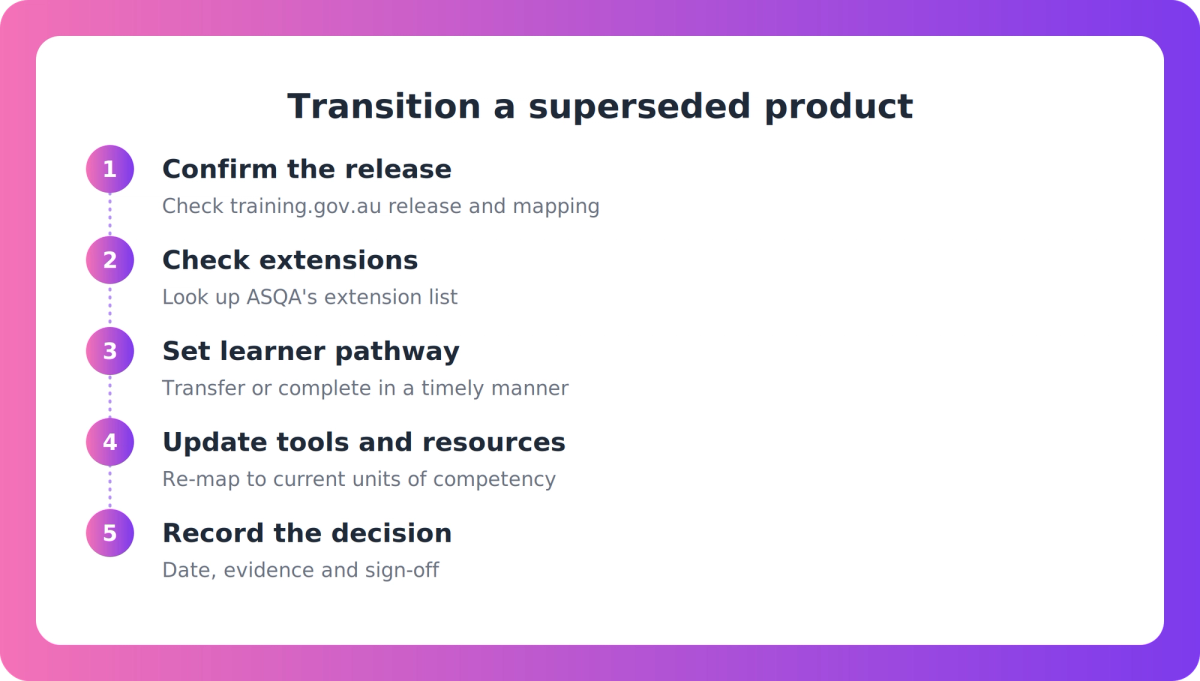
Use one repeatable process per superseded product, and keep the record.
- Confirm the release. Check the training.gov.au release and mapping for the replacement product. Register for update notifications there.
- Check extensions. Look the product up on ASQA's extension list.
- Decide the learner pathway. For each cohort, choose transfer or completion, and set a defensible "timely" end date.
- Update assessment and resources. Re-map assessments to the current units of competency, and refresh learner materials to match.
- Record it. Log the decision, the date, the evidence and who signed off.
An illustrative example
Imagine a qualification is replaced mid-year. A cohort of 20 learners is part-way through. Your policy says "stop enrolling after 12 months", but the ASQA list shows no extension, and your delivery schedule means two learners will finish well after that date.
The safer move is a documented pathway. Transfer those two, or set a dated completion plan with the reasoning recorded. The policy line alone won't carry you through an audit conversation.
What about the audit angle?
Regulator attention is current. ASQA released Version 2 of its Practice Guides on 29 October 2026, with more examples, case studies, FAQs and AI use in VET. ASQA IQ for October 2026 covers the Regulatory Risk Priorities for 2026-27.
Neither source showed currency-specific content in our research, so read them directly. You'll also see vendor claims that auditors check the unit of competency version against assessment tools and resources. That's plausible, but we couldn't verify it as an ASQA statement. Treat it as a prompt to check your own alignment, not a rule.
Our take
The "reset" story is tidy, and tidy is why it's risky. A fixed 12-month rule is easy to put in a policy, but it can be wrong in both directions: too short where an extension exists, too loose where learners are drifting. We think the stronger position is a per-product decision trail that shows you read the release, checked the mapping and set a timely pathway on purpose. Currency is a habit you can evidence, not a date you can diarise.
FAQ
Does a JSC training package update require a scope application?
Not for equivalent products. ASQA states it automatically updates an RTO's scope when new equivalent training package products are released. Check the release and mapping on training.gov.au to confirm a product is equivalent.
Is there still a 12-month limit to stop enrolling in a superseded product?
Sources conflict. Some provider policies and ASQA's legacy page show a 12-month example. ASQA's 2025 Standards FAQs and the WA Government fact sheet describe a "timely manner" with no single timeframe. Confirm against Compliance Requirement 14.
Where do I check for transition extensions?
ASQA publishes a list of training products with current transition extensions. Check it for each superseded product before applying any standard timeline, because extensions are product-specific.
How can I get early warning of upcoming changes?
Register for training package update notifications on training.gov.au. DEWR's Training Package Assurance Project Outcomes page also lists JSC submissions by status, which shows what's in the pipeline.
Next step
Pick one qualification on your scope that's changed in the last year. Check its release, mapping and extension status, then see whether your records show a dated, product-specific transition decision. If they don't, that's your starting gap. For more on keeping content current, our earlier piece on training package currency and audit risk is a useful companion.