Role-Play Training Australia: Closing the Practice Gap
Australian managers are already rehearsing hard conversations, just not with a coach. Survey data suggests many are turning to public AI tools, while formal role-play training in Australia is still mostly a workshop. The practice gap has shifted from "no rehearsal" to unguided, unstructured rehearsal, and that's what training design now has to address.
Key takeaways
- A recent survey found 53% of AI-using managers have used AI for at least one sensitive management task. Rehearsal is happening, but informally.
- 75% of the Australian workforce report no formal workplace AI training, so most improvised practice is unguided.
- Formal provision is often a half-day event. One session rarely allows repeated, coached rehearsal.
- Good practice design is private, contextual, repeated and coached, with clear rules on what learner data goes where.
- The evidence is mostly vendor-sourced and manager-focused. There is no Australian data on students or VET learners, so treat the picture as directional.
What does the Australian evidence actually show?
It shows managers are improvising. A DLPA/Pureprofile survey of 1,008 Australian business leaders and workers found that 53% of managers who use AI have used it for at least one sensitive task. Those tasks include difficult feedback, performance reviews, conflict and complaints. The same survey found 12% of respondents cited avoiding difficult conversations as a reason for using AI at work, and that 75% of the workforce had received no formal AI training. The findings were also covered by HR Leader.
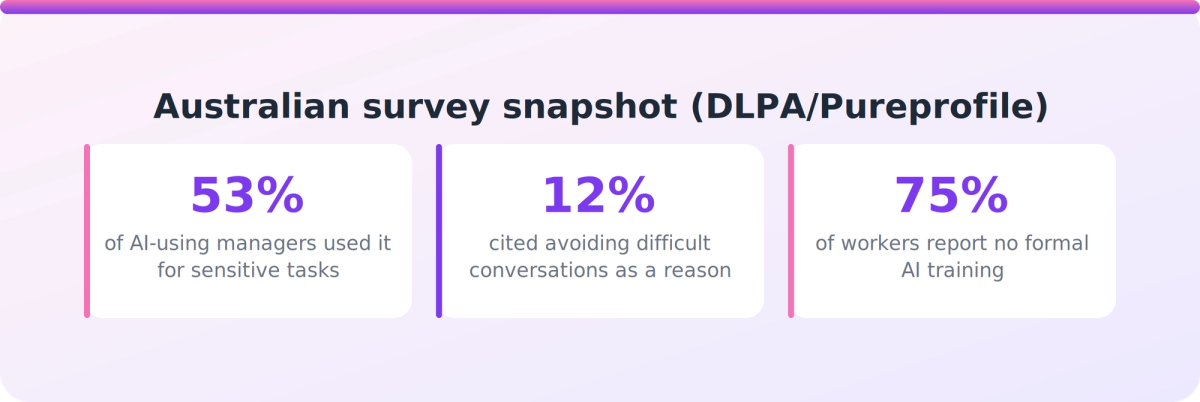
Two caveats matter. The AI-using manager subsample is 365 people. And DLPA is a leadership-training provider with a commercial interest in the topic.
The older baseline is similar. An Allianz/YouGov study (fieldwork December 2021) found 82% of employees hadn't been trained in how to conduct crucial conversations. That's dated, but it suggests the training gap isn't new.
Why is formal provision still workshop-shaped?
Because events are easy to sell and schedule, and live practice is hard to scale. Take IPAA Victoria's "Making Difficult Conversations Work". It's a half-day course, 9:30 am to 1:00 pm on Thursday 5 November 2026. That's a reasonable introduction. It isn't a rehearsal schedule.
Some providers do name the real problem. The Experience Lab in Perth says "They're difficult because no one has practised them". It uses actor-facilitators, with executive cohorts in small groups or one-to-one, so practising carries less visibility cost. iHR Australia runs a "Workplace Reality Theatre" format in virtual workshops. Both are vendor claims, but the instinct is sound: practice beats information.
The Fair Work Ombudsman offers a free employee course on difficult conversations with interactive scenarios. It's the authoritative government baseline, though the page isn't recent.
The common limit is frequency. Actors and facilitators are expensive. One session, however good, doesn't give anyone ten attempts at the same conversation.
What's risky about improvised AI rehearsal?
Three things: privacy, quality and consistency.
- Privacy. US data isn't Australian data, but it's a warning. The Predictive Index's AI and People Leadership Report (18 August 2026, US sample, from a vendor that sells a competing coaching product) found 44% of managers admit entering employee names or performance details into public AI tools.
- Quality. A general chatbot has no view of your policies, your award or enterprise agreement context, or your organisation's expectations. It can sound confident and still coach badly.
- Consistency. Without a design behind it, each manager practises something different, with no shared standard for what "good" looks like.
The same US report found 42% of managers know what they want to say but struggle with how to say it. Rehearsal is the obvious remedy. Unguided rehearsal just moves the risk somewhere less visible.
What should well-designed, coached practice look like?
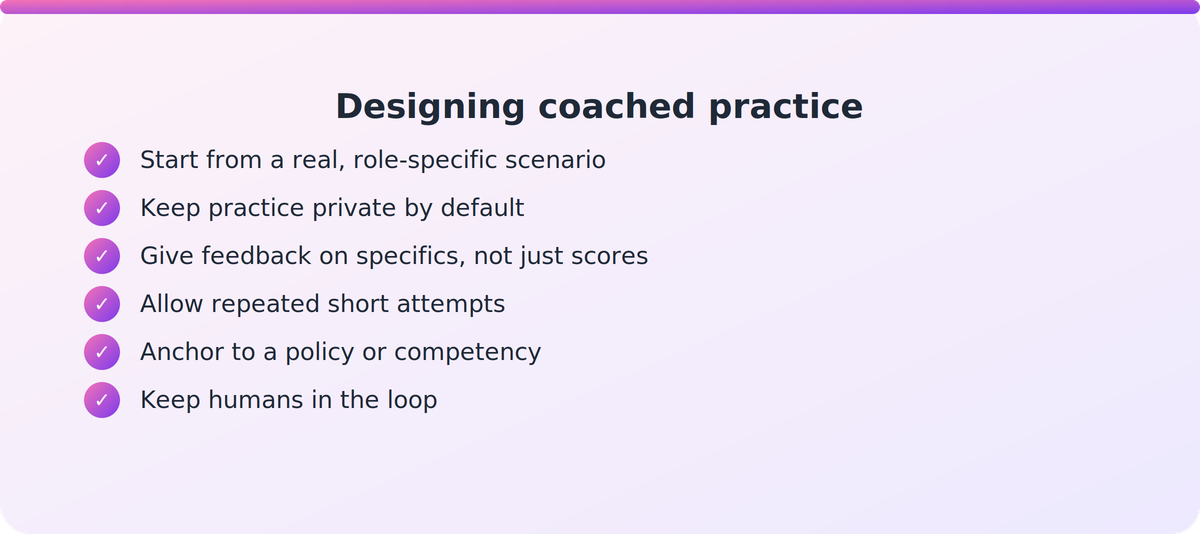
It should work like a good sparring partner: realistic, repeatable and private. Here's a practical checklist for any Australian workplace or training organisation:
- Start from a real scenario. Base it on the learner's actual role, industry and the conversations they face, not a generic script.
- Make it private by default. Learners should be able to fail safely, without an audience, and without real employee details leaving your environment.
- Give feedback on specifics. Coaching should point to what was said, such as tone, clarity and whether the issue was named, not only a score.
- Allow repetition. Three short attempts in a week beat one long session in a quarter.
- Anchor it to a standard. Link the scenario to the policy, procedure or competency it supports.
- Keep humans in the loop. Use practice data to inform facilitator and manager conversations, not replace them.
An illustrative example
Imagine a team leader preparing to give a underperforming team member feedback. Instead of a half-day course, they get a ten-minute simulated conversation that reflects their workplace, then coaching on how they opened and whether they stayed on the issue. They try it again with a more defensive "employee". By the real conversation, it's their fourth attempt, not their first. This is a hypothetical, but it's the shape of the design.
What does this mean for RTOs and training organisations?
It means role-play shouldn't be limited to what an actor budget or a timetable can support. Many units of competency in training packages across the Australian Qualifications Framework (AQF) involve communicating, handling conflict, giving feedback or serving difficult customers. Learners need to demonstrate these in realistic conditions.
Any practice design still has to sit comfortably within the Standards for RTOs 2025 and ASQA's expectations. Practice is not assessment, and your assessment evidence rules don't change because the practice partner is AI. The sensible approach is to use rehearsal to build skill, then assess against the unit requirements through your normal validated methods. Check specifics with your compliance lead and the current ASQA guidance.
What don't we know yet?
Quite a lot. The research found no peer-reviewed or government evidence from the last 90 days measuring how often Australian learners rehearse hard conversations. There's also no Australian data on students or VET learners as distinct from managers. The practice-gap claim rests on indirect evidence, mostly vendor-led surveys, plus a US comparison. We think the direction is credible. The size is uncertain.
Our take
The interesting shift isn't that managers use AI. It's that they've shown what they want: a private place to try, fail and try again. Training organisations that keep treating rehearsal as an event will be competing with a free chatbot that has no guardrails. The better answer is not to ban improvised practice. It's to provide a structured, coached version that's more useful, safer and grounded in the learner's actual job.
FAQ
How common is AI-assisted rehearsal of difficult conversations among Australian managers?
One recent DLPA/Pureprofile survey found 53% of AI-using managers had used AI for at least one sensitive management task, such as feedback, reviews, conflict or complaints. The AI-using subsample was 365 people, and DLPA sells leadership training, so read it as indicative rather than definitive.
Is a half-day workshop enough for role-play training in Australia?
It can introduce frameworks and build confidence, but it rarely allows repeated, coached rehearsal. Practice that sticks usually needs multiple short attempts over time, with feedback on specifics. Workshops work best as a starting point, not the whole programme.
What are the risks of using public AI tools to practise workplace conversations?
The main risks are privacy, coaching quality and inconsistency. US data from the Predictive Index found 44% of managers admit entering employee names or performance details into public AI tools. That is not Australian data, but it shows why clear rules matter.
Is there free Australian guidance on difficult conversations?
Yes. The Fair Work Ombudsman offers free employee and manager courses on difficult conversations, including interactive scenarios, plus a downloadable manager's guide.
Next step
Pick one conversation your learners or managers dread, such as feedback, a complaint or a performance concern. Ask how many times they've realistically practised it before the real thing. If the answer is "once, in a workshop", that's your gap, and a good place to start designing.