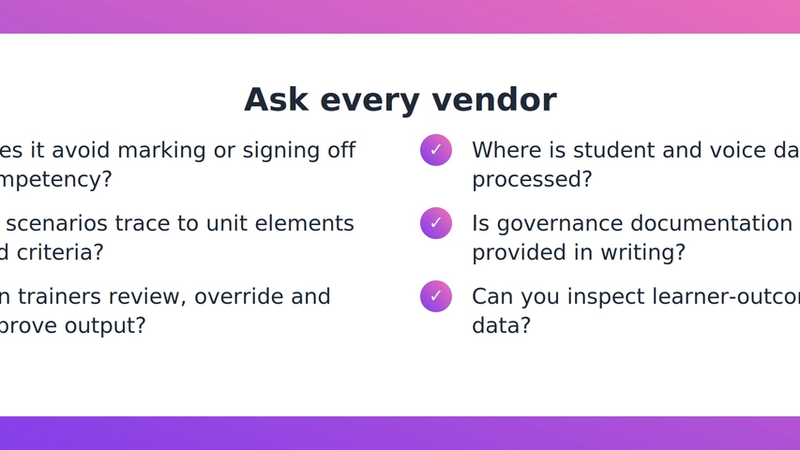
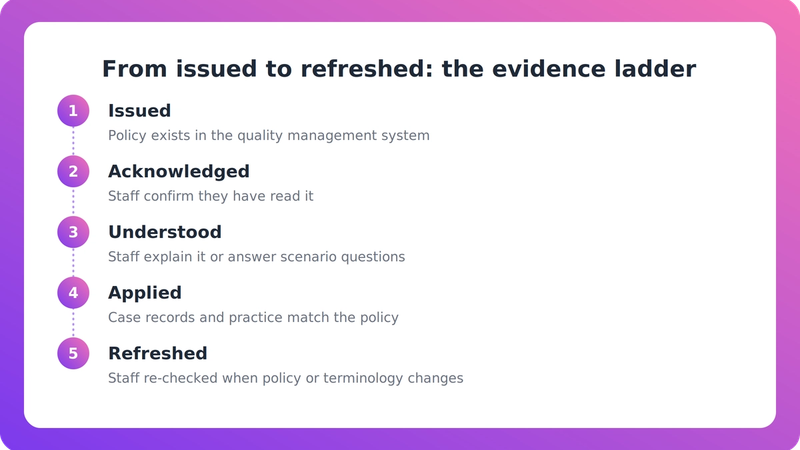
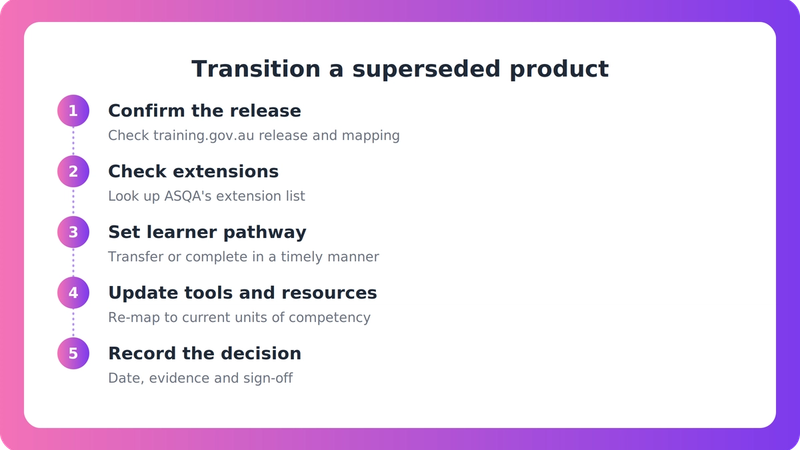
If every assessment tool, TAS and learner guide waits for your sign-off, you aren't running self-assurance. You're running inspection, and you're a single point of failure. Under the 2025 Standards, the stronger design builds quality in upstream, so you assure the system rather than read every page.
Key takeaways
- A review queue that only you clear is a risk in itself. When you are away, overloaded or wrong, nothing else catches the problem.
- ASQA's outcomes-based approach gives providers flexibility in how they show compliance. That puts the burden of proof on your own systems.
- Three design choices move quality upstream: named ownership per document type, evidence that is traceable as it is created, and early-warning signals.
- Your role shifts from reading everything to testing that the system works, and still reading the high-risk items yourself.
- No official data was found on how common the review bottleneck is. Treat this as practitioner reasoning, not a sector statistic.
Why this lands on your desk
The 2025 Standards for RTOs have been in full effect since 1 July 2025. They have three elements: the Outcome Standards, the Compliance Standards (including the Fit and Proper Person Requirements and the NRT Logo Conditions of Use Policy), and the Credential Policy, per DEWR. ASQA says its approach has shifted to match the outcomes focus, with more flexibility for providers and more regulatory engagement.
Flexibility has a cost. When the regulator doesn't prescribe how you show compliance, you have to design and defend the method. ASQA's information webinar urged providers to focus on systems for self-assurance and continuous improvement.
Then there is the Annual Declaration on Compliance. As described on the ASQAcast, it confirms the provider currently meets the Standards and complied for all certifications issued in the last 12 months. You are the person who has to be confident enough to stand behind that.
Why the last-checkpoint model breaks
Here is my reasoning, not an ASQA statement. A declaration covering a full year of issued certifications is hard to support if your assurance is a sample of documents reviewed at the end. Reading what reached your desk tells you about those documents. It tells you little about the ones that never did.
The model also fails in ordinary ways:
- Volume. Reformed qualifications were anticipated for delivery from 2026, following a purpose-based approach agreed by Skills Ministers on 6 December 2024. Each change sends TAS, assessment tools and training products back into the queue.
- Late discovery. A gap found at sign-off means rework. A gap found at drafting means a conversation.
- Fragility. Leave, illness or a rectification scramble stalls everything, and the queue grows.
Legacy documents add exposure. ASQA has said activities spanning 1 July 2025 are decided against the 2025 Standards, with no overlap in its scheme. A document still built around the old Standards is a live issue, not a transition item.
The wider context matters too. ASQA's 2025-26 risk priorities listed non-genuine providers and bad-faith operators first, including fraudulent issuance of qualifications. DEWR reports $4.8 million for ASQA's qualification-fraud enforcement in 2026-27, after $4.7 million in 2025-26. It also says ASQA has cancelled qualifications issued without appropriate training or assessment. That says nothing about your RTO specifically. It does show why document-level assurance is under scrutiny.
Three design moves that put quality upstream
ASQA hasn't been found to prescribe any document-management tool or review workflow. How you build this is your call.
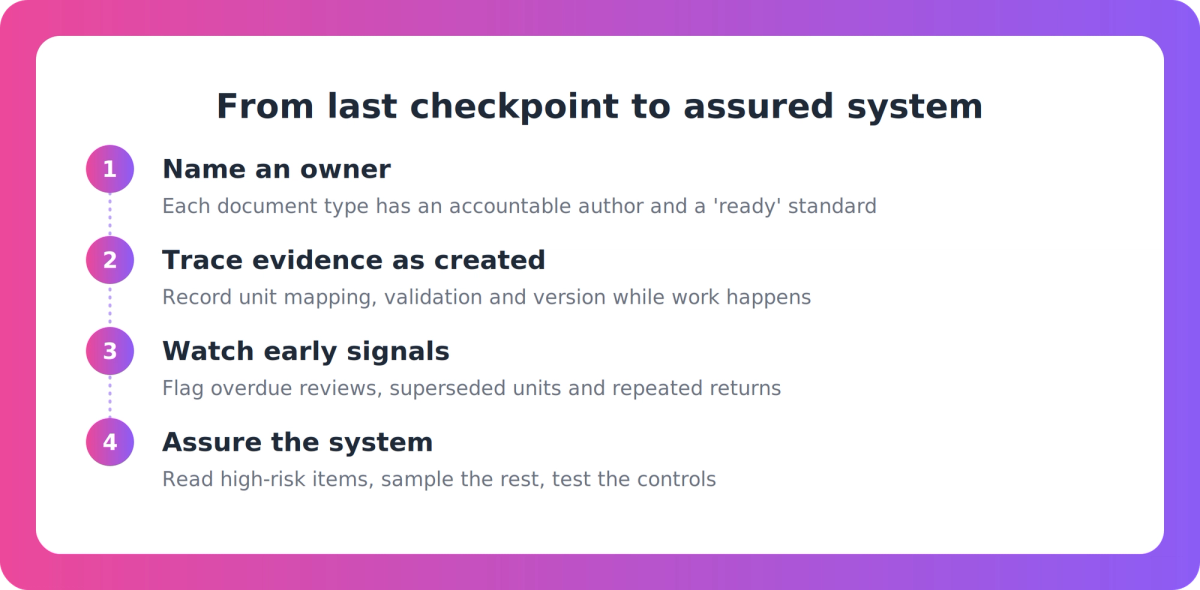
Name an owner for every document type
Every TAS, assessment tool, learner guide and policy needs a named owner and a written definition of "ready for review". That definition might be: mapped to the unit of competency, written for the learner cohort, checked against the current training package release.
Owners are accountable for meeting it before anything reaches you. Your review stops being the first quality check and becomes the second.
Make evidence traceable as it is created
Evidence reconstructed before an audit is evidence you can't fully trust. Build the trail while the work happens: who authored the tool, which unit it maps to, who validated it, when it was last reviewed.
If you can't answer "which certifications relied on this version?" in minutes, the declaration is resting on memory. Evidence scattered across drives, inboxes and spreadsheets is mostly a design problem, not a discipline problem.
Build early-warning signals
Choose a few signals that tell you something is drifting before an auditor does:
- Documents past their review date.
- Assessment tools linked to a superseded unit or training product.
- Document types with no named owner.
- Items returned repeatedly from your review for the same reason.
The fourth is the most useful. A repeated failure is a system fault, so fix the upstream standard instead of fixing each document.
An illustrative example
Take a hypothetical RTO whose compliance manager reads every assessment tool before release. A unit is superseded and the updated tools arrive in a batch of forty. Under the checkpoint model, they queue, and delivery either waits or goes ahead unreviewed.
Under the system model, authors check their own tools against the "ready" definition. Mapping is recorded as they work, and the early-warning list flags tools tied to the old unit. The compliance manager reads the flagged and high-risk items in full, samples the rest, and checks the sampling results for patterns. This is an invented scenario, not a measured outcome.
What you still read yourself
Assuring a system doesn't mean never opening a document. Read in full the items where the cost of error is highest: new qualifications, high-risk units, anything touching recognition of prior learning, and material produced under new processes. ASQA has also published Principles for the Responsible Use of AI in VET, and its 2026 sector workshops asked whether an RTO's AI use complies with the 2025 Standards. If AI touches your drafting, review those items with extra care. Check ASQA's latest news directly for the 2026-27 risk priority wording and the AI principles, as I haven't verified their text here.
Our take
The compliance manager who clears every document is often admired for diligence and quietly exposed by it. Diligence at the end of the line is not the same as assurance. The more defensible position, to the regulator and to your CEO, is that quality is the job of whoever creates the document and your job is to prove the system holds.
That is a harder job than reading, and a more senior one. It means writing standards others can meet, tolerating documents you haven't personally seen, and trusting signals over instinct. We think that trade is worth making.
FAQ
Does ASQA require a particular document review workflow?
No prescribed workflow or tool has been found. The 2025 Standards are outcomes-based, and ASQA says providers have flexibility in how they demonstrate compliance, so the design is your decision.
How does the Annual Declaration on Compliance relate to document review?
The declaration confirms the provider currently meets the Standards and complied for all certifications issued in the last 12 months. My reasoning is that an end-of-line sample of documents is unlikely to support a full year of certifications on its own.
Should a compliance manager stop reviewing documents?
No. Stop being the only reviewer. Keep full review for high-risk items and use sampling and signals for the rest.
Is the review bottleneck a proven sector-wide problem?
No official data was found on how much time compliance managers spend on review or how common the bottleneck is. The argument here is practitioner reasoning based on ASQA's self-assurance expectation.
Your next step
This week, pick one document type, such as assessment tools. Write down who owns it, what "ready for review" means, and how you would know it had drifted. If you can't answer all three, you have found the first thing to fix.