Most RTOs learn about a compliance gap when an auditor points to it. That is a visibility and ownership problem, not a diligence problem. Under the 2025 Standards, where ASQA looks at outcomes rather than document sets, RTO compliance risk early warning means seeing your own drift before the regulator does.
Key takeaways
- ASQA selects performance assessments using provider risk indicators. If you can't see your own indicators, you are relying on the audit to show you.
- ASQA's figures show non-compliance is common in these assessments: 78% in 2024–25 and 39% from July 2025 to March 2026. The two figures are not directly comparable, so don't read a trend into them.
- Early warning needs three things: a defined set of signals, a named owner for each, and a regular review cadence.
- ASQA's stated priorities are a ready-made list of what to self-check. Start there rather than with a blank page.
- You can't disclose what you haven't detected. That applies to the Annual Declaration on Compliance, to fit and proper person expectations and to data reporting.
Why this lands on your desk
The 2025 Standards have applied in full since 1 July 2025, with no overlap period. ASQA's homepage says it is the provider's responsibility to be informed of changes. In practice, that responsibility is yours.
The guidance is still moving. ASQA has released a second version of its Practice Guides. Secondary reporting from Skills Education says they are supplementary and not intended to carry legal or compliance obligations, and that the FAQs reached Version 3 on 1 October 2025. Treat those secondary claims as indicative. Either way, you are the one deciding what needs action and what is background reading, often with no clear signal.
Meanwhile the obligations pile up. ASQA lists an amended Data Provision Requirements Instrument 2020 among its recent legislative changes. It also released a Statement of Regulatory Expectations on Fit and Proper Person Requirements and notification of material changes on 7 May 2026, and the Annual Declaration on Compliance link went to RTO CEOs on 3 March 2026. Each of these asks you to know your position and be able to state it.
What ASQA's numbers tell you, and what they don't
In 2024–25, ASQA conducted 284 performance assessments selected on provider risk indicators. According to the ASQA Annual Report 2024–25, 221 (78%) found non-compliance. Of those 221, 102 (46%) satisfied ASQA they had returned to compliance.
From July 2025 to March 2026, ASQA's regulation reporting shows 116 completed performance assessments, with 45 (39%) finding non-compliance. One commentator says the two figures aren't directly comparable. We found no official explanation for the gap, so we won't offer one.
What the numbers do support is modest but useful. When ASQA selects a provider on risk indicators, it often finds something. The sources describe what ASQA is finding and prioritising. They don't explain why individual RTOs fail. So the practical question is not "are we diligent?" but "what does ASQA see that we can't?"
Use ASQA's stated priorities as your self-check list
An early-warning system doesn't need to be elaborate. It needs a defined set of questions you ask yourself on a schedule. ASQA's Corporate Plan 2026–27 says embedding the 2025 Standards remains its most significant regulatory priority. Commentary from eSkills Australia (secondary) lists the 2026–27 risk priorities as:
- provider governance, market conduct and non-genuine operations
- quality and fitness-for-purpose of delivery
- integrity of qualifications and competency outcomes
- transparency and assurance in complex and international delivery
ASQA's 2025–26 risk priorities named phoenix activity and high-volume, low-quality RPL assessment models as integrity concerns. Third-party notes from a March 2026 ASQA update say ASQA flagged non-compliant AI use as an emerging issue. That one is secondary-sourced, so use it as a prompt, not a rule.
An illustrative monthly review
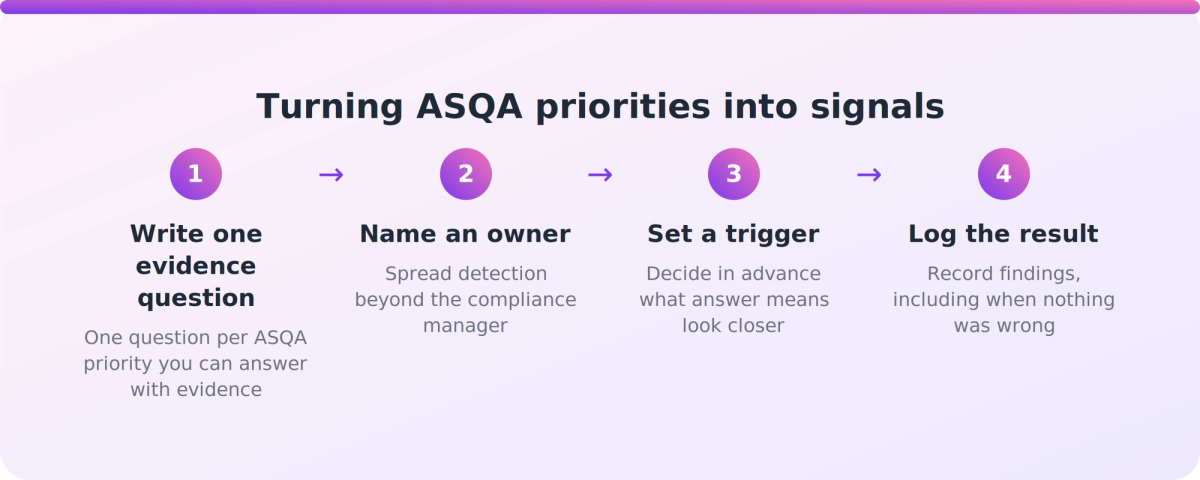
Here is a hypothetical example of turning those priorities into signals. It is illustrative only, not a prescribed method.
- For each priority, write one question you could answer with evidence. For example: "Can we show how RPL decisions were made for the last ten completions?"
- Name one owner per question. It shouldn't be you for all of them.
- Set a trigger: what answer means "look closer"? Decide before you look, so you can't talk yourself out of it.
- Log what you found, even when nothing was wrong. That log is your own record of monitoring.
Early warning is an ownership problem
Gaps rarely survive because nobody cares. They survive because nobody can see them. Evidence sits in drives, inboxes and spreadsheets, and every document review routes through you, so you become the bottleneck as well as the only detector.
Outcome-focused regulation makes this worse. ASQA says the 2025 Standards focus on the quality of outcomes for students and employers, and that there will be more regulatory engagement. A checklist of documents is a weaker answer to that than evidence of what happens in delivery and assessment.
The fix is to distribute detection. Trainers, assessors, student support and finance staff see drift first. Give them a simple way to say "this looks off" and a clear place for it to land. Your job shifts from finding everything to triaging what arrives.
Our take
The annual audit-readiness push is the wrong unit of effort. A scramble before an audit shows diligence, but it can't give you early warning, because by then the signal is already late. We think the better measure of a compliance function is how often it finds a gap before anyone external does, and how quickly it can say so.
That also changes how you talk to your CEO and board. "We found it, we've rectified it, and here's the record" is a stronger position than "we had no findings". The Annual Declaration on Compliance, which commentary suggests lets RTOs disclose non-compliance alongside rectification steps (secondary), rewards exactly that habit.
FAQ
What is RTO compliance risk early warning?
It is an internal view of where your RTO is drifting against the 2025 Standards and ASQA's stated priorities, available before a regulator or auditor raises it. It combines defined signals, named owners and a regular review rhythm.
Do ASQA's non-compliance rates show audits are getting easier?
Not necessarily. ASQA found non-compliance in 78% of 284 performance assessments in 2024–25 and 39% of 116 from July 2025 to March 2026. One commentator says the figures aren't directly comparable, and no official explanation was found, so avoid drawing a trend.
Are the Practice Guides compulsory?
ASQA's homepage says providers are responsible for staying informed of changes. Secondary reporting says the Practice Guides are supplementary and not intended to carry legal or compliance obligations. Check ASQA directly for the current position before deciding how to treat any guide.
Where should I start if I have no monitoring in place?
Pick one ASQA priority, such as RPL integrity or the quality of delivery. Write one evidence question, name an owner, and review it monthly. Expand once that rhythm holds.
Next step
This week, choose one ASQA priority from the list above and write the single question you would least want an auditor to ask first. Then check whether anyone besides you could answer it with evidence today.