Most RTO CEOs can tell you what a student costs to enrol or to deliver. Almost none can tell you what it costs to get one learner assessed as competent. That second number matches how the Standards for RTOs 2025 judge you, and nobody publishes a benchmark for it.
Why this lands on your desk
You own the P&L, and you answer to the board and ASQA for outcomes, not activity. The Standards for RTOs 2025 commenced on 1 July 2025. ASQA-regulated RTOs are assessed against the Outcome Standards Instrument 2025 and the Compliance Standards and Fit and Proper Person Requirements Instrument 2025. DEWR notes the policy documents themselves don't impose legal obligations, but the instruments do the regulating.
So the question changes. "How many students did we enrol, and what did each cost?" is a volume question. "What did it cost to get a learner to demonstrated competency against the units of competency, with evidence we can defend?" is the one your regulator is effectively asking.
Here is the uncomfortable part. Our research found no authoritative public data on average RTO operating margins, compliance cost per RTO, provider-level trainer attrition or cost per competent student. If you want the number, you build it from your own data. If you don't, you go without.
Why the pressure on unit economics is rising
Three things are moving at once.
The mix is shifting. NCVER reports more than 5.1 million students in nationally recognised VET in 2025. Participation is high, but students in qualifications fell by 108,360 while short courses and stand-alone subjects rose. One analyst reading (Claire Field & Associates, not NCVER) is that government-funded student numbers are declining. Shorter products change the maths of every fixed cost you carry.
The trainer base is thinning. The Jobs and Skills Australia VET Workforce Study (October 2024) describes an older, ageing and highly casualised workforce. A VDC summary of it quotes VET teacher numbers shrinking by between 11% and 18% over the last decade, despite high and growing demand. That is a margin issue and a key-person risk at the same time.
Currency is getting dearer. Industry Skills Australia notes that digital transformation and rapid technological change are increasing the time and cost for trainers and assessors to maintain vocational currency. You rarely see that line in a budget, but it sits inside every delivery hour.
Policy is moving too. ATEC legislation has passed Parliament, and the government says ATEC will allocate funding under the new Managed Growth Funding system and implement needs-based funding. Treat the detail as context and check it against primary sources. The direction is clear enough: funding will lean harder on what you can show, not what you can enrol.
Where the cost of competency actually sits
Cost per enrolment hides most of what matters. A learner who passes first time and a learner who needs three attempts, a supervisor call and a rebuilt evidence file cost very different amounts. They look identical in an enrolment report.
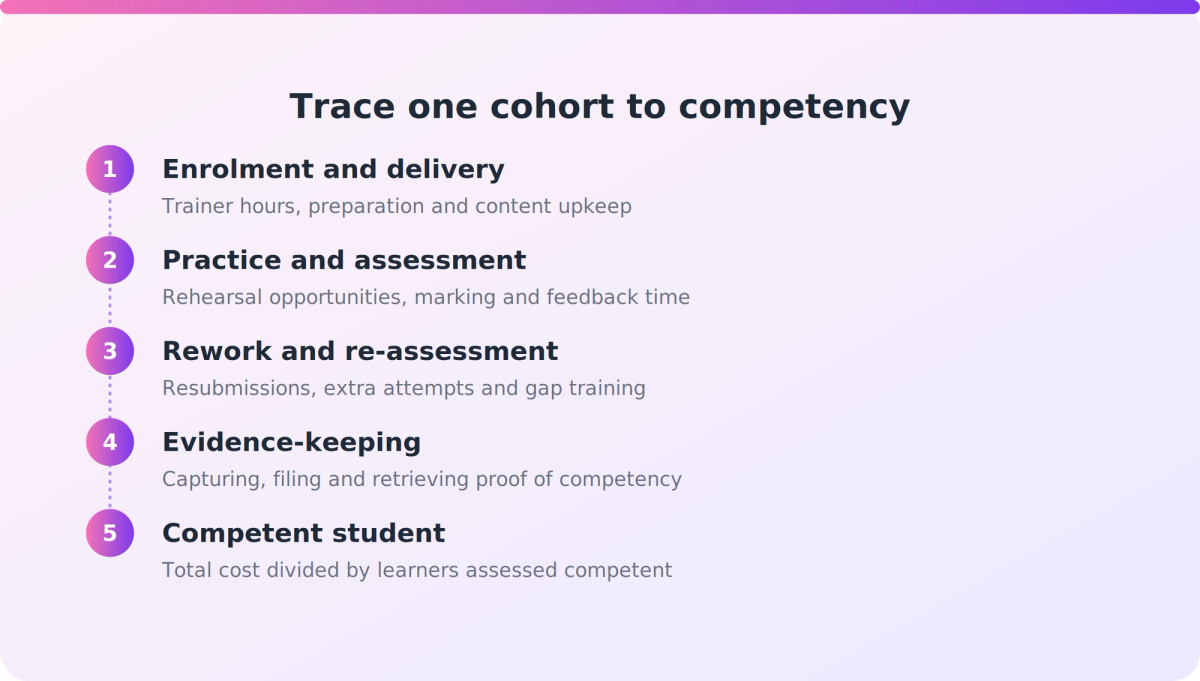
The components worth tracing are these:
- Trainer and assessor time: contact hours, but also preparation, marking, feedback and moderation.
- Rework and re-assessment: resubmissions, second and third attempts, gap training.
- Content upkeep: how often resources are rebuilt and who is paid to do it.
- Practice opportunities: how many chances a learner gets to rehearse before the assessed event, and what each costs.
- Evidence and compliance: capturing, filing and retrieving what proves competency.
That last item is no side cost. Secondary sources describe the 2026 Annual Declaration on Compliance as the first to require a full year of compliance against the 2025 Standards, with ASQA saying self-monitoring evidence should underpin it. Evidence is part of what a competent student costs you, whether or not it appears on a line in the ledger.
Start with one qualification
Don't try to model the whole business. Pick one qualification with real volume and trace a cohort end to end: enrolment, delivery, assessment, rework, evidence, completion. Use timesheets, LMS data, assessment records and payroll. The first version will be rough. It will still show you something your enrolment report never has.
Where you have room to move
Cost per competent student is where a CEO can act without weakening compliance, because the levers are about doing the same job with fewer wasted loops. Fewer re-assessments, better-timed practice, evidence captured as work happens, content that is cheaper to keep current.
What you should not do is chase the number by cutting assessment rigour. The Standards judge outcomes and the integrity behind them. ASQA's published AI case studies include one on assessment integrity, where an RTO combined written and verbal evidence to maintain integrity while supporting responsible AI use. Read that as a regulator-side signal that technology is workable where assessment validity holds. It is not a cost-saving claim, and the evidence on your unit costs has to come from your own numbers.
Key takeaways
- Cost per enrolment measures volume. Cost per competent student measures what the Standards for RTOs 2025 hold you to.
- No public benchmark exists for it, so you must define and measure it from internal data.
- Trace cost through delivery, assessment, rework, content upkeep, practice and evidence, one qualification at a time.
- Shrinking, casualised trainer capacity and rising currency costs make this a margin and key-person question.
- Reduce cost by removing waste in the path to competency, never by thinning assessment validity.
Our take
The sector has spent years optimising what is easy to count. Enrolments, hours, completions. Those numbers feel safe because everyone reports them the same way.
We think the CEOs who steer best through the next few years will be the ones who can say, with a straight face, what it costs them to produce one competent learner, and where that cost leaks. Not because the number is a target, but because it exposes the decisions you actually control. It will be imperfect and contestable. That is fine. A rough internal number beats a polished benchmark that doesn't exist.
And be careful about promised savings from anyone, including us. Margins differ by provider, and your data is the only evidence that counts.
A first step for this quarter: ask your finance lead and your head of training to trace one cohort together, and bring the result to your next board pack.
FAQ
What is cost per competent student?
It is the total cost of getting one learner assessed as competent against the relevant units of competency. It includes delivery, assessment, rework, re-assessment, content upkeep, practice and evidence-keeping, not just enrolment or delivery cost.
Is there an industry benchmark for RTO cost per student?
Our research found no authoritative public benchmark for cost per competent student, average RTO operating margins or compliance cost per RTO. You need to define and measure the metric from your own data.
Does the Standards for RTOs 2025 require me to report this?
No source in our research says so. The Standards commenced on 1 July 2025 and are outcome-focused, which makes the metric relevant to how you weigh cost against demonstrated competency and evidence. It is a management choice, not a regulatory requirement.
Can technology lower the cost without risking compliance?
ASQA's AI case studies suggest technology use is acceptable where assessment integrity holds, for example by combining written and verbal evidence. They don't claim cost savings. Test any change against your own unit costs and your assessment validity.