The RTO Manager's Compliance Workload: Which Hours Actually Protect Completions?
Nobody has published which compliance hours protect completions, so you are triaging on judgement, not proof. The best-supported judgement points one way: spend scarce hours on evidence that planned training and assessment actually happened, and fewer on documents that exist to look compliant. Treat that as a hypothesis to test, not a rule.
Key takeaways
- There is no authoritative public data on how many hours RTOs spend on compliance, or on which compliance activities lift completions. Any prioritisation is a judgement.
- Secondary reporting on ASQA's focus points to governance, delivery quality, and proof that planned hours match what students received.
- The 2025 Standards make the RTO fully responsible for third-party arrangements, so partner oversight belongs on your desk.
- NCVER's completion rate lags by four years, so track subject-level progress as an earlier internal signal.
- Check this reading against ASQA's Practice Guides and your own data before you reallocate anyone's week.
Why this lands on your desk
You sign the Annual Declaration on Compliance. That makes you accountable for how thinly effort is spread across the four quality areas of the Outcome Standards: training and assessment, VET student support, VET workforce, and governance. ASQA says the revised Standards came into full regulatory effect on 1 July 2025.
You also answer for completions, and the official number is slow. NCVER reports that 48.9% of 2021 commencements were completed within four years, down from 49.5% for the 2020 cohort. Whatever you trade off today won't show in that figure for years.
Then there is the workforce. Jobs and Skills Australia has described VET teachers as in national shortage. The brief's JSA findings are from October 2024, and I found no 2026 update. It reports a workforce that is older, highly casualised and paid less than other education sectors. Industry Skills Australia also reports rising time and cost for trainers and assessors to maintain vocational currency. Every hour on paperwork is an hour not spent training, assessing or supporting students. That constraint is structural, not temporary.
What the sources do and don't tell you
They don't tell you which compliance activity protects completions. Proving that would take your own data or ASQA's published audit findings.
They do suggest where the regulator's attention sits. A vendor summary of ASQA's 2026–27 priorities lists governance, delivery quality, qualification integrity and complex delivery models, and says ASQA wants planned hours reconciled with what students actually received. I couldn't retrieve ASQA's Corporate Plan itself, so treat that as secondary.
One RTO's notes from an ASQA sector workshop on 11 March 2026 say the 2025 Standards make explicit that the RTO remains fully responsible, including for third-party arrangements. The same notes record ASQA cautioning against buying off-the-shelf policies and continuous improvement systems without tailoring them. Commentary that ASQA is running fewer, sharper audits is not an ASQA statement. I wouldn't plan around it.
Where to put the hours first
This is one reading of the sources, not a sourced claim. Effort goes first where a gap would show you didn't deliver what you said you would.
Delivery reconciliation
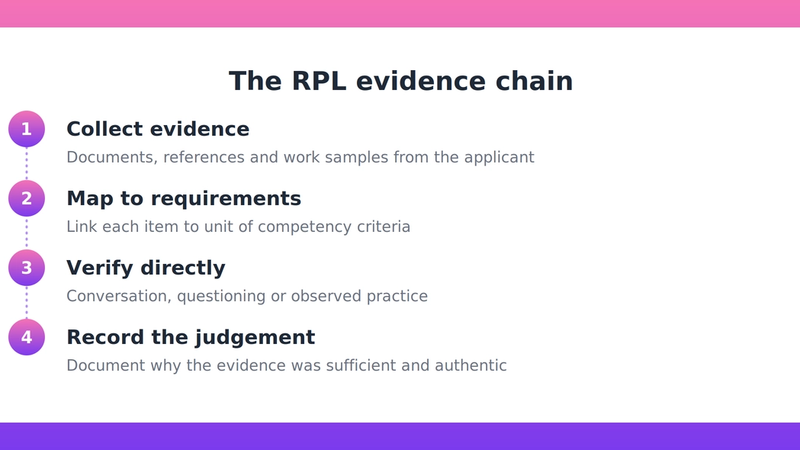
Compare planned hours and activities with what students received. Timetables, trainer rosters, session records and LMS activity should tell the same story. If they don't, you want to find out before an auditor does.
Assessment validity
Check that assessment tasks and evidence cover the unit of competency, and that decisions are consistent across assessors. This matters most with a casualised workforce, where practice drifts without anyone intending it.
Student support records
The VET student support quality area is one of four, and support is where completions are most plausibly won or lost. Record who was identified as needing support, what was offered, and what happened next.
Third-party arrangements
If partners deliver or assess for you, you own the outcome. Spot-check their delivery evidence the same way you check your own.
What to slow down or stop
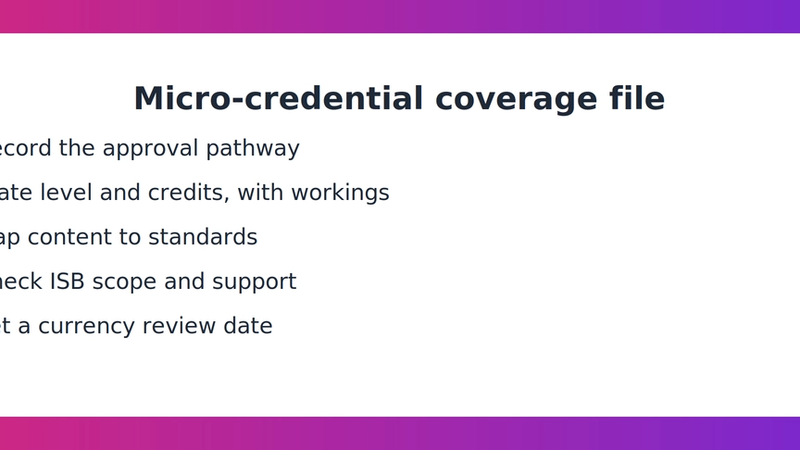
Be selective, not casual. Anything the Standards require still gets done. But a generic policy pack that nobody has tailored is the clearest candidate for less time. If ASQA has warned against untailored off-the-shelf documents, effort spent filing them doesn't protect you.
Watch for documents that nobody reads, registers that nobody reconciles, and meetings that produce minutes but no decisions.
A one-cohort test you can run this month
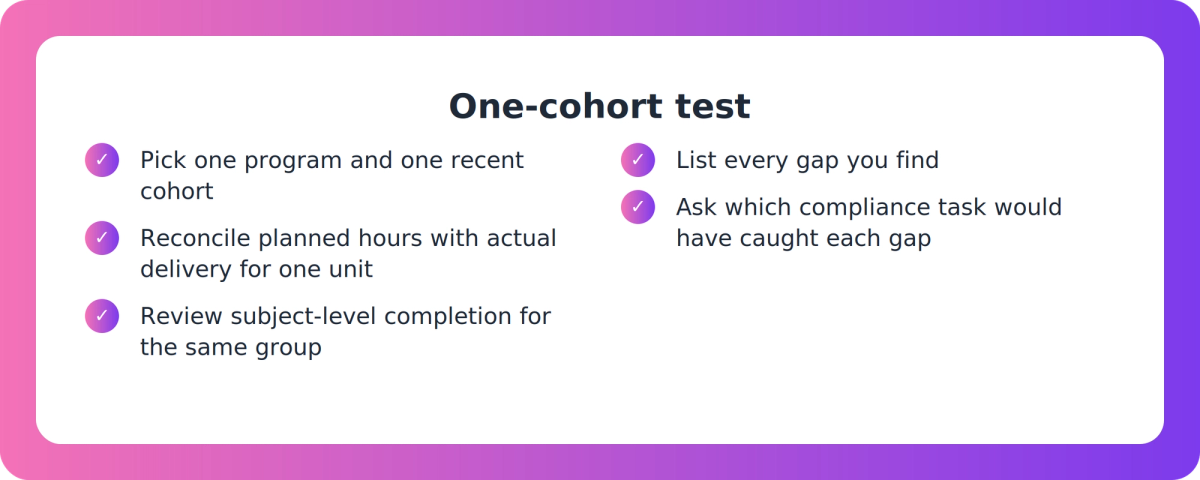
This example is illustrative, not a measured result. Pick one program and one recent cohort. Reconcile planned hours against actual delivery for a single unit. Then look at subject-level completion for the same group.
NCVER research from May 2024 suggests that students completing all enrolled subjects could be considered alongside program completions as an additional success measure. It doesn't replace program completion, but it gives you a signal in weeks rather than years.
If the units with the biggest delivery gaps also show the weakest subject completion, you have a local signal worth acting on. If they don't, your instinct was wrong for your RTO, and that is useful to know.
Our take
Compliance effort should be judged by what it proves about delivery, not by how much of it exists. We can't show that any compliance hour lifts completions, and neither can anyone else publicly. But a regulator that reportedly cares about whether planned training happened gives you a defensible way to rank your hours.
The discipline is to hold that ranking loosely. Read ASQA's Practice Guides, check the DEWR standards page for the current instruments, and let your own subject-level data overrule anyone's commentary, including this post.
FAQ
Is there data on how many hours RTOs spend on compliance?
No authoritative public figure was found. Any number you see quoted should be treated as an estimate until you can see its method.
Which compliance activities protect completions?
No public evidence shows this. A prioritisation towards delivery reconciliation, assessment validity and student support records is a reasoned reading of ASQA's reported emphasis. Test it against ASQA's Practice Guides and your own data.
Does the RTO remain responsible when a third party delivers?
Notes from an ASQA sector workshop on 11 March 2026 say yes. The 2025 Standards make explicit that the RTO remains fully responsible, including for third-party arrangements.
Why track subject-level completion?
NCVER's headline rate arrives about four years after commencement. NCVER research suggests all-subject completion could sit alongside program completion as a success measure, so it works as an earlier internal signal, not a replacement.
Your next step
This week, pick one unit in one program and reconcile its planned hours against what was delivered. Write down every gap, then ask which compliance task last month would have caught it.