Nobody publishes what a unit of competency costs an Australian RTO to deliver, or what margin each training product earns. If your board pack steers by a blended margin, it is an estimate, and the product mix is moving underneath it. The only reliable view of RTO profitability by qualification is one you build from your own data.
Key takeaways
- The research found no authoritative public data on RTO operating margin, cost per unit or cost per student by product. Any benchmark quoted at your board is an internal or vendor estimate.
- Qualification enrolments are falling while short courses and stand-alone subjects grow, so a blended margin can hide very different economics.
- Trainer supply, the 2025 Standards and assessment rework add cost to specific units, not evenly across the business.
- Cost each product on its real drivers: trainer time, assessment build, validation, rework and compliance exposure.
- AI can reduce back-office cost, but only inside existing obligations. It does not make assessment decisions.
Why this lands on your desk
You own the P&L and answer to the board for margin. You also decide where the next dollar of investment goes: more qualification capacity, more short courses, or more stand-alone units.
That decision is hard to make well on blended numbers. NCVER's Total VET students and courses 2025 reports more than 5.1 million students. Qualification students fell by 108,360, while short courses and stand-alone subjects grew.
The next point is my interpretation, not an NCVER finding. If your mix is shifting the same way, the average margin you reported last year may not describe the business you run this year.
What the evidence does and doesn't tell you
The gap is real, and it is worth saying plainly. The research found no public data on operating margin, cost per unit or cost per student by product. It also found no published measure of how the 2025 Standards changed compliance costs.
Funding-side factors, including state funding, fee-free TAFE and financial viability requirements, were not covered here. Check those against dewr.gov.au, asqa.gov.au and your state training authority before you finalise any model.
So be wary of any single number labelled "typical RTO margin". Build your own.
The cost drivers to price into every unit
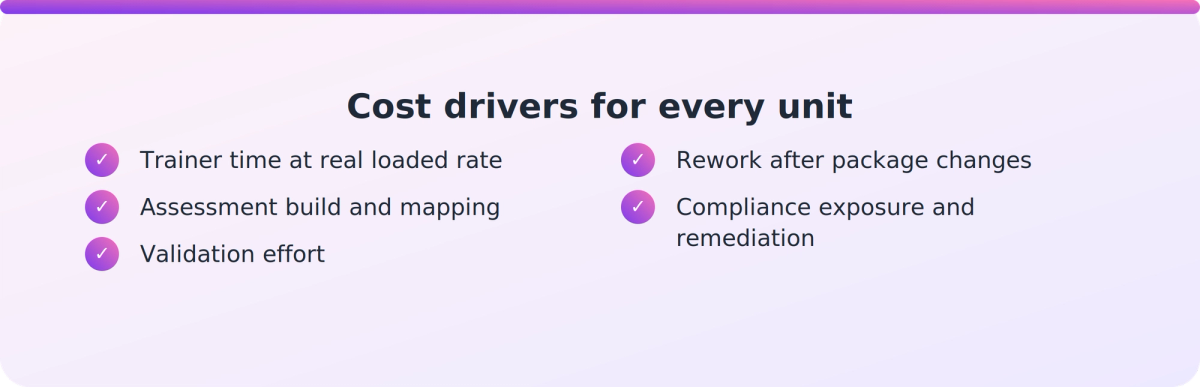
The expensive parts of a unit are rarely the delivery hours on the timetable. Start with these drivers, and cost each product against them:
- Trainer time. Delivery, marking, learner support and currency, at your real loaded rate, including casual and contract staff.
- Assessment build. Writing tools and assessor guides, and mapping them back to the unit.
- Validation. The time spent testing assessment before and after use.
- Rework. Updates when a training package changes or validation finds a gap.
- Compliance exposure. The cost of getting coverage or evidence wrong, including remediation and reputational damage.
None of these appears on a standard enrolment report. Most of them sit in salaries and are never attributed to a product.
Where the cost is hiding: assessment
The 2025 Standards for RTOs commenced on 1 July 2025. They replaced the 2015 Standards and comprise the Outcome Standards and the Compliance Requirements, plus a Credential Policy (ASQA webinar transcript).
RTOs use a self-assurance model to show how they meet the Outcome Standards in their own context. ASQA says providers should demonstrate systems for all aspects. That means more evidence work, and it lands on specific units rather than on the business as a whole.
Churn adds to it. One vendor blog reports roughly 60 new training products expected around mid-2026 as Jobs and Skills Councils ramp up, with each refreshed unit meaning rework to materials and training and assessment strategies. Treat that as unverified until you check with the relevant council. If it holds, it is a recurring cost, and it belongs in your unit costing.
Audit exposure is a margin line, too
ASQA's 2025–26 risk priorities lead with non-genuine providers and bad-faith operators. ASQA research also flags high-volume, low-quality assessment models that issue qualifications through RPL without adequately verifying competence (summary).
If a product's margin depends on that kind of throughput, the margin is borrowed against future remediation. Commentary suggests ASQA is tilting toward sharper audits over rectification windows. That is commentary, not an ASQA statement, but it is a reason to count exposure as a cost.
The trainer supply problem you can't fix alone
Jobs and Skills Australia's VET workforce work reports VET teachers in shortage nationally and in every state and territory for two years. Many leave for better-paid industry or higher education roles. Almost 50% of the VET workforce is over 50, against 30% of the wider workforce, and the workforce is highly casualised.
For your costing, that means trainer hours are not a flat rate. A unit that needs scarce industry-current trainers costs more than one that doesn't, and a unit that depends on one person carries key-person risk. I found no public data on key-person risk in compliance specifically, so you will need to assess it internally.
Questions to ask your team this quarter
- Which products have grown or shrunk in enrolments over the last two years, and what happened to margin for each?
- How many hours did we spend building, mapping, validating and refreshing assessment for our top ten units?
- Which units depend on a single trainer or assessor?
- Which units were reworked after a training package change, and what did it cost?
- Where does a product's margin depend on volume rather than verified competence?
- Who checks AI-supported material, and how do our tools handle learner data?
Question six deserves care. ASQA's Principles for the Responsible Use of AI in VET introduce no new regulatory requirements. They apply within existing obligations, including the 2025 Standards. Secondary commentary adds that AI cannot make an assessment decision. A small Victorian study of five newly qualified trainers found some workplaces with no institutional guidance on generative AI. Don't assume your policy exists in practice.
Our take
The most useful number in your business is probably one you don't have: the full cost of a unit, from build through to audit-ready evidence. Blended margin rewards you for growth you may be losing money on, and punishes products that are quietly carrying the rest.
Build a rough version first. Ranges beat precision, and you can sharpen the inputs as you go. Then treat AI as a way to lower the hidden cost of assessment work inside your existing obligations, not as a way around them.
FAQ
Is there a public benchmark for RTO margin by qualification?
Not that the research found. It located no authoritative public data on RTO operating margin, cost per unit or cost per student by product. Any figure presented as a benchmark should be treated as an internal or vendor estimate.
Why can blended margin mislead an RTO CEO?
NCVER reports qualification enrolments falling by 108,360 in 2025 while short courses and stand-alone subjects grew. A blended margin can mask very different economics across those products. That is an interpretation of the data, not an NCVER finding.
Does ASQA allow AI to reduce assessment workload?
ASQA's AI principles add no new requirements and apply within existing obligations, including the 2025 Standards. Secondary sources say providers should consider who checks AI-supported material and how tools handle data. AI cannot make an assessment decision.
A first step
Pick your three highest-enrolment products and ask your Head of Training and Compliance Manager for the hours behind each one: building, mapping, validating and refreshing assessment. Even a rough answer will show whether your blended margin is telling you the truth.