The real cost of keeping course content current isn't in your budget. It sits in the trainer, compliance and operations hours spent rewriting, re-mapping and re-evidencing material every time a standard or quality expectation moves. No public NZ data measures it, which is exactly why a COO should measure it first.
Why this lands on your desk
You own the systems and people behind delivery, reporting and compliance. Content currency crosses all three. So its hours land in operations capacity, even though nobody budgeted for them.
You are also judged on whether the organisation can grow delivery without growing headcount in step. Every manual refresh cycle competes with that goal. A trainer rewriting an assessment guide is a trainer not delivering. A compliance officer re-mapping evidence is not improving the system.
The cost is invisible because it is spread thin. Two hours here, a day there, a "quick tidy-up" before an intake. Added up across a year and a full programme suite, it behaves like a standing headcount that nobody hired.
What changed in 2026, and why currency is now a process
Three shifts turn content currency from a periodic project into an operational routine.
iQAF puts self-review at the centre. NZQA announced on 15 January 2026 that the integrated quality assurance framework (iQAF) was live. From 1 January it stopped beginning new EER processes or consistency reviews, although those already underway would be completed. Providers now submit an annual self-review summary report and meet NZQA to discuss the improvement plan.
NZQA describes self-review as evidence-based and focused on the whole organisation and its systems. It covers education quality, learner wellbeing and safety, the effectiveness of the QA system, and student outcomes. Providers may be asked for supporting evidence on request.
The PTE Rules 2026 raise the bar on internal controls. They replace the PTE Registration Rules 2025 and the PTE Enrolment and Academic Records Rules 2022, and remove the annual fee. They require PTEs to keep financial records up to date, maintain adequate internal financial controls and keep their NZQA online profile current. A PTE's quality management system is required under the Quality Assurance of Tertiary Education Providers Rules 2026.
Standard-setting has a new address. Workforce Development Councils were disestablished on 31 December 2025, and eight Industry Skills Boards now provide vocational education standard-setting functions. TEC's consultation notice described a role strongly focused on standard setting with lower government funding. It also proposed that some sectors' standard-setting move to NZQA.
Put together: an annual evidence cycle, a tighter expectation of controls, and a changing map of who owns which standard. Currency can no longer live in somebody's good intentions.
Where the hours actually go
Here is the honest caveat. I found no authoritative public data on how much effort or headcount NZ providers spend keeping content current. Anyone quoting you a figure is guessing or selling.
What you can do is look at where the work happens. Based on how these roles interact, expect hours in at least four places:
- Trainers rewriting learning material and assessments after a standard changes.
- Compliance staff re-mapping content to standards and re-assembling the evidence trail.
- Operations staff updating course and qualification records so systems still match what is taught.
- Whoever tracks the source, checking which body now owns the standard and whether anything has moved.
The data link is worth testing. TEC's schedule lists a March IND and SDR returns in April, August and December. Each return carries learner, course enrolment and course register files. A content change that alters a course or qualification structure may flow into those files. That is my inference, not a TEC statement, so check it against your own systems before you rely on it.
Audit your own content-currency workflow
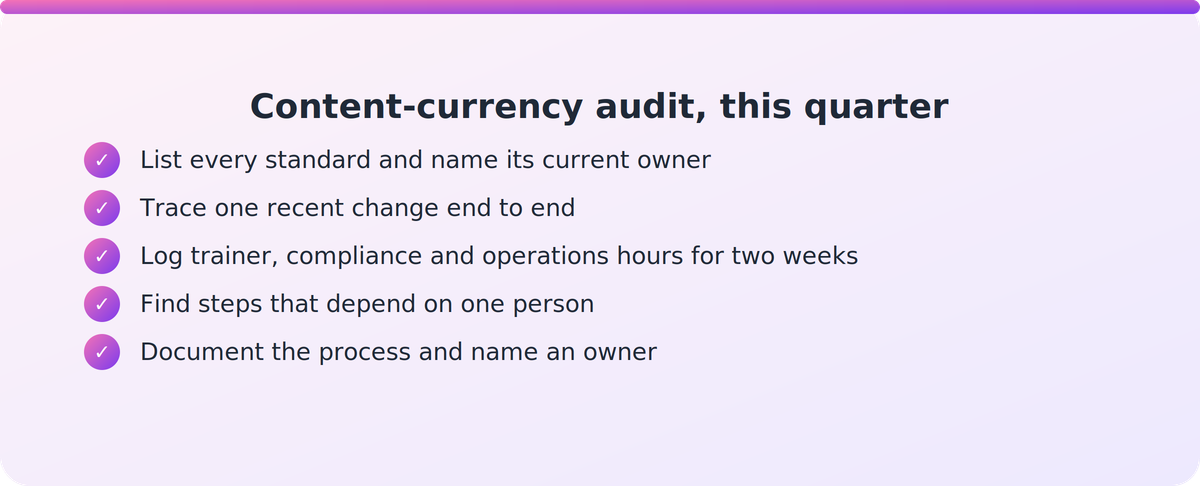
You don't need a consultant to size the tax. You need two weeks of honest tracking and a few questions. Do this quarter:
- List every standard and qualification you deliver against. Beside each, name the current owner: an Industry Skills Board, NZQA, or another body. Mark any you can't answer confidently.
- Trace one recent change end to end. Pick a revision and follow it from notice, through content rewrite, mapping, evidence, record updates and sign-off. Note who touched it and how long each step took.
- Log the hours. Ask trainers, compliance and operations staff to record time against "keeping content current" for two weeks. Rough numbers beat none.
- Find the single points of failure. Which steps depend on one person's memory? Process knowledge trapped in individuals is an efficiency problem, and given iQAF's evidence expectations, probably a compliance exposure too.
- Write the process down and name an owner. One page, one accountable person, one trigger for review.
Why process knowledge needs to outlast people
Sector turbulence shows how quickly capacity changes. RNZ reports Te Pūkenga is due to be disestablished by 31 December 2026. The Spinoff reported it lost over $80m in funding and one in 10 staff ahead of the split. Your organisation is different, but the lesson transfers: if the know-how leaves with a person, the cost of currency jumps overnight.
What to treat with caution
Two things in circulation deserve scepticism. Technical Institute, a consultancy, reports that iQAF's area of interest for July 2026 to July 2027 is generative AI in delivery and assessment. That is secondary reporting, so confirm it with NZQA before you restructure anything.
Claims about "expiring" qualification statuses or TEC risk-rating weightings come only from vendor blogs in my research. Verify them with NZQA and TEC before they influence a budget.
Our take
Most PTEs treat content currency as a series of small emergencies, absorbed by good people working a bit harder. That is a hidden tax, and it grows with every programme you add.
Our view is that currency should be run like any other operational process: owned, documented, timed and reviewed. The first step isn't a tool or a restructure. It is knowing what the work costs today. Once you have hours on a page, you can decide what to simplify, what to automate and what to stop doing. Until then you are managing by instinct, and the cost stays in someone else's weekend.
Key takeaways
- Content currency is a recurring operational cost spread across trainers, compliance and operations staff. It rarely appears as a budget line.
- No public NZ data quantifies it, so measure your own hours before assuming it can be absorbed.
- iQAF's annual self-review, the PTE Rules 2026 and the move from WDCs to Industry Skills Boards make currency an owned process rather than a periodic project.
- Know who owns each standard suite you deliver against; the map has changed.
- Document the workflow so the knowledge doesn't leave when people do.
FAQ
Is there NZ data on what keeping course content current costs a PTE?
No authoritative public data was found on the effort or headcount NZ providers spend on this. The practical answer is to measure your own, by tracking trainer, compliance and operations hours across a recent content change.
What does iQAF mean for content currency?
NZQA's iQAF has providers submit an annual self-review summary report and meet NZQA to discuss the improvement plan. Self-review is evidence-based, and providers may be asked for supporting evidence. Current, well-evidenced content supports that process.
Who sets vocational standards now that WDCs have gone?
Workforce Development Councils were disestablished on 31 December 2025. Eight Industry Skills Boards now provide vocational education standard-setting functions. TEC's consultation proposed that some sectors' standard-setting move to NZQA, so confirm ownership for each suite you deliver.
Do content changes affect TEC reporting?
Possibly. Providers report through the SDR and IND on TEC's Data Exchange Platform, with returns carrying learner, course enrolment and course register files. Changes to course or qualification structures may flow into those files. That is an inference, so test it against your own systems.