The expensive part of a training package update is rarely the rewriting. It is the unplanned scramble to find out which assessment tools, learner materials and records depend on the unit that changed, and who knows. No source puts a dollar figure on it, but the cost shows up as rework and lost capacity.
Key takeaways
- A training package release is a recurring operations event, not a one-off content task for trainers.
- The hidden cost sits in person-dependent knowledge and records that don't connect. No authoritative source quantifies it, so measure your own.
- The 2025 Standards for RTOs allow flexibility in how you demonstrate compliance, but that flexibility doesn't reduce the evidence you need to show.
- Package changes now land in the same period as the shift from AVETMISS to the VET Information Standard, so capacity collisions are likely.
- The fix is a defined change process with traceable links from unit to assessment to material to data, not more heroics.
Why this lands on your desk
You probably don't write assessments. You do own the process that decides who rewrites what, in what order, every time a Jobs and Skills Council (JSC) updates a training package. If that process lives in two or three people's heads, each release becomes firefighting, and delivery quietly pays for it.
The pressure is also regulatory. The 2025 Standards for RTOs came into effect on 1 July 2025, made up of the Outcome Standards, the Compliance Standards (including the Fit and Proper Person Requirements) and the Credential Policy, as the DEWR summary of the Standards sets out. ASQA says the 2025 Standards give providers more flexibility in how they demonstrate compliance, alongside more regulatory engagement.
Flexibility is not less evidence. You still need to show how an assessment changed, why, and that it stayed current. Retrieving that in an afternoon is an operations capability, not a compliance-officer talent.
What one package release sets off
Trace a single superseded unit through a typical portfolio and the ripple is obvious:
- Assessment tools that reference the unit need review and, often, rewriting and re-mapping.
- Learner materials tied to those tools need to match, or learners get confused.
- Version control has to show which cohort is on which version.
- Transition planning decides who finishes on the old product and who moves to the new one.
- Reporting has to reflect the right unit and qualification codes.
None of that is exotic. The cost comes from doing it for the first time, again, every time, because nobody wrote down the order or the dependencies.
The supply of change is steady. The JSC program guidelines say JSCs will consider RTO needs when developing learning resources, and an Assurance Body assesses draft training products against the Training Package Organising Framework. The Future Skills Organisation's April 2026 quarterly update lists projects to develop learning and assessment resources for updated packages, including maritime and hospitality. Check the original PDF for timelines. The text extracts poorly.
The reporting layer is moving at the same time
Your content team isn't the only group absorbing change. ASQA reports that the amended Data Provision Requirements Instrument 2020 took effect on 1 October 2026, and that the VET Information Standard will replace AVETMISS for the VET Provider Collection. NCVER describes a progressive rollout from 2026 with API-based reporting technology.
NCVER will also stop updating the AVETMISS Compliant Software Register, with a final update on 26 October 2026. It advises organisations to confirm support directly with their software vendors. That conversation is yours.
The dates are fixed. NCVER's September 2026 Data Support Bulletin lists the Q3 2026 collection window as 1–16 November 2026. The 2026 annual fee-for-service AVETMISS submission window runs 1 January to 28 February 2027 with no extensions, using data accurate as at 31 December 2026.
So the real question is simple. Can a package update be absorbed by a defined process, or does it consume the same few people and the same weeks as the next reporting deadline?
Smaller units, more touchpoints
NCVER's Total VET students and courses 2025 reports that qualification students fell by 108,360, while short-course and stand-alone subject students rose. Short-course students rose in both fee-for-service markets but fell in government-funded training.
The next step is my reading, not an NCVER finding: more, smaller enrolments mean more mapping and reporting touchpoints per learner. If your headcount scales linearly with that, you are buying complexity one person at a time.
Qualification reform adds to the load. Queensland's DTET notes Skills Ministers agreed a purpose-based approach to qualification design on 6 December 2024, with new templates available to developers from 1 July 2025 and reformed qualifications anticipated for delivery from 2026.
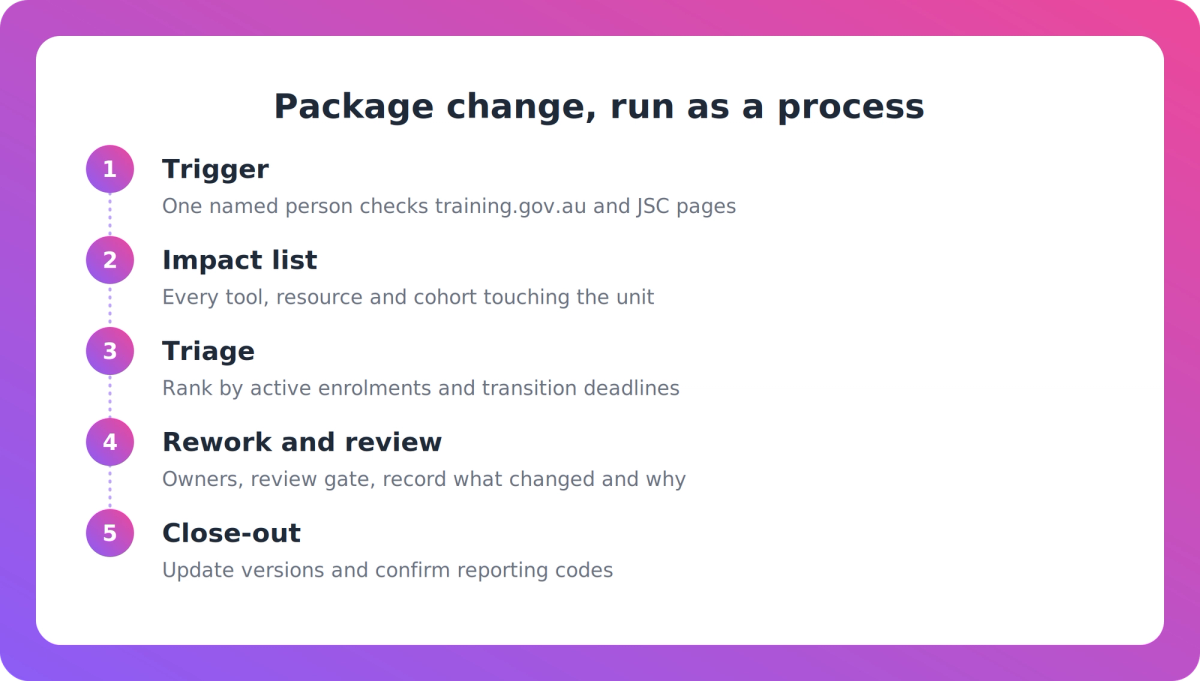
A repeatable change process you can run this quarter
You don't need a transformation programme to start. You need a written sequence that doesn't depend on who is in the office.
- Trigger: name one person who checks training.gov.au and each relevant JSC project page on a set rhythm.
- Impact list: for each changed unit, list every assessment tool, learner resource and cohort that references it.
- Triage: rank by active enrolments and transition deadlines, not by who shouts loudest.
- Rework and review: assign owners, set a review gate, and record what changed and why.
- Close-out: update version records and confirm the reporting codes with whoever submits your data.
*Illustrative example:* a unit is superseded and 14 assessment tools reference it. If nobody can list those tools within a day, your first week goes on discovery, not rework. If the list is a query, not a memory, the week goes on the rewrite itself.
The principle is traceability. Unit links to assessment, assessment to material, material to cohort, cohort to data. Every break in that chain is a place where knowledge hides in someone's head.
What nobody can tell you
Be wary of anyone quoting a neat figure here. I found no authoritative source that quantifies the cost of rewriting assessments after a package change, or the hours spent on manual reporting. I also found no consolidated schedule of package releases and transition deadlines.
Vendor blogs offering VET Information Standard go-live dates or a transition end date are unverified, so treat them as such. Your best data is internal: log the hours your last package change actually took, by person.
Our take
Most RTOs treat each package release as a content emergency and then wonder why quality is uneven. We think the more useful frame is operational. If an update needs the same three people every time, you don't have a process, you have a dependency.
The 2025 Standards and the data reforms both reward organisations that can show how things were done. The RTOs that cope best will be those who can answer "what depends on this unit?" without a meeting.
FAQ
How much does it cost to rewrite assessments when a training package changes?
No authoritative source quantifies it. The cost is mostly unplanned rework and pulled capacity, so the reliable figure is your own: log hours by person and task on the next release.
Do the 2025 Standards for RTOs reduce the evidence I need for assessment changes?
No. ASQA says the Standards give more flexibility in how providers demonstrate compliance, alongside more regulatory engagement. You still need a repeatable way to show how assessment changes were made and kept current.
What reporting dates should operations plan around?
Per NCVER's September 2026 Data Support Bulletin, the Q3 2026 collection window is 1–16 November 2026. The annual fee-for-service AVETMISS submission window runs 1 January to 28 February 2027, with no extensions.
Is the VET Information Standard replacing AVETMISS?
ASQA says the VET Information Standard will replace AVETMISS for the VET Provider Collection. NCVER says rollout is progressive from 2026 and advises confirming support directly with your software vendors.
One thing to do this week
Pick your last training package change and sketch, on one page, who did what, in what order, and what they had to ask someone else. Wherever a name appears more than twice, you've found the dependency to fix first.