Validation is now a named ASQA concern, but it samples assessment tools and judgements. It doesn't clearly test whether your learner guides, documented approach to training and assessment, and assessment tasks still match each other and the current unit of competency. Close that gap with a pre-use review before tools go live.
Key takeaways
- Ineffective validation has reportedly moved into ASQA's top areas of concern, so the sampling lens is on your tools and judgements.
- Nothing in the Standards for RTOs 2025 explicitly requires learner guides, tasks and the current unit to be reconciled. That gap is our inference, not a regulator statement.
- Standard 1.3 (pre-use review) and Standard 1.5 (validation) are different jobs. One cannot stand in for the other.
- Off-the-shelf kits and AI-generated content can look complete without ever being checked against the unit.
- Technology can support pre-use alignment checks. It cannot replace independent, credentialled human validation.
Why is training resource validation under the spotlight?
Because ASQA is reportedly finding RTOs weak at it. A practitioner write-up of an ASQA update says ineffective assessment validation entered ASQA's top five areas of concern in September 2026. It describes validation as a pre-use review and notes a skills deficit in confirming that all requirements can be met with sufficient, valid evidence. We haven't checked the original ASQA slides, so treat the detail as secondary reporting.
The pattern fits what consultants report from audits. VET Advisory Group and RTO Resource Australia list the same repeat findings:
- Tasks that don't cover all performance criteria.
- Assessment materials left unchanged after a training package update.
- Superficial mapping.
- Purchased resources used without checking full unit coverage.
Where exactly is the blind spot?
It sits between documents, not inside any one of them. The Standards for RTOs 2025 no longer mandate a training and assessment strategy (TAS), though the RTO's approach to training and assessment must still be documented, according to Skills Education's notes from the ASQA sector workshop in Brisbane on 11 March 2026.
Our inference: with no single mandated document tying materials to assessment, drift is harder to spot. A learner guide teaches one version of a topic, the task assesses another, and the unit has since been updated. No source states this directly. But it is where the audit findings above would naturally come from.
Standard 1.3 or 1.5: which job are you doing?
They are different jobs. Per eSkilled and CloudAssess, Standard 1.3 adds an obligation to review assessment tools before use. Standard 1.5 covers validation of assessment practice.
- Pre-use review (1.3): Is this tool, as built, capable of collecting sufficient, valid evidence against the current unit? It happens before the tool reaches a learner.
- Validation (1.5): Did our assessment practice and judgements hold up? It needs independent, credentialled people.
Coastwide Training's summary of ASQA's update warns that AI "validation" platforms often perform the 1.3 function rather than 1.5. An automated check can't replace the human task the Credential Policy requires. Useful, yes. A substitute, no.
Does AI-assisted content make the gap bigger?
It makes the gap matter more. Coastwide's summary says purchased off-the-shelf kits and AI-generated assessment content can look complete but were never checked against the unit's elements, performance criteria and assessment conditions. Polished output hides drift well.
ASQA's Assessment Practice Guide names related risks:
- Assessment tools not contextualised to the student cohort and assessment system.
- Leaving assessments that incorporate AI tools or outputs out of the validation sample.
- Relying too heavily on AI assistance for validation decisions without enough human oversight.
The stakes are real. CAQA's summary of the ASQA 2025–26 Annual Report records 18,941 qualifications and statements of attainment subject to cancellation decisions because they were issued without appropriate training or assessment. Verify that figure on asqa.gov.au before quoting it.
How do you close the gap before tools go into use?
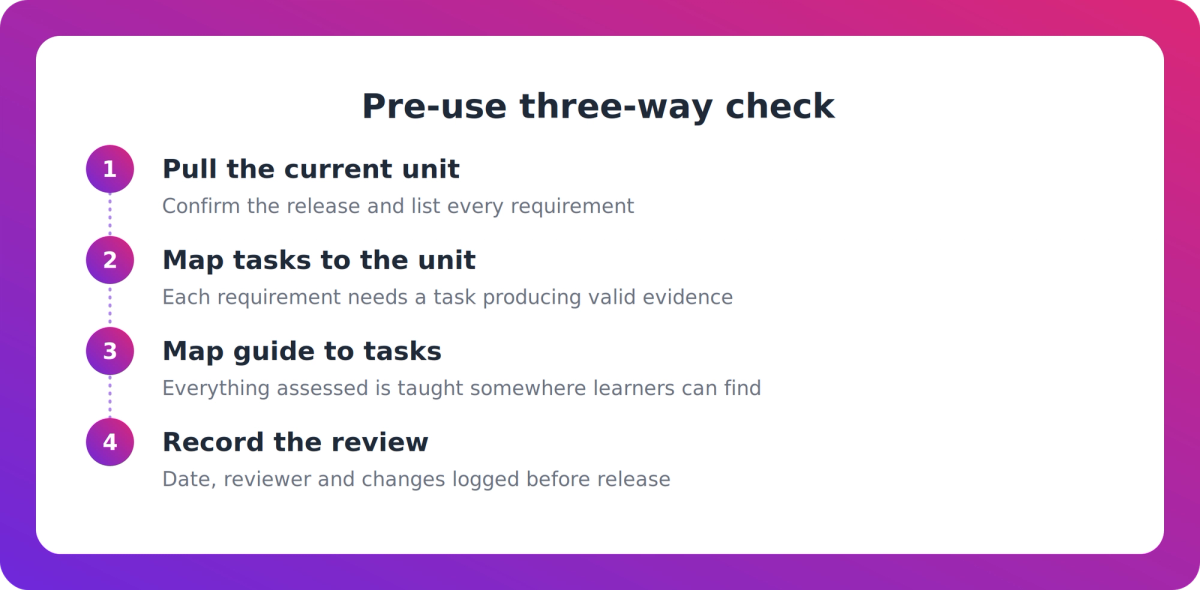
Run a three-way reconciliation on every unit before release. RTO Resource Australia suggests checking against the current training.gov.au unit's performance criteria and knowledge evidence, not just the unit code.
- Pull the current unit. Confirm the release on training.gov.au. List elements, performance criteria, performance and knowledge evidence, and assessment conditions.
- Map tasks to the unit. Check each requirement has at least one task that would produce sufficient, valid evidence. A mapping matrix isn't proof on its own.
- Map the learner guide to the tasks. Check every task requirement is taught somewhere learners can find it.
- Check context. Confirm the tool suits the cohort and delivery mode, such as workplace, classroom, distance, LLN or ESOL support needs.
- Record the review. Date it, name the reviewer and log the changes. This is your pre-use review evidence.
- Then send it to validation. Independent, credentialled validators judge assessment practice. They shouldn't be your first line of defence against an unmapped criterion.
What does drift look like in practice?
Here is an illustrative, hypothetical example. A unit is superseded and a new knowledge evidence item is added. The assessment task is updated. The learner guide isn't. Learners are now assessed on content they were never taught, and the mapping matrix still shows full coverage because it was built against the old unit.
A validation sample might catch it. A pre-use three-way check would catch it sooner, before a single learner is affected.
Our take
Most RTOs treat validation as the safety net, and ASQA's reported focus will push them to lean on it harder. We think that's backwards. Validation can only judge what the tool already is. If a task skips a performance criterion or the guide teaches last year's unit, you've built the finding before anyone looks. Do the reconciliation first, keep humans accountable for validation, and use AI only to speed up the checking, never to sign it off.
FAQ
What is the difference between Standard 1.3 and Standard 1.5?
Standard 1.3 adds an obligation to review assessment tools before use. Standard 1.5 covers validation of assessment practice, which needs independent, credentialled people. One is a pre-use quality check and the other is a check on practice and judgements.
Does the Standards for RTOs 2025 require a training and assessment strategy?
No. According to Skills Education's notes from the ASQA sector workshop on 11 March 2026, a TAS is no longer mandated. The RTO's approach to training and assessment must still be documented.
Can AI validate assessment tools for an RTO?
Not in the sense ASQA requires. Coastwide Training's summary says an automated check cannot replace the human task the Credential Policy requires. ASQA's Assessment Practice Guide also flags relying too heavily on AI for validation decisions without sufficient human oversight.
What should I check a purchased resource against?
Check it against the current unit on training.gov.au, including performance criteria, knowledge evidence and assessment conditions, not just the unit code. Then confirm it suits your cohort and delivery mode. Consultants list unchecked purchased resources as a common audit finding.
Next step
Pick one unit you deliver this term. Pull the current training.gov.au release and trace every requirement through the task and the learner guide. If you find a mismatch, you've found the kind of drift an audit would find for you.