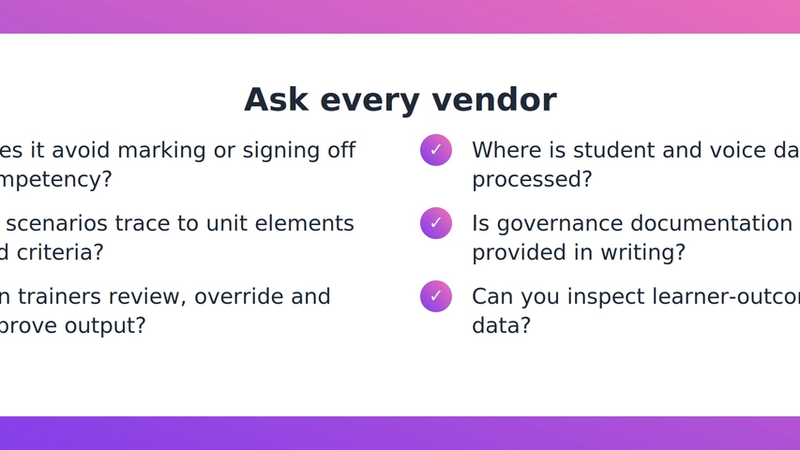
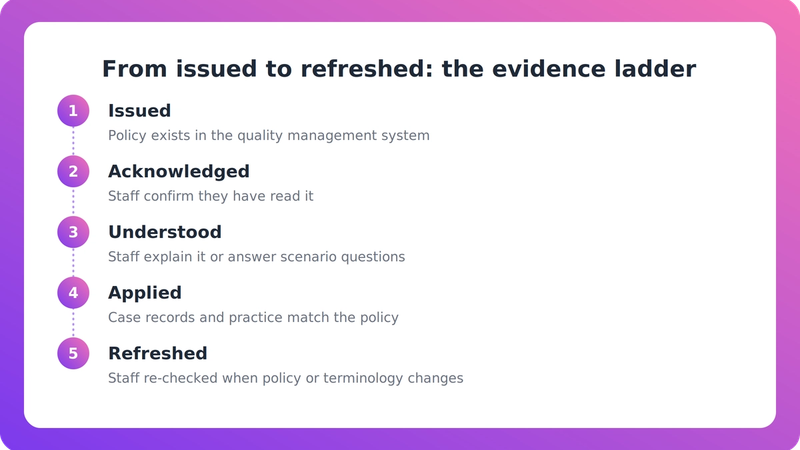
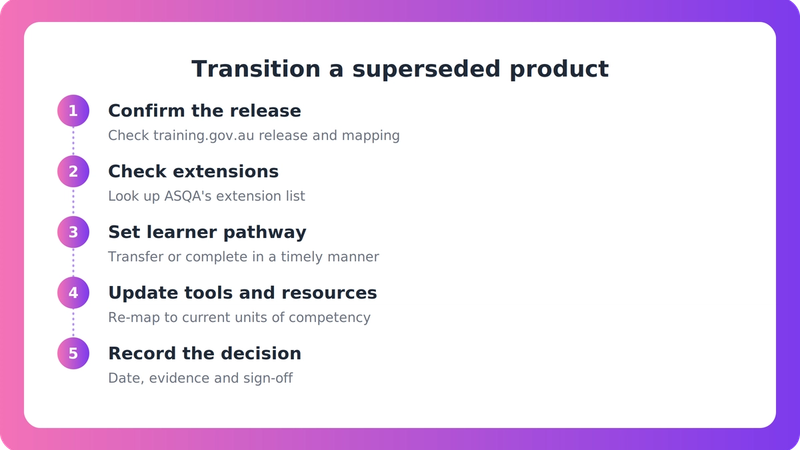
Unit of Competency Mapping Software: Test Before You Buy
Test it yourself. ASQA publishes no benchmark for mapping accuracy, and we found no ASQA scheme that approves mapping software. So load a unit you know well and check that every requirement traces to a specific task and benchmark. Then edit a task and see whether the mapping keeps up.
Key takeaways
- Treat "full coverage" as a claim to test, not a feature to trust. Run a unit you know well through every shortlisted tool.
- Be sceptical of "ASQA-approved" or "ASQA-compliant software". We found no ASQA register or endorsement scheme for mapping software.
- Accuracy, completeness and traceability matter more than the format. Check that mapping updates when tasks or units change, including ASK-format units.
- Templates, platform modules and AI generators suit different needs. Pick the type before you compare vendors.
- Whatever the tool, a qualified assessor stays accountable for validation and the competency decision.
What should unit of competency mapping software actually cover?
It should compare an assessment against every part of the unit, so you can show evidence is collected across the whole unit. ASQA's guide to assessment tools names elements, performance criteria, performance evidence, knowledge evidence and assessment conditions. Vendor and consultant sources also include foundation skills.
A useful matrix lists each of these:
- Elements and performance criteria
- Foundation skills
- Performance evidence items
- Knowledge evidence items
- Assessment conditions
- The unit code, title and release it was built against
If a tool maps only elements and performance criteria, it isn't giving you full coverage.
Is mapping software "ASQA-approved", and does ASQA require mapping?
No software is ASQA-approved, and you should treat that label as a red flag. We found no ASQA register or endorsement scheme for mapping software, and RTOFlow itself says no software is "ASQA-approved".
Whether mapping is mandated is less clear. aXcelerate says it isn't explicitly required but is crucial for tool validity. A VETos blog says ASQA doesn't prescribe a template. We found no ASQA text confirming either point. The safer position is that accuracy, completeness and traceability are what count.
The 2025 Standards for RTOs took effect on 1 July 2025. Providers in Victoria and Western Australia may instead be regulated by the VRQA. When a vendor cites a clause, read the text on the ASQA Standards page or legislation.gov.au. One template vendor cites clauses 1.1.2a and 1.3.2a, for example. Check them yourself.
Template, platform module or AI generator?
Choose by workflow, not by hype. Each type answers a different need:
- Static templates (for example the vetr mapping template or Specialised VET Services' matrix). Cheapest, but accuracy depends entirely on whoever fills them in.
- Student management or assessment platforms with a mapping module (for example Cloud Assess). Mapping sits alongside records you already keep. How deep it goes varies.
- Generators that draft the tool and the mapping together (for example RTOFlow and VETos). Faster drafting, but you're relying on the tool's mapping logic, so testing matters most here.
The pre-purchase test: run a unit you know well
The best test uses a unit you've already validated, so you can spot errors fast. This is the process we'd run:
- Pick a familiar unit. Choose one where you know the tasks and the weak spots.
- Check the source. Compare the unit code, title, release and requirement text with training.gov.au. Does the tool pull live data, or is someone retyping it?
- Check every requirement type. Elements, performance criteria, foundation skills, performance evidence, knowledge evidence and assessment conditions should all appear.
- Trace each one. Each requirement should point to a specific task and benchmark, not a vague "covered in Assessment 2".
- Plant a gap. As an illustrative check, remove one knowledge evidence question and see whether the tool flags the hole.
- Look for over-assessment. Does it flag content with no matching requirement? That content adds learner workload.
- Edit a task. Does the mapping update, or does it go quietly stale?
- Check the records. Look for version history, an audit trail and an exportable, dated and signed pre-use review record.
- Have a qualified person review the output against the training.gov.au unit.
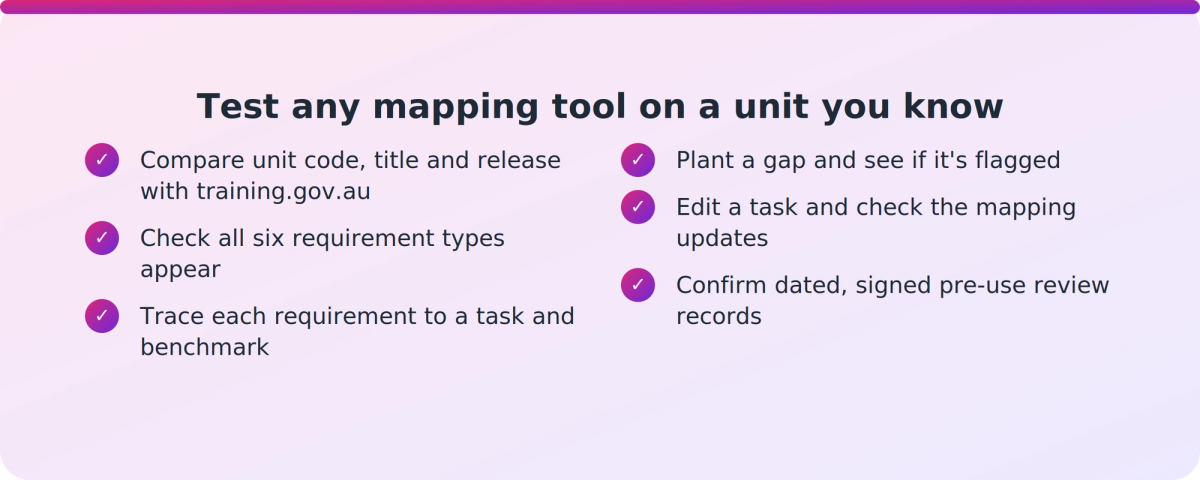
No official benchmark exists, so this is your own test. Run the same one on every vendor and ask for a hands-on trial on your own units, not a demo on theirs. Ask for independent references too.
How does mapping cope with change, and where does human validation fit?
A tool should handle change without a rebuild, and the brief points to four places to probe:
- Superseded or equivalent units. Ask how the tool links old and new releases.
- Clusters. Check whether it maps across units delivered together.
- ASK-format units. Vendor sources say TPOF 2025 is introducing the ASK unit format alongside traditional units. Verify that on DEWR or training.gov.au, then test a real ASK unit. See this vendor overview for background.
- Edited tasks. This is the most common failure point, because a matrix that was right at export can be wrong a month later.
Providers are assessed against the Standards in effect when a decision is made, so version history helps. Reported scrutiny of recordkeeping and quality-assurance systems under the 2025 framework makes that evidence trail worth having.
On AI, ASQA's Assessment Practice Guide includes designing tasks so AI cannot replace the skill being assessed. Secondary sources such as SKG and rtobase report that AI cannot make assessment decisions or complete validation. Confirm that against ASQA's own guides. Either way, software assists. A qualified assessor remains accountable for validation and the competency decision.
Where VETos fits
VETos is one option to put through the same test, not a shortcut around it. Its assessment mapping page says it generates a mapping matrix with each assessment tool from live training.gov.au data, for traditional and ASK-format units. It also says the matrix updates when a task is adapted. That may suit RTOs running ESOL, LLN or workplace/RPL versions of one unit.
It also describes modelling a whole training package as one connected structure. The aim is to show coverage across a qualification and catch cross-unit gaps that unit-by-unit checks miss. The site says the matrix can be exported for pre-use validation, with version history as the evidence trail. It also states that an assessor validates every mapping against the Principles of Assessment and Rules of Evidence and makes the final competency call.
These are vendor claims. We found no independent evaluation of its mapping accuracy, no named Australian RTO case study and no published coverage benchmark. Pricing is based on scope, with volume discounts.
Our take
Most buyers ask "does it map the whole unit?" That's the wrong question, because every vendor says yes. Ask instead what the tool does when a task changes, a unit is superseded or the mapping is wrong, and who catches it. A tool that makes errors visible to a qualified person beats one that hides them behind a clean-looking matrix. Mapping software should speed up the validator's work, not replace the validator.
FAQ
What should unit of competency mapping software cover?
It should list every element, performance criterion, foundation skill, performance evidence item, knowledge evidence item and assessment condition. It should also state the unit code, title and release, and trace each requirement to a specific task and benchmark.
Is mapping software ASQA-approved, and does ASQA require mapping?
We found no ASQA register or endorsement scheme for mapping software, so be sceptical of "ASQA-approved" claims. We also found no ASQA text confirming that mapping is mandated or that a template is prescribed. Accuracy, completeness and traceability are what matter.
How should mapping software handle superseded units, ASK units and task edits?
It should link superseded or equivalent units, handle clusters and ASK-format units, and update the mapping when a task is edited. Test each on your own units. Verify ASK-format details on DEWR or training.gov.au.
Should I buy a template, a platform module or an AI generator?
Templates are cheapest but rely on manual accuracy. Platform modules sit with your existing records. Generators draft the tool and mapping together. Pick by workflow, then run the same hands-on test on each shortlisted option.
Next step
Before any demo, choose one unit you know well and write down the checks above. If you'd like VETos on your shortlist, test it against that list at vet.supahuman.com like any other option.