Workforce Development Council Unit Standard Review: What Now
There's no Workforce Development Council review cycle left to plan around. The WDCs were disestablished at the turn of 2026, and eight Industry Skills Boards now hold standard-setting functions. For PTEs, refresh pressure arrives standard by standard, so content currency is an ongoing discipline backed by version traceability and self-review evidence.
Key takeaways
- A "Workforce Development Council unit standard review" is now a legacy phrase. The WDCs no longer exist, and Industry Skills Boards (ISBs) set the pace.
- Change is rolling and per-standard. There is no single transition date for converting unit standards to skill standards.
- Hard dates are already landing, so track each standard's status rather than waiting for a fixed cycle.
- Programme documents must clearly identify standards taken from the Directory of Assessment and Skill Standards (DASS).
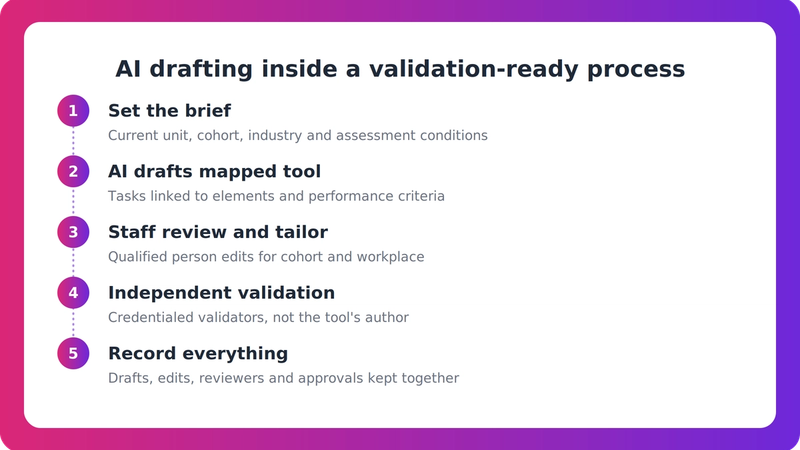
- If you use generative AI to refresh content, expect questions about governance and human oversight.
Do Workforce Development Councils still run unit standard reviews?
No. The Toi Mai disestablishment Order 2025 disestablished Toi Mai Workforce Development Council on 1 January 2026. Ohu Ahumahi describes the WDCs as disestablished on 31 December 2025. The one-day gap is a minor discrepancy in how the sources frame it, not a practical problem.
What matters is who holds the pen now. Eight ISBs provide the standard-setting functions. If your content calendar still has a "WDC review" line in it, retire it.
What replaced the review cycle?
Rolling change, one standard at a time. The Manufacturing and Engineering ISB says about 1,200 skill standards are developed. It also says there is no single transition date for every standard, and that providers will need to align programmes as qualifications and unit standards are reviewed.
Skill standards are designed differently from unit standards. So a conversion isn't just a code swap. Your assessment approach may need a fresh look.
One caution on the five-year rhythm. A SupaHuman blog post (vendor content, so verify with NZQA) says the DASS rules remove the five-year maximum review period and add "current", "expiring" and "discontinued" statuses. Treat that as a prompt to check, not a settled fact. The practical lesson holds either way: don't assume a fixed cycle.
Where are the hard dates?
Some are already fixed. NZQA's eQuate (March 2025) states that for Level 3 and 4 reo Māori standards, the last date for assessment of the expiring standards is 31 December 2026.
If you deliver against those standards, that date is your deadline. Don't wait for a council to remind you.
What does NZQA now expect as evidence?
Continuous, provider-generated evidence. NZQA's 15 January 2026 notice, covered alongside its new tertiary quality assurance framework, says it isn't beginning any new EER processes or consistency reviews from 1 January. Providers submit an annual self-review summary report and meet NZQA to discuss the improvement plan.
Two rule changes sit underneath this:
- The Programme Approval, Recognition, and Accreditation Rules 2026 require programme documentation to clearly identify any standards taken from the DASS.
- The PTE Rules 2026 change the annual financial return to biennial unless NZQA notifies otherwise. Worth noting, but it's a separate matter from content currency.
The first one is the sleeper. An outdated standard reference in a programme document is now a visible gap, not a typo.
How can a PTE run continuous content currency?
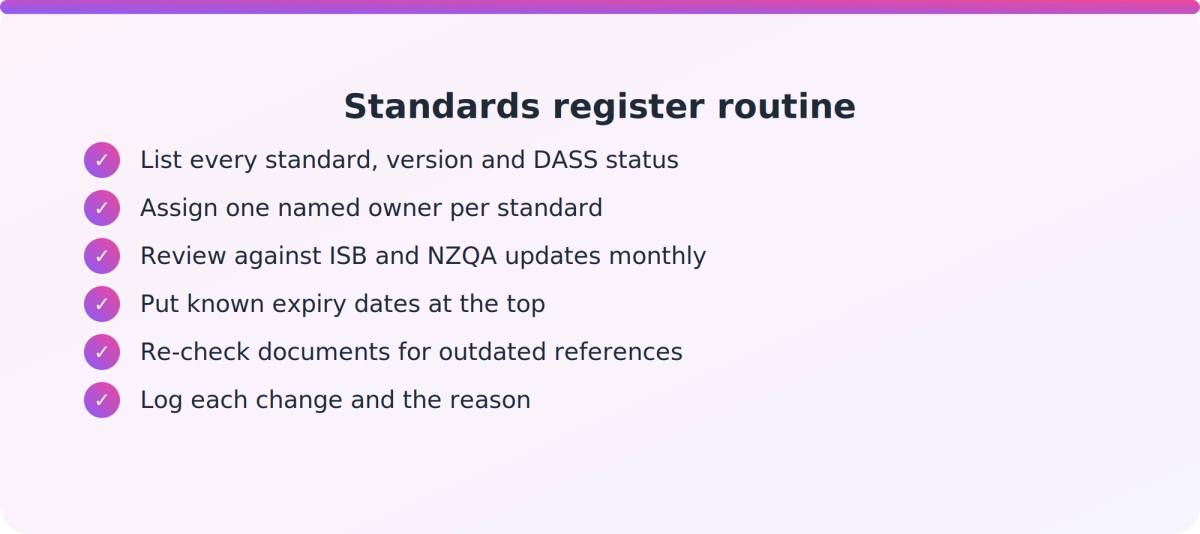
Treat it as a register, not a project. Here's a simple routine.
- List every standard you deliver. Record its ID, version and current DASS status.
- Assign an owner. One named person per standard or programme, not "the quality team".
- Set a check rhythm. Review the register against ISB and NZQA updates on a fixed schedule, such as monthly.
- Flag by date. Put known expiry dates, like 31 December 2026 for the reo Māori standards, at the top.
- Re-check documents. Search programme documents, assessor guides and learner materials for old references.
- Log the decision. Record what changed and why. That log feeds your annual self-review.
A short illustration
Imagine a PTE delivering 30 unit standards across two programmes. A check shows four are flagged "expiring" and one has a skill standard replacement. That's five jobs, not thirty. The register turns an undifferentiated worry into a short, ordered work list. (This is a hypothetical example, not a measured outcome.)
Why does generative AI raise the stakes?
Because refreshed content is where AI is most tempting, and it's an emerging scrutiny point. According to Technical Institute, a provider consultancy rather than the regulator, NZQA's thematic focus from July 2026 to July 2027 is the use of generative AI in delivery and assessment. It also reports proposed new overall quality descriptors from July 2027.
Check NZQA's own pages before you rely on that. But if you do use AI to rewrite assessments, be ready to show:
- who reviewed the output, and what they changed
- how the content maps back to the current standard version
- how learner authenticity and assessment integrity are protected
Speed isn't the risk. Unreviewed speed is.
Our take
The "hidden refresh cycle" framing is mostly vendor language, and we should be honest about that. The real shift is less tidy: you've lost a calendar and gained a discipline. The PTEs that cope best won't be the ones that refresh fastest. They'll be the ones that can show, for any standard on any day, which version they deliver, who checked it and why. Fast AI-assisted refresh only helps if that trail exists first.
FAQ
Do Workforce Development Councils still review unit standards?
No. The Toi Mai disestablishment Order 2025 disestablished Toi Mai on 1 January 2026, and Ohu Ahumahi describes the WDCs as disestablished on 31 December 2025. Eight Industry Skills Boards now hold standard-setting functions.
Is there a single date when unit standards become skill standards?
No. The Manufacturing and Engineering ISB says there is no single transition date for every standard. Providers will need to align programmes as qualifications and unit standards are reviewed.
Are PTEs still subject to EER?
According to NZQA's 15 January 2026 notice, it isn't beginning any new EER processes or consistency reviews from 1 January. Providers submit an annual self-review summary report and meet NZQA to discuss the improvement plan.
What should programme documents say about standards?
The Programme Approval, Recognition, and Accreditation Rules 2026 require documentation to clearly identify any standards taken from the Directory of Assessment and Skill Standards. Check for outdated references.
A next step
This week, export the list of standards you deliver and mark each one's current status and any known expiry date. If you can't do that in an afternoon, that's your first improvement to make.